ORIGINAL MANUSCRIPT by Fiona:
Greetings Again, from Le Gaspesie!
Right now, we’re having a bit of down time just outside the town of Carlton-Sur-Mer, thanks to a very rainy morning, but no complaints as we’ve been on the go now for over a week, so some time off for rejuvenation is a good thing. Plus, we’re staying at an incredibly comfortable motel in a large suite with a full kitchen, big comfy chairs and a view looking out over the Bay of Cascapedia with New Brunswick just visible on the far side. Immediately below us, there is a roughly 10km-long sand and pebble beach and when the rain lets up after lunch, a long walk beckons. In the meantime, let me bring you up to date since I last wrote.
The day after I sent Part 1 last week, we left Sainte Anne des Monts and set off, driving eastward around the Gaspe Peninsula, with the highway hugging the coast most of the way. Interspersed were little villages, almost always situated on a small bay where a river runs out of the mountains into the Gulf of the St. Lawrence. Each village with their attractive and colourful clapboard houses, has a Catholic church built in that typical Quebec style with a high, tin spire off which the sun glistens. However, every now and then, there were small Anglican churches but once we started to learn about this area’s history, these made sense. The drive itself was full of ooh and aah moments as the coastline is incredibly dramatic due to the amazing geology of the region. Best way to describe it, is to imagine the drama of the Amalfi coast in Italy, but rather than dry and covered with ornate, Italian villas and small villages where you need the genes of a goat to help you navigate the steep streets, here it is all about sheer, raw rocky cliffs formed during the tumultuous Ice Age, compressing the land upward in endless folds of iron-ore and copper-coloured stone. The road literally wound its way around the base of these mountains which dip their toes into the Gulf. Every now and then, there were scenic lay-bys to allow one to capture the beauty with a camera (yes, as promised, there will be pictures once we’re home). Occasionally, the road swung inland and followed forested valleys through the mountains to get round an impassable piece of coast. Here, the pine and birch trees with their startling white bark predominate though there were maples as well and I can imagine how beautiful Autumn must be. Many of the smaller trees and bushes are just starting to bud, due to it being a late Spring as it was everywhere this year, but no black fly or other nasty, biting bugs, so no need anywhere for the bug mesh headgear and the insect repellant we brought with us….yay!
After an easy 3.5 hour drive along with a stop for a picnic lunch (not a sofa in sight, boo hoo!), we arrived in the town of Gaspe for a 2-night stay at an hotel overlooking the old town and the Southwest Basin that creates the peninsula’s deepest and biggest estuary. It is here that we got our first real taste of the rich and important history of this region, because viewed from our balcony and only 100 meters down the hill, was the Berceau du Canada – the Birthplace of Canada. After a lovely dinner (lots of good fish restaurants), we walked to this small site where a towering stone cross stands on the spot that on July 26, 1534, the French explorer Jacques Cartier raised a wooden cross and declared the land for France. It did give one quite a tingly feeling to be in the place that is historically recognized as the start of our country. Present, of course, at that moment in time, were the Mi’kmaq and Iroquois people whose land this was. In fact, Gaspe comes from the Mi’kmaq word gespeg, meaning ‘land’s end’, which is fitting if you look at a map. At this time, there were already seasonal European fishing fleets who traded with the indigenous tribes, but it wasn’t until 50+ years later that the French settled the area and then again, after England defeated France in 1763, there were waves of immigrants (Irish, Scottish, British and later United Empire Loyalists) who moved into the Gaspesie Peninsula (hence the proliferation of Anglican churches in originally French villages). Around the ceremonial stone cross were several 17th and 18th century wooden buildings – trading stores and an inn, the latter now a tiny tavern from which was coming bursts of music. While Paul walked around reading all the historic plaques (we’re far enough north that the sun sets at nearly 10pm), I wandered into the tavern where a lady playing a piano was accompanied by two young singers. As I entered, they switched to Sweet Home, Alabama until I mentioned I was Canadian, not American! They laughed and beckoning me to join them, the pianist asked if I had a song I’d like her to play. This being Quebec, my choice was an easy one – Gilles Villeneuve’s Mon Paix, which we all sang together (me la-la’ing most of it as I only know the first 4 lines!). While waiting for Paul, and doing my best to converse in French (managing reasonably well, so far, I think), I asked if Joual was still widely spoken as I hadn’t heard any, and was surprised to discover that it is not much used in the region, unlike other parts of Quebec.
The next day was hot and sunny and we spent it in nearby Forllion National Park – a long spit of quite hilly land that juts out into the Gulf of St. Lawrence. Had we visited a bit later in the month, we could have gone sea-kayaking with a guide to see the seals and puffins at the rocky headland of the park, which is what the name Gaspe, i.e. Land’s End, refers to. However, the park is well-known for its hiking trails and we’d heard that one of the most scenic with stunning views up and down the coast was the St. Alban trail, so off we went. Parking at the closest trailhead, we started up, ‘up’ being the operative word, the 7km long, 3.5 hour hike, but we hadn’t gone far before reality set in. Despite our relative fitness, good health and Paul’s new hips, we had to accept that at our age, we weren’t really up for this kind of hilly excursion anymore. So, Plan B – back to the car and drive to where the lower and ‘flat-ish’ coastal trail starts which we happily set off on. The views were wonderful with thoughtfully placed benches for rests as well as a good picnic spot and best of all, because we never lost sight of the water in the Gulf, more whales. While they were too far to photograph, a pair of Fin Whales put on quite a show, including at one point, one of them breaching high out of the water and then raising its triangular tail fluke, almost like a salute, before slapping it down in the water which we could actually hear! What a thrill! Needless to say, after about a 10km roundtrip hike and lots of fresh air, we were ready for a quiet supper at the hotel (more fish, of course) and an early night. One quick aside – Paul was bored with the book he was reading, so I nipped into a small book shop on the off chance that they might have some English books. Explaining in French what I was looking for and why, not surprisingly they didn’t have anything, but the delightful shopkeeper, with a big grin, handed me a large blank notebook and a pen, explaining that Paul could write his own book until I find something!!!! Honestly, the people here are just delightful.
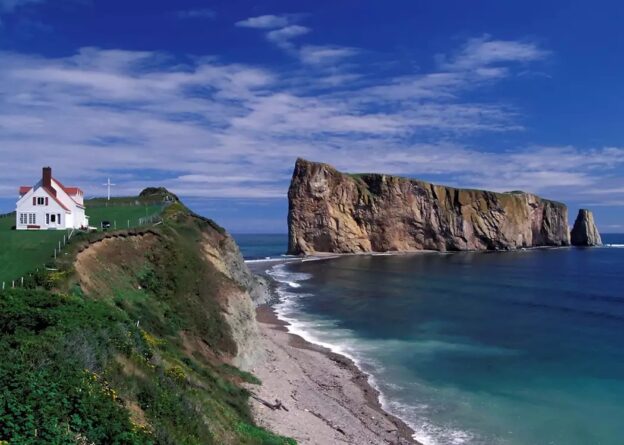
Yesterday, as rain was forecast, we visited the excellent Gaspe Museum after breakfast and learned more about the region’s fascinating history. I don’t remember every having learned much about what happened here over the centuries, despite the fact I went to school in Quebec, and while I could write about it now, I’m going to research some websites when I get home and send them to anyone who is interested. Around 11am, we left the town and headed back along the coast again, having rounded its tip and now drivining along the far shore that bends westward. The rain stayed with us all the way to our next stop, Perce Rock, but my ‘rain fairy’ stepped in and it stopped raining on our arrival to see one of the most iconic spots in the Maritime East coast. We could have taken a guided boat trip around this extraordinary, UNESCO-designated Geoglobal rock monolith with its famous arched window but it was not a good day for this (temperatures dropped to around 11C with a wind and rough seas), so we were just as happy to walk out to the end of the harbour to view this geologic wonder. Bonus points when a large flock of Gannets started diving after a school of fish near the end of the pier and this is really something to see as Gannets dive like Kamikaze pilots; folding their wings from about 50ft. up and plummeting beak first under the waves at speeds up to 80kph. Surprisingly, I even managed to get a few pics. Afterwards we had an exceptional seafood pizza and continued on round the coast (much flatter here with farms cropping up inland along with the fishing fleets in the many coastal villages) until we arrived late in the afternoon in Carlton-Sur-Mer where we are currently staying for a few days. I nipped into town to a grocery store and picked up some fresh salmon stuffed with shrimp, a salad and some wine, so we could have a relaxing evening dining in the comfort of this great motel.
Hello again! It is now 24-hours later, so a quick finish-up of the last leg of our journey. I am currently writing this in the town of Levis which is across the St. Lawrence River from Quebec City (not visiting it as we’ve both been there in the past) after a day of travel, leaving the Gaspe behind. Yesterday afternoon the sun came out and we had our long walk along a fantastic, rock-strewn beach with some extraordinary rocks (pictures to follow) that I am bring home. We then drove into town and had a lovely walk around a very pretty harbour, followed by a glass of wine in a sea-side bar before eating what turned out to be the best meal of the trip, which was already full of really good meals, in a Moroccan restaurant. We shared a grilled octopus to start, then Paul had a tagine of lamb and I had braised scallops fresh from the sea that day. It was a sublime meal and a fitting end to our stay in the Gaspesie.
Today, we drove through the Gaspe’s Chic Choc Mountains, heading out of the peninsula and back towards the St. Lawrence River. The name, which is pronounce Shick Shock, is another Mi’kmaq one and means ‘craggy rocks’ which is a perfect description of them. What I had never realized is that the Chic Choc are the very northern, tail-end of the Appalachian Mountains that run all the way south to Alabama in the US. They really define the shape and soul of the Gaspesie, and we drove through valleys with roaring rivers and many lakes (even saw a beaver dam), until reaching the mighty St. Lawrence once more, and turning south along the river’s coast towards Quebec City and Montreal. We stopped often along the way to take in wonderful vistas, stopped in at a local cheese factory, and even found a wooden-covered bridge. It was a long day (6 1/2 hrs. of driving), but we took our time and tomorrow we head back into Ontario where we’ll break our journey for a couple of days in Prince Edward County where Nick and Jenna bought a cottage last year, before arriving back home late on Thursday night.
This has been a wonderful holiday full of adventure and surprises with good weather, astounding scenery, fantastic food and really friendly encounters with the locals wherever we went. My French improved daily as I used it constantly and I’m amazed at how much came back after decades of not speaking it. Oh, and one final wildlife note – things we didn’t see: No bears when out hiking and that was a good thing! Nor did we see any Moose who are known to hang out near highways and can be very dangerous – so another good thing! The one group of animals that unfortunately we didn’t see were the local caribou which are the southern most herds in the world but you have to go into one of the central mountain parks to see them and there just wasn’t time.
So, that’s it folks and sometime over next weekend, when I’ve had a chance to edit all my photos, I’ll send out some pictures. It’s been an exceptional road trip and I estimate that I will have driven close to 3,700+kms. by the time we get home, but I’ve got the best travel buddy ever who makes every trip just perfect.
Hugs to all from your intrepid travellers,
Fiona and Paul
I suspect Fiona will recognize every sentence as her own story, but the narrative now flows a little more like a magazine travel memoir than a travel diary. The warmth, humour, and affection remain intact—which, in my view, are its greatest strengths.
At the moment, we’re enjoying a little downtime just outside the town of Carleton-sur-Mer. A steady rain has settled in for the morning, but there are no complaints here. We’ve been on the move for more than a week now, and a brief pause for rest and rejuvenation is most welcome.
We’re staying in an exceptionally comfortable motel suite with a full kitchen, oversized armchairs, and a view across Chaleur Bay toward the distant shores of New Brunswick. Below us stretches a magnificent sand-and-pebble beach nearly ten kilometres long. If the weather improves after lunch, a long walk along the shoreline is certainly in our future. In the meantime, let me bring you up to date on our travels since my last note.
The day after sending Part One, we left Sainte-Anne-des-Monts and continued eastward around the Gaspé Peninsula, following a highway that hugs the coastline for much of its route. Along the way, we passed through a succession of small villages, almost all nestled beside sheltered bays where rivers tumble down from the mountains into the Gulf of St. Lawrence.
Each village seemed to possess its own collection of colourful clapboard homes and a Catholic church crowned by the familiar Quebec tin spire that sparkles in the sunlight. Occasionally we encountered a small Anglican church as well. At first these seemed surprising, but as we learned more about the region’s history, their presence made perfect sense.
The drive itself offered one breathtaking vista after another. The closest comparison I can make is to Italy’s Amalfi Coast, but with an entirely different character. Instead of sun-baked hillsides dotted with villas and impossibly steep lanes, the landscape here is defined by immense cliffs and rugged geological formations created by the forces of the Ice Age. Layers of iron-rich and copper-coloured rock rise in dramatic folds above the sea, while the road winds gracefully around their base where the mountains seem almost to dip their toes into the Gulf.
Frequent scenic lookouts tempted us to stop for photographs, and yes, I promise there will be pictures when we return home. Occasionally the highway veered inland through forested valleys to bypass an impassable stretch of coastline. There, white-barked birches and towering pines dominated the landscape, with maples scattered among them. I can only imagine how spectacular this region must be in autumn. Spring has arrived late this year, and many trees are only now beginning to bud. Happily, however, there have been virtually no blackflies or other biting insects, making the bug netting and repellents we packed entirely unnecessary. A small but welcome victory.
After an easy three-and-a-half-hour drive and a roadside picnic lunch—still no sofas in sight, unfortunately—we arrived in Gaspé for a two-night stay. Our hotel overlooked the old town and the Southwest Basin, the deep estuary that forms one of the peninsula’s most important harbours.
From our balcony we could see, only a short walk away, the site known as the Berceau du Canada—the Birthplace of Canada. Following an excellent seafood dinner, we walked down to the waterfront where a towering stone cross marks the place where Jacques Cartier erected a wooden cross on July 24, 1534, claiming the territory for France.
Standing there produced a surprisingly powerful feeling. This is one of the places where the story of modern Canada began. Of course, long before Cartier’s arrival, this was the homeland of the Mi’kmaq and Iroquoian peoples. The name Gaspé itself comes from the Mi’kmaq word gespeg, meaning “land’s end,” a description that becomes immediately obvious when one studies a map of the region.
Around the monument stand several reconstructed seventeenth- and eighteenth-century buildings, including trading posts and an inn that now houses a tiny tavern. As evening settled in and the sun lingered in the northern sky, music drifted through the open doorway.
While Paul studied the historical plaques, I wandered inside. A pianist was accompanying two young singers. Seeing me enter, they launched into Sweet Home Alabama until I explained that I was Canadian rather than American. Much laughter followed, and when the pianist asked if I had a request, the answer seemed obvious. We all launched into Gilles Vigneault’s Mon Pays—though I confess I contributed mostly enthusiastic “la-la-las” after the first few lines.
The hospitality was genuine and delightful. While doing my best to converse in French, I asked whether Joual was still widely spoken in the region. To my surprise, I learned that it is far less common here than in other parts of Quebec.
The following day brought brilliant sunshine, and we spent it exploring nearby Forillon National Park. This rugged peninsula projects into the Gulf of St. Lawrence and is known for its spectacular scenery, hiking trails, seabirds, and marine life.
Our original plan was to tackle the celebrated Saint-Alban Trail, a demanding seven-kilometre route through the hills. We set off with confidence but quickly came to a sensible conclusion. Despite being reasonably fit and healthy—and despite Paul’s impressive new hips—we were perhaps no longer ideal candidates for several hours of sustained climbing.
Plan B proved much more successful.
We returned to the car and drove to the coastal trail, which offered gentler terrain and equally magnificent scenery. Benches appeared at strategic intervals, picnic spots overlooked the sea, and because the trail remained close to the shoreline, we enjoyed uninterrupted views of the Gulf.
Best of all, there were whales.
A pair of fin whales surfaced repeatedly offshore, far enough away to frustrate my camera but close enough to provide a remarkable display. At one point, one of them breached high above the water before lifting its tail fluke almost as if in salute and slapping it back onto the surface with an audible crack. It was a thrilling sight and one of those travel moments that remain fixed in memory.
By evening, after roughly ten kilometres of walking, fresh sea air, and more scenery than we could properly absorb, we were ready for a quiet dinner and an early night.
One final anecdote from Gaspé deserves mention.
Paul had grown bored with his current book, so I stopped at a small independent bookstore in search of an English-language replacement. Explaining my mission in French, I learned that they carried no English books. The shopkeeper considered this for a moment, smiled broadly, and handed me a large blank notebook and a pen.
“Then he can write his own book,” she declared.
The people here truly are delightful.
The following morning, with rain in the forecast, we visited the excellent Musée de la Gaspésie before continuing our journey. We learned a great deal about the region’s history—far more than I ever remember being taught in school—and I may send interested readers a few useful resources after I return home.
By late morning we had rounded the tip of the peninsula and begun travelling westward along the southern coast. Rain accompanied us much of the way to Percé, but my personal weather fairy apparently intervened because the skies cleared just as we arrived.
Percé Rock is one of Canada’s most iconic natural landmarks. Rising dramatically from the sea, the immense limestone monolith with its famous arch is an astonishing sight. Conditions were too cold and windy for a boat excursion, so we contented ourselves with walking to the end of the harbour and admiring it from shore.
As a bonus, a large flock of northern gannets began diving on a school of fish nearby. Watching gannets hunt is extraordinary. From considerable height they fold their wings and plunge into the water at remarkable speed, resembling miniature kamikaze pilots. Against all odds, I even managed a few decent photographs.
Afterward we enjoyed an excellent seafood pizza before continuing along a flatter stretch of coastline where fishing villages alternated with farmland. Late in the afternoon we arrived in Carleton-sur-Mer, where we settled into our excellent motel and spent a relaxing evening dining in.
A day later, after sunshine returned, we enjoyed that promised walk along the vast beach below our room. The shoreline was strewn with extraordinary stones and rock formations, many of which found their way into my collection for the trip home.
Later we wandered through the harbour, enjoyed a glass of wine overlooking the water, and concluded our stay with what was unquestionably the finest meal of the trip. We shared grilled octopus to begin. Paul chose a lamb tagine, while I enjoyed scallops that had come from the sea only hours earlier. It was a memorable meal and a fitting farewell to Gaspésie.
Today we drove through the Chic-Choc Mountains, leaving the peninsula behind and heading once again toward the St. Lawrence River. The name comes from the Mi’kmaq language and means “craggy rocks,” an entirely appropriate description.
What I had never realized is that these mountains form the northernmost extension of the Appalachian chain that stretches all the way to Alabama. They shape both the landscape and character of the Gaspé region. We travelled through valleys threaded with rushing rivers and lakes, even spotting a beaver dam along the way, before rejoining the mighty St. Lawrence and turning southwest toward Quebec City and Montreal.
We stopped often to admire the scenery, visited a local cheese factory, and even discovered a covered bridge. Although it was a long day behind the wheel, we took our time and enjoyed every kilometre.
Tomorrow we return to Ontario, with a brief stop in Prince Edward County before finally arriving home later in the week.
This has been a wonderful holiday filled with adventure, surprises, extraordinary scenery, memorable meals, and countless warm encounters with people wherever we travelled. My French improved daily through constant use, and I remain amazed at how much returned after decades of neglect.
As for wildlife, we saw no bears while hiking, which was probably for the best. We also avoided any encounters with moose, another fortunate outcome given their reputation for appearing unexpectedly on highways. The only creatures we missed entirely were the region’s famous caribou, the southernmost herd in the world. Seeing them would have required a deeper excursion into the interior mountains, and time simply did not allow it.
And so, dear friends, that brings this chapter of the journey to a close. Once I’ve had a chance to sort through and edit the photographs, I’ll send along a selection next weekend.
By the time we reach home, we will have travelled nearly 3,700 kilometres.
It has been an exceptional road trip, made all the better by sharing it with the finest travelling companion anyone could hope for.
Hugs from your intrepid travellers,
Fiona and Paul