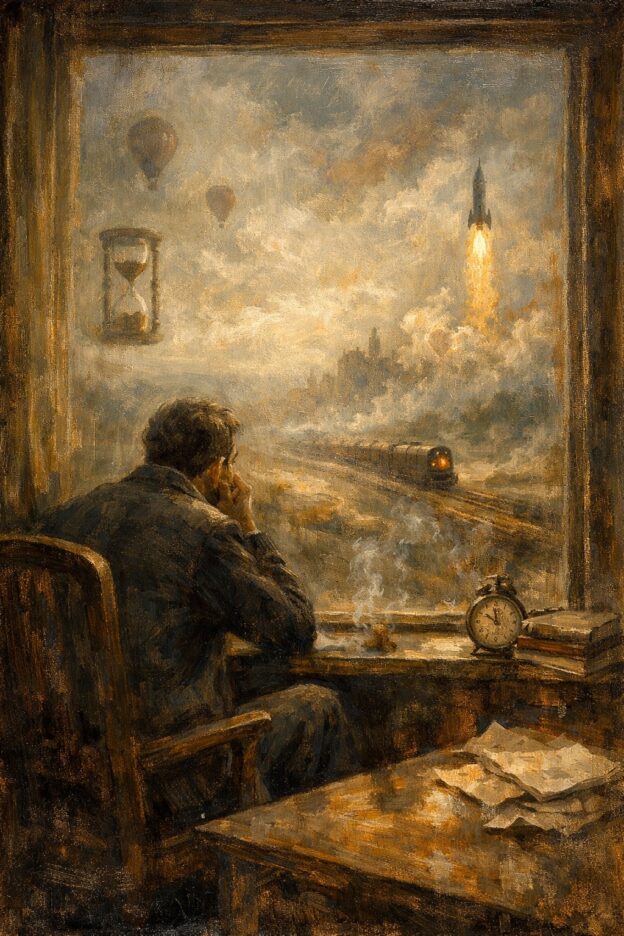
Lately my already limited sphere of activity has been encumbered waiting. Though I am willing, dear Reader, to relate the dreary detail of what it is that I await, it is irrelevant to the toxicity of the psychosis. The very implication of waiting – that is, a mere postponement – is, one might reasonably conclude, enough to assuage one’s anxiety. And yet it is not. The desire to complete the ambition far outweighs the poetry of idle submission to the weight of minutes, hours, days, weeks or months. Indeed the knowledge of its foreseeability only stimulates the pressure surrounding the deferral.
Most commonly, that is on the balance of occasions on which it arises, waiting is mandatory. By contrast there are times when waiting is a choice; but in such instances waiting is better described as putting off, more an option than an obligation. It is the collateral necessity of waiting that primarily defines and rules its effect. Timelines for example predict arrival, perfection, production and opportunity. Each of those credentials supports what are inarguable events governing materialization or appearance.
Eventually the reasonableness of the waiting encompasses the affliction. One retires – admittedly not without hesitation – to a more theoretical review of the circumstances. It is a blunt reminder of the hypothetical nature of the deferral, the requirement to live with prediction and estimate rather than experience and practicality. Soon the mirage of what is awaited begins to morph into an equally impractical and inestimable proposition. The characteristic of what one awaits becomes clouded by vapours of imagination and deferral, themselves a reminder of the lack of clarity that mystifies the anxiousness. When this formula overtakes the cause, waiting becomes an intellectual exercise, stretching things out of mind, whirling further into space, removing oneself from the former immediacy of the convulsion.
Possibly there is psychological advantage to withdraw from waiting. If – as is likely – it’s going to happen anyway; if – as cannot be denied – there is no value in living the present overcome by the future; and if – also indisputably – patience is a virtue, there is sufficient argument in favour of abandoning the wait. The posture immediately puts one in the bearing of a changed actor, liberated from relentless irritability, unhinged by meaningless and further disruptive speculation, free once again to orbit in a controlled manner the living reality of one’s experience.
Unfortunately this liberated motif is fleeting. Sooner than later there is a revival of the initial championship, a combustible yearning for the future, a radical oversight of the present, a futile preoccupation with the future. The formulation of the future overtakes the redundancy of doing so. Patience is replaced with urgency. Meanwhile the foam and froth of the rocket launch overwhelms the vision of the topic in mind. No longer is the produce at hand visible to the eye. What remains is a blurry fiction of what is to come, where detail is usurped by imagery, and reality succumbs to fantasy.
Then we are removed from a number of distinctions which tend to balance one’s day, the summary of which is fact. Fact – with its attachments of truth and clarity – instantly distills what is ahead, reducing the path and exhibiting the channel. But unshackled by such condensation and compression we become alive to the fanciful only. Never does the myth escape the present; but in the meantime, until it does, we may lapse into a needless containment and obliteration, a passing acuity like watching from the windows of train. Proximate but untouchable. And all the waiting in the world makes no difference. Waiting only prolongs the vanishing image, its inexpressible fortuity being its only consistency,