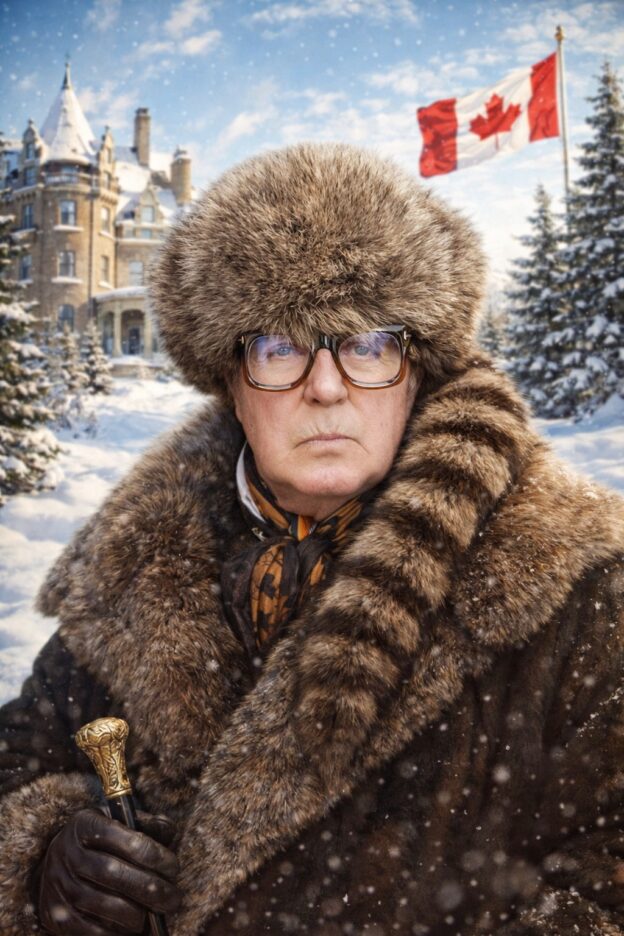
My time-honoured friend Fiona from Toronto mentioned in an email to me on this cold winter day that she was having to go outside on an errand which she said was less troublesome for two reasons. One, she said, was the convenient proximity of the TTC which overcame the hurdle provoked by mountains of snow inhibiting car parking. The second encouragement was her new winter coat. I have asked her to send me a photo. In the meantime I discovered that her intelligence has sparked my own interest in the subject.
Coincidentally it was almost 60 years ago that I got a racoon fur coat from Flesher Furs at their store on Bank Street, Ottawa. It was also the same year that Fiona and I met at undergraduate studies at Glendon Hall, Toronto. I distinctly recall wearing the coat on campus and feeling terribly proud to do so. My paternal grandfather was a former silver fox rancher and dealt with stores in Montréal (and I suspect in Toronto as well). My mother – who similarly dealt with Mr. and Mrs. Izzie Flesher at Flesher Furs – had numerous fur coats including of course a mink coat.
Canadians, as one might expect, have many winter coat options – though I have to say the fur coat is unrivalled for warmth. A close second is the sheepskin coat likewise available handsomely for both men and women. I have also a heavy leather jacket from Eddy Bauer. Bauer revolutionized the down winter coat which in addition to being uncommonly light and warm was easy to pack.
Born on Orcas Island in Washington State, Eddie grew up hunting and fishing in the forests and mountains of the Pacific Northwest. He loved the outdoors and turned his life-long passion into a vocation in 1920 when he opened his first sport shop in downtown Seattle. It soon became a popular community hub, not only for acquiring great outdoor gear, but for swapping stories and information. Eddie had some big news of his own to share when he returned from a trip to Canada in 1930 with a new hunting partner, a Black Lab – the first ever in Washington state!
If one feels compelled to exit the animal furs or hides, there are limitless alternatives from the standard winter parka to cashmere and thick cotton full-length dress coats to the more informal duffle coat (typically hooded and fastened with toggles).
A parka, along with the related anorak, is a type of coat with a hood, that may be lined with fur or fake fur. Parkas and anoraks are staples of Inuit clothing, traditionally made from caribou or seal skin, for hunting and kayaking in the frigid Arctic. Some Inuit anoraks require regular coating with fish oil to retain their water resistance. Parkas are typically longer, often extending to the thighs or knees. Anoraks are usually shorter than parkas, often hip-length, and are traditionally a pull-over jacket.
The words anorak and parka have been used interchangeably, but they are somewhat different garments. Strictly speaking, an anorak is a waterproof, hooded, pull-over jacket without a front opening, and sometimes drawstrings at the waist and cuffs, and a parka is a hip-length cold-weather coat, typically stuffed with down or very warm synthetic fiber, and with a fur-lined hood.
The word parka is derived from the Nenets language. In the Aleutian Islands the word simply means “animal skin”. It first entered the Englishwritten record in a 1625 work by Samuel Purchas.
My sister inherited from my mother a silver fox “chubby”. It was a modification of a waist-length jacket which had, under the arms, a simple hide, thus enabling the wearing, when closing one’s arms and nestling one’s hands into the side pockets, give the coat a bulbous appearance. It was of course predominantly fashionable, normally worn on formal occasion with a full-length gown.
As a further collateral I note that I have also in my possession a ‘coon hat that I also purchased at Flesher Furs. This is unquestionably the most exquisite and functional winter hat one could possibly own. I remember wearing my ‘coon hat most commonly when I went skating for miles along the Rideau Canal on bitter cold January days. The hat had an elevated flap that could be let down for ear muffs if desired (though I found the thick fur of the hat already afforded ample protection and warmth).
Finally I cannot overlook mentioning my unique custom when skiing years ago at Mont Tremblant. I wore my ‘coon coat in lieu of the usual tight-fitting waist-length ski jacket made of synthetic material. You laugh, but I can tell you that when sitting on the frozen seat of the ski lift for the prolonged ascent to the top of the mountain, it was far more comfortable in the long fur coat notwithstanding how preposterous I may have appeared during the descent! I further distinguish (and excuse) myself by reiterating as well that I was born in Montréal – a feature I consider of immense identity both personal and national.
Reacquainting myself with these seemingly superficial cosmetic garment ingredients does nonetheless inspire and rejuvenate me. It heartens me as well to learn that my friend Fiona is similarly uplifted by her new winter coat. It isn’t often I am any longer thrilled with a new purchase – or a new anything for that matter. But reactivating these erstwhile profligacies is an unparalleled gratification.