
It’s a simple enough question, “Why do you get up in the morning?” Yet it is not simple to answer. The knottiness of the answer is naturally not any restraint or irresolvable impediment to do so. We all do it. Eventually. Rather it is the peculiarity and variety of answers, many of which are seemingly blunt and uninteresting or too vulgar and bawdy to bare repeating. It is nonetheless upon examination a complicated issue, one which merits at once both intellectual, poetic, philosophic and natural reply. Some reasons however tend more to the psychological vein and they can paint a very sharp or austere image of a reluctance to remove oneself from beneath the covers. One recalls for example the likes of Søren Kierkegaard, Simone de Beauvoir, Jean-Paul Sartre, Friedrich Nietzsche, Albert Camus and the theatre of the absurd.
According to Albert Camus, the world or the human being is not in itself absurd. The concept only emerges through the juxtaposition of the two; life becomes absurd due to the incompatibility between human beings and the world they inhabit. This view constitutes one of the two interpretations of the absurd in existentialist literature. The second view, first elaborated by Søren Kierkegaard, holds that absurdity is limited to actions and choices of human beings. These are considered absurd since they issue from human freedom, undermining their foundation outside of themselves.
The absurd contrasts with the claim that “bad things don’t happen to good people”; to the world, metaphorically speaking, there is no such thing as a good person or a bad person; what happens happens, and it may just as well happen to a “good” person as to a “bad” person. Because of the world’s absurdity, anything can happen to anyone at any time and a tragic event could plummet someone into direct confrontation with the absurd.
The earliest acquaintance I have with the morning reveille was at boarding school at St. Andrew’s College when an alarm rang in the hallways at 7:00 am throughout each of the four houses of the Upper and Lower Schools, Macdonald House, Flavelle House, Fourth House and Sifton House.
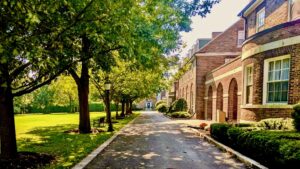
The morning bugle call, known as Reveille, was originally conducted as “Troop” in 1812 and was designed to muster the unit or for roll call, but as time passed it came to mark when the flag was raised in the morning and honors paid to it.
Most often at school the removal from the lair was instantaneous. This was especially so if one had one or more roommates or slept in a dormitory (as did the Lower School students). There was an underlying rush to the showers to avoid delay upon arrival or to obscure the need for early morning conversation with others either in the showers or at the sinks for shaving (if one were old enough to have to do so). To this day I maintain the privacy of the morning ablutions.
The earliest hour of the morning I recall having to awaken was when working my first summer job. It was in 1968 after my first year of undergraduate studies at Glendon Hall in Toronto. I was a road worker for Standard Paving Company (of which my father’s dear friend and former university colleague Donald MacKinnon was then Vice-President). Now I know this inspires the blend of influence but it was strictly low-level employment. I had to be on the job between four and five o’clock each morning. Frequently my task was to descend into manholes to relocate or remove gravel which had mistakenly fallen into the sewer. Latterly I worked at a weigh station on a gravel pit, calculating and recording the weight of trucks as they left the pit with their cargo. The good side of the job was that I was paid $2.50/hr which at the time was about double what other students could expect. The problem however was that I wasn’t able to get the tan I had predicted. Instead I was obliged to wear my shirt and a hard hat. I lasted about two weeks. Out of my own initiative I contacted the principals (the Chiarelli family) at the Cedarhill Golf & Country Club nearby my parents’ home at Bruce Farm. I negotiated employment as lifeguard of the pool. You can imagine that that was more convincing for me as a summer job and tanning project. I can’t recall what they paid me nor when I had to be on the job. But it was never a challenge getting there.
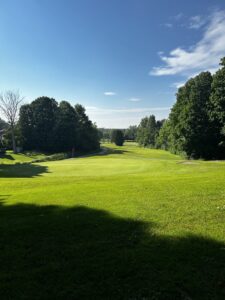
During undergraduate and graduate studies awakening was most often predicted by the schedule for lectures or the necessity to study or to compose an article for a particular course. Sometimes getting out of bed was plagued by hangover from the previous night’s festivities but frankly it was an infrequent obstruction mainly because drinking alcohol was either illegal (as it was in undergraduate when we hadn’t yet attained the age of 21) or expensive. I am reminded too that in undergraduate I lived in residence on campus when having breakfast in the dining hall was limited to a specific time. We often congregated with the same people every day over breakfast to catch up with one another.

Working for a living began an entirely new model for getting out of bed. My first job was with a distinguished law firm at 100 Sparks St in Ottawa called Macdonald, Affleck, Barristers &c. As an “articled clerk” I was but a short step above the in-house priority of the legal secretaries with whom I regularly congregated in the staff room early each morning before the arrival of the lawyers and settling into the day’s work and instructions. At the time I lived in Pestalozzi College, 160 Chapel St in Sandy Hill.
Looking at the unassuming apartment complex now, who would’ve known that a college once existed here at 160 Chapel Street? Known as the “People’s University,” Pestalozzi College was a student-run cooperative residence that existed in the late 1960s and into the 70s as a free-thinking, open-concept school, based on the model of Toronto’s infamous student-run Rochdale College. Some of the extracurricular activities that occurred in the building included literary readings and the Ontario Provincial Gay Liberation Conference in 1973 as well as Ottawa’s first public gay dance, hosted by GO (Gays of Ottawa, who also had their headquarters there). Existing as an alternative school, the entire building was a strange mix of open education, residence, and “free love and good drugs” that eventually fell apart in much the same way that Rochdale did. By the late 1970s, both school and building existed as a community centre of sorts, offering facilities for artists’ studios and yoga classes before the entire building (with very little notice) was converted by its owners into an apartment complex, Horizon Towers.
It was a short but palpable walk from Pestalozzi College along Rideau Street past the Château Laurier Hotel and the Parliament Buildings to the office on Sparks Street. I refused to take a bus because, working for the law firm and wearing a bespoke suit and vest, I inappropriately considered it lower class. I had never taken buses anywhere at anytime.
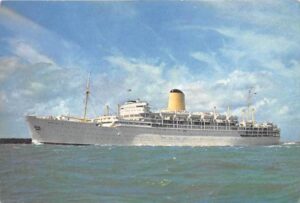
The closest I had ever come to public transportation was the Queen Mary or the S.S. Arcadia to Europe or when flying or taking a train, First Class, from Djursholm where my parents lived to Stockholm where my father worked.

Djursholm was one of the first suburban communities in Sweden, its history as such beginning in 1889 with the founding of Djursholm AB (Djursholm Inc.) by Henrik Palme and the subsequent 1890 inauguration of the railway line connecting Djursholm to Stockholm, Djursholmsbanan. Since 1895 it has been served by electric suburban trains but the original branch was closed in 1975. Djursholm is the wealthiest community in Sweden, with the most expensive property prices in the country. It was built as a garden city with large villas, most from the turn of the century, along winding roads. From the start, the elegant seaside quarters attracted many well known academics, cultural personalities and industrialists.
After completion of articles I attended Osgoode Hall on University Avenue in Toronto for the Bar Admission course. I lived in residence (a private suite) at Devonshire House, University of Toronto as a Don. I either walked to Osgoode Hall or went by subway. The Bar Admission course was rigorous and the hours began strictly and repeatedly at nine o’clock in the morning. There was no debate about when or if to get out of bed. My career depended upon it. This is not to say I hadn’t the occasional difficulty doing so. Once the students, as a traditional prank imposed on any new Don, removed my entire bedroom furniture to the front quadrangle of Devonshire House. The customary morning practice was however restored.
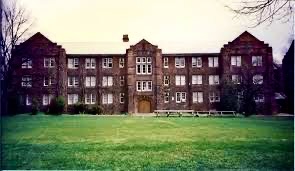
When I began my solo law practice in Almonte the question of removal from bed was even more down-to-earth and imperative. It was then a matter of life or death. The elevation was at any cost or under any circumstance, health or sobriety. I am again reminded of the wistful thoughts of the existentialists which were swiftly defeated by the necessity to “pay the rent” (or in my case, the mortgage, the staff and everything else).

Then things changed. I became old and unemployed. That’s when the debate about why to get up in the morning really began. Until then the question had been pretty much self-evident and had thus largely escaped me. Suddenly however I was able to remark with impunity that I hadn’t any compelling reason to get out of bed, by which I mean it wasn’t a mandate or necessity or imperative. So the complex philosophic element ensued.
The “liberality” does of course make the matter all the more illusive and discernibly frustrating. There were echoes of those who said, “I feel I’ve lost my purpose in life!” But rather than dissolve into that heady distracting discussion, let me instead assure you that I have been spared the dilemma surrounding “Why do you get up in the morning?” by the same things which have spared me otherwise throughout my lifetime. In a word, routine. It’s what got me through school, enabled me to play the piano, the 100 yard dash, the practice of law and now the assembly of the picturesque drama to which I awaken each day, inviting me to tricycle, breakfast, ruminate, wash the car, etc. It is a shallow resolve, I agree. But it works and thus spares me the conclusion of suicide or dismal self-absorption preferred by the existentialists.
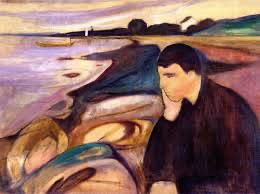
The ingredient to the distillation of the query is not, “Don’t worry. Be happy.” There is an undeniable element of pure unqualified luck associated with the enterprise. I don’t for a moment suggest there are those who are stimulated to get of bed each day by the same privileges and happy manifestations I currently enjoy (note the temporal limitation). But it offends my inherent sense of logic to usurp the splendour of life by some wasteful persuasion of those common concepts in existentialism which include existential crisis, dread, and anxiety.
My undergraduate degree in Philosophy was entertaining and useful only by virtue of its deductive radiance. Perhaps I am disclosing an inveterate optimism. But adopting my own inferential thinking I would say instead that I am saying it as it is.