
It’s windy today 240°WSW, Wind 25 km/h, Gusts 45 km/h, waxing crescent moon illumination 32‰ and Air Pressure 754 mmHg. I no longer have the brass Chelsea barometer left hanging on the wall of our Laura Crescent house from which we summarily departed over a decade ago. The weather – like other features of life – is now a technological feat on my iPhone. But like the creatures and vegetation above and below the river water, we first respond to the weather by instinct and sensation.
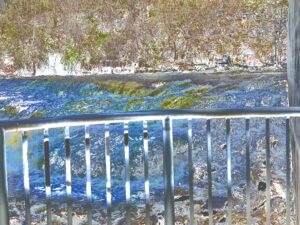
To ensure I hadn’t misread the signs, during my car ride this morning I opened the windows – all of them, the driver’s and passenger’s sides, front and back as well as the landau roof – and I felt the wind, the battering wind. It was not the usual experience of driving with the windows open. When the wind is high – as it is today – the perception is that the wind is equally violent even against a racing automobile. The wind buffeted me from both sides, cleansing the cabin throughout, disturbing whatever had been forgotten on the back seat, flapping the unhinged seat belts, roaring into an unseen bulbous cloud of uncommon strength and resistance.
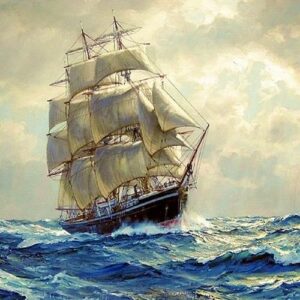
We have a history of escape along the North Atlantic coast, sailing along the winding adjacent roadway, relishing the fresh air, soaking in the sun and the grandeur of the crashing sea reflecting its own response to the wind. Soon perhaps we shall venture once again to Nova Scotia, completing the circle of my romantic life from beginning to end, punctuating our local and distant friendships at the first and last domaines of our travel, restoring a maritime dream that wasn’t meant for me but which I may nonetheless live vicariously through them. Silly me! Already I have my sailing cap which I must remember to bring with me.
My nautical elevation goes back a long way – to my childhood when I read about Blackbeard the Pirate and his cabin boy Jim Hawkins. Or was it Treasure Island?
Treasure Island (originally titled The Sea Cook: A Story for Boys) is an adventure novel by Scottish author Robert Louis Stevenson, telling a story of “buccaneers and buried gold”. It is considered a coming-of-age story and is noted for its atmosphere, characters, and action.
My attraction to the sea thus began – perhaps enlivened by the treasures of buried gold! And then of course there was Moby Dick (highlighted in later life by visiting Nantucket Island where Herman Melville putatively resided). To this day whenever I am within a maritime city I frequent a local hardware store to unearth whatever they carry to satisfy sailing needs. My latest token acquisition is a small knotted white rope braid which I attach to my Mont Blanc key chain. It reminds me of the distracting hobbies associated with life at sea (though of course I have no idea how it was intended to be used).
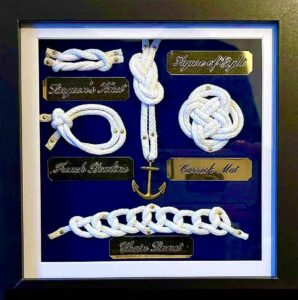
Unsurprisingly I remain a devoted landlubber. We’ve even abandoned the prospect of a cruise (though for reasons not directly related to voyage at sea). For the moment anyway we’ve become inert and intransigent. We intend to confine our acquaintance with sailing and the sea to visions from afar. It’s all a rewind of the usual psychology surrounding change and continuity. The adjustment is evolving as it should – like the wind in the sails!
Sailing
It’s windy today — 240° WSW, wind at 25 km/h, gusting to 45. The waxing crescent moon glimmers faintly at 32‰ illumination. Air pressure sits low at 754 mmHg, as though the sky itself is pressing inward.I no longer have the brass Chelsea barometer left hanging on the wall of our Laura Crescent house from which we summarily departed over a decade ago. Weather now arrives as numbers and icons on my iPhone. But like the creatures above and below the river water, we first feel the weather by instinct — by skin and bone and sensation.
To ensure I hadn’t misread the signs, I opened every window during this morning’s drive — driver’s side, passenger’s side, front and back, even the landau roof. I let the wind in, fully. It battered the cabin, not with the usual playful rush of air but with force, a blunt and swirling assault. It disturbed forgotten things on the back seat, sent the unused seatbelts flapping like slack rigging, and roared in a way that formed an invisible, swelling dome of pressure. Against the racing car, the wind was no less violent — as though it meant to cleanse, to remind me who was in command.
We have a history of escape along the North Atlantic coast, where we once chased the roadway’s curves like a ship tacking against the wind. There, we breathed the salt air, soaked in the sun, and watched the crashing sea reflect its own response to the invisible hand of weather. Soon, perhaps, we’ll venture back to Nova Scotia — completing the circle of my romantic life, from its beginning to its inevitable close. There, at the first and last domaines of our wanderings, we might restore that maritime dream — not mine by right, but one I might yet inhabit vicariously. Silly me! I’ve already set aside my sailing cap, which I must remember to bring along.
My elevation to things nautical goes back to childhood, to tales of Blackbeard and his cabin boy Jim Hawkins — or was it Treasure Island? Yes, Treasure Island (originally The Sea Cook: A Story for Boys), Stevenson’s grand adventure of buccaneers and buried gold. A coming-of-age tale, they call it now. For me, it was the seed — the start of my fascination with wind and sail and treasure, both real and imagined. Later came Moby-Dick, a darker voyage, brought to life when I visited Nantucket and walked where Melville himself once stood.
To this day, whenever I find myself in a maritime town, I detour into local hardware stores to unearth some small relic of the seafaring life. My latest find: a simple white knotted rope braid, now clipped to my Mont Blanc key chain — a sailor’s knot, perhaps, though I confess I don’t know its proper use. Still, it pleases me. It carries the scent of salt air and old, distracting hobbies.
Yet, unsurprisingly, I remain a devoted landlubber. We’ve even abandoned the prospect of a cruise — not for fear of the sea, but for reasons more pedestrian. For now, we’ve chosen inertia, even obstinacy. Our acquaintance with the sea is to be confined to distant vistas, to memories and tokens.
It is, in truth, the old rhythm of change and continuity. The adjustment unfolds in its own time — like the wind in the sails, catching and releasing, filling and emptying. Always moving, even as we stay still.