Yesterday I received an email from a Canadian friend who posed a question;
So, I’ve been wondering: what’s it like being Canuks in the US right now? I was speaking to some friends who winter near West Palm Beach in Florida last week and they say, while most of the time, one just carries on as usual, if people know they are Canadian, there have been a few unpleasantnesses. Not to the point where they’d come home early, but they do feel a bit on edge. I suspect that you’re probably not encountering any issues, but would love to know.
For the most part we haven’t a lot of contact with people while here on Hilton Head Island. Our cottage is literally at the southern most point of the island in a tiny gated community (Lands End) which is already in a larger gated community (Sea Pines). Though we share cheery hellos with those whom we pass when walking about or tricycling we seldom stop to chat. Even when we do politics is avoided. Our primary conversations are with restaurant servers and those conversations seldom if ever dip into the toxic arena of politics. I did however have a fairly ambitious conversation with my Russian hairstylist who is married to an American gentleman. She spoke approvingly of Trump and generally reflected what we believe to be the South Carolina feeling of white people here. As for people of colour we haven’t occasion to cross paths with them because the majority we see here are Mexicans doing roadwork or other such tasks (such as working at the car wash).
None of these encounters has provoked anything in the nature of argument or innuendo. Largely I would say South Carolinians are notable for their iconic southern hospitality and gentility. Many of the interlopers here are from northern states whose political biases vary. Of course except when driving the car with its Ontario licence plates nobody would suspect we’re Canadian. I have chatted only once with our immediate neighbours and that conversation was typically respectful. Many of the people here are only here for a couple of weeks so that too inhibits any depth of conversation.
Having said all that, it does not entirely address your question, “what’s it like being Canuks in the US right now?” Aside from the American perspective, our own feelings are far less muted or ambivalent. We have essentially determined that, upon our return to Canada in April. we do not wish to visit the United States of America in the future. This decision arises partly from having exhausted – during the past decade when we wintered here for 6 months annually – everything we wish to explore. The annual treks have become like moving house perpetually; and when we get here it is no longer like a holiday. Instead we feel as though we’re blending in with the wallpaper. As for optional winter trips to Mexico or the Caribbean, many of those places have highly uncomfortable travel warnings from the Canadian government plus we’ve historically experienced and subsequently seen pictures of beaches there paraded by gun-toting militiamen. Other safer places are often outrageously expensive ($45,000 for two weeks). We’ve also abandoned the prospect of cruising because the short-term raucous/alcoholic vernacular doesn’t appeal. And finally it must be admitted that we find the direction of American society as evident in the unfolding saga of daily news reports disturbing, depressing and shocking. While I will not say that that characterization reflects the behaviour of the Americans whom I know and who I count among my friends, the majority that propelled Trump to power have enacted a far different credential, one which we feel hasn’t yet fully expressed itself. In short, to answer your question, America is a very different place for us Canucks.
In the result we’re presently rethinking our possibilities. We’re not big on airports or planes; and anything in Europe or China or the South Pacific is generally out of the question because of my incremental immobility (and my physicians do not recommend back surgery).
What persists however is my unqualified affection for the American luxury automobile and driving. We’ve ordered a 2026 Cadillac EV (including having arranged the installation of a 240v outlet in the garage adjacent the parking spot). We’d like to visit friends in Nova Scotia who are building a new oceanfront home. There are as well nearby resorts such as Deerhurst Lodge in Algonquin park which suit our preferences for swimming, massages and dining. Plus we’ve discovered even more immediate venues in Dunrobin along the Ottawa River which suit our more ephemeral lifestyle.
I hope this answers your question without having confused the matter irrelevantly. A few other matters: we have seen very few Ontario license plates here this year; Canadians (relatives) wintering in Florida report being advised to remove the Canadian flag; a Canadian cancelled her trip to Hilton Head Island in reaction to the political climate; another Canadian couple (relatives) has left the island weeks in advance for the same reason.
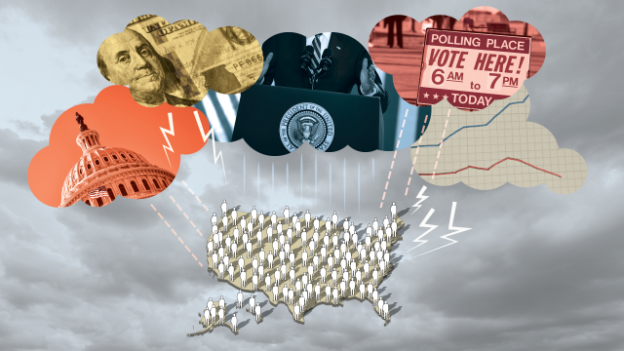
Americans have long been critical of politicians and skeptical of the federal government. But today, Americans’ views of politics and elected officials are unrelentingly negative, with little hope of improvement on the horizon.
Majorities say the political process is dominated by special interests, flooded with campaign cash and mired in partisan warfare. Elected officials are widely viewed as self-serving and ineffective.
A comprehensive new Pew Research Center study of the state of the nation’s politics finds no single focal point for the public’s dissatisfaction. There is widespread criticism of the three branches of government, both political parties, as well as political leaders and candidates for office.
Notably, Americans’ unhappiness with politics comes at a time of historically high levels of voter turnout in national elections. The elections of 2018, 2020 and 2022 were three of the highest-turnout U.S. elections of their respective types in decades.
But voting in elections is very different from being satisfied with the state of politics – and the public is deeply dissatisfied.