
There are people who, for whatever reason peculiar to each of them, wish to leave an impression. Very often the inclination is peculiar to the artist, who, by nature of his or her work, promotes an exhibition of his or her definition of something whether it were a view, a person or an idea. Mixed among this vast arena of possible impressions (which might reasonably include actors, comedians, singers and entire orchestras) is the writer who, depending upon the precise scope of the undertaking, may exemplify either information, narrative or detail or a broader dynamic of philosophy or fiction for example. What however is common to each of these enterprises is the determination to make an impression.
My latest introduction to the ineffable breadth of this paradigm is carvings. I understand carvings to be formations which, if not illustrated independently, are embellished with ink or paint then impressed upon paper. What follows below for example is the product of carving durable rubber or plastic erasers which are then applied to ink and finally impressed upon paper.
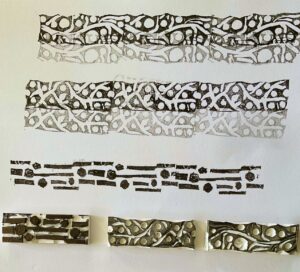
The production is not far removed from the more typical or recognizable impressions related to oriental writing:
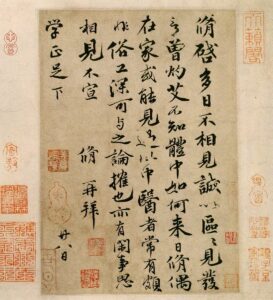
What followed from this evolving intelligence was a discussion of calligraphy which oddly had once been of interest to me though I had capitulated the more artistic theme of imagery to the literary theme of words while preserving the equally artistic quality of the pens themselves. The connection of course is the impression of ink upon paper. The difference is the elaboration of the substance of pens and ink (though perhaps I might usefully note the alignment of writing with the growth of technology).
As coincidence would have it while aimlessly tricycling about the neighbourhood today, last evening’s discussion at table with a dinner guest Stephanie about carvings, ink and pens was punctuated (pardon the pun) when I happened to come upon Don and Laura, parents of Gord who created my first web site which has since morphed from a political platform to a literary chronicle. Indeed as I write this particular account I am employing the very particles of the web site created by Gord for the definition of my impressions.
If my memory serves me it was about 2014 when I consulted Gord about initiating the web site. He was a young man beginning his career but he indisputably had all the credentials for technology. I won’t say he spoke another language but he clearly had a depth of understanding of this new world which far surpassed my own. While I haven’t advanced much in my understanding of technology, I haven’t lost my thanks to Gord for the platform he so skilfully compiled for my use and enjoyment during the past decade and continuing to this day. I have stuck to his choice of Domaine Name and Web Hosting. In a world where things change so quickly it is perhaps unusual that so much of what Gord created a decade ago thrives to this day.
Calligraphy (kalligraphía) ‘beautiful writing’) is a visual art related to writing. It is the design and execution of lettering with a pen, ink brush, or other writing instrument. Contemporary calligraphic practice can be defined as “the art of giving form to signs in an expressive, harmonious, and skillful manner”.
In East Asia and the Islamic world, where more flexibility is allowed in written forms, calligraphy is regarded as a significant art form, and the form may be affected by the meaning of the text or even different words.
In the Western world, the aim of calligraphy is normally regarded as only to achieve attractive writing that is usually consistent within each piece of writing, with little or no interpretation of the text attempted.
Common calligraphy pens and brushes are: Quill, Dip pen, Ink brush, Qalam, Fountain pen, Chiselled marker