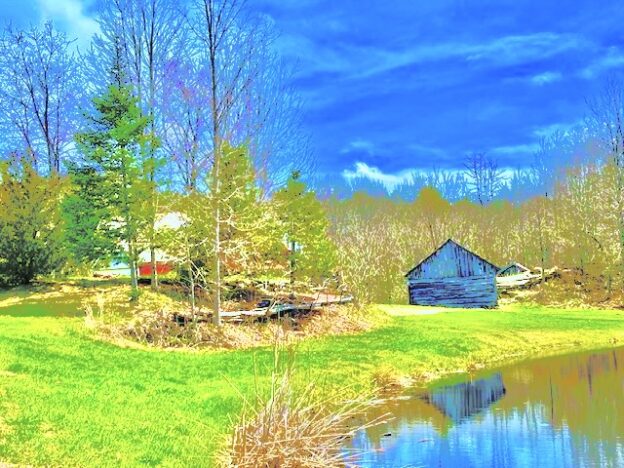
Today we went to Flower Station.
Our usual Sunday drive takes us into the countryside. For a change today I thought we’d visit a place of which I have heard spoken many times but had never been to. Flower Station is at the precise eastern corner of Lanark County in Lavant Township. As we discovered within moments after turning off Highway 511 onto the French Line, the entire area is within what are romantically called the Lanark Highlands because of the hilly, up and down, rollercoaster roadway.
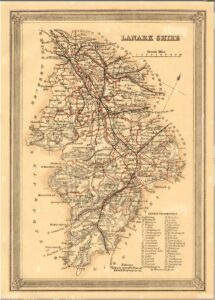
In 1812, The British Government designated all of Lanark County as a potential landing point for European immigrant settlers. With the establishment of Perth as a military town in 1816, Lanark Township, Dalhousie Township and North Sherbrooke Township were opened for even greater settlement in 1820. From the outset, Lanark Village was designated to be the chief local administrative base for Northern Lanark. Lavant and Darling were also opened for settlement over the following 20 years, in order to accommodate the increasing number of immigrants from the British Isles.
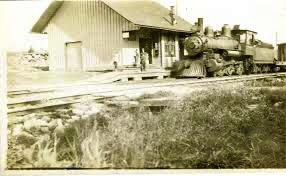
The earliest settlers were unemployed Scots who left the overpopulated areas of Glasgow and Lanarkshire, following the Napoleonic war. In 1820, approximately 400 families arrived in Lanark Village, bringing with them skills in cotton weaving, carpentry, blacksmithing and shoemaking. A similar influx of Irish settlers arrived during the 1830’s and 1840’s. However, the growth of the area was somewhat impeded by the muddy, rocky terrain and steep slopes, which prevented easy travel. As a result, many settlers opted to reside in Perth, unwilling to make the dangerous trek to Northern Lanark.
Of the settlers who did arrive in the Village, all males over 21 years of age were granted 100 acres divided up using the traditional grid system – a grid which is still evident in the current land use pattern and property boundaries. Although the intention of the original settlers were to farm each parcel of land, it soon became apparent that the only lands that could be cultivated were those located in floodplains, along rivers or adjacent to lakes. Consequently, most settlers opted to perform timber-related activities instead. Early industrial activity typically included grist mills, flour mills, pork-packing and tanning establishments – soon followed by the introduction of maple syrup operations, lumbering, saw mills, furniture activities and fishing.
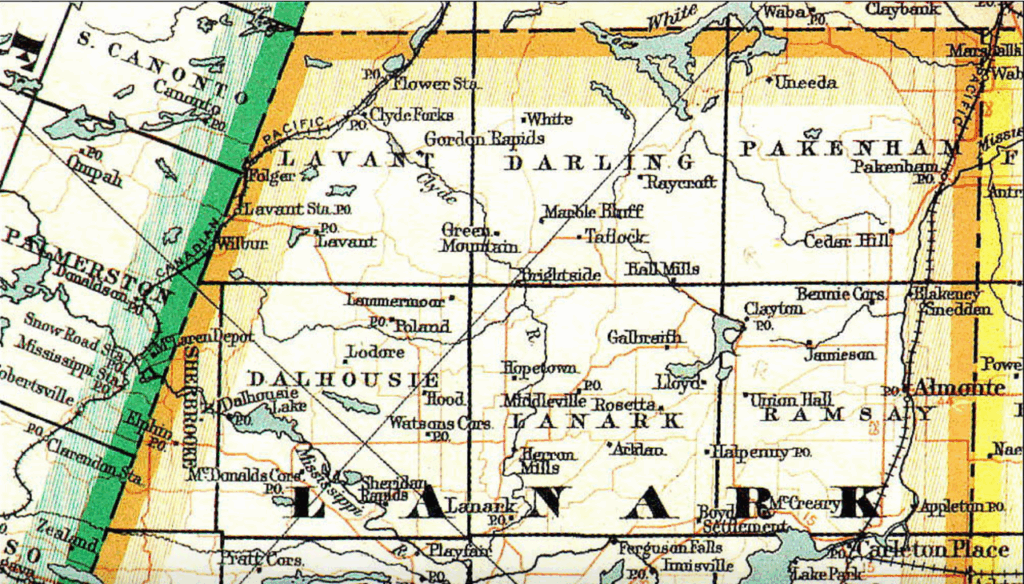
This area of Lanark County is known for its mineral deposits. I recall being told decades ago that W. H. Stafford, Barrister &c. of Almonte represented one or more of the Toronto mining companies which had proprietary interests there. As recently as during my practice of law in the County of Lanark (until 2014) I represented a gentleman from Ottawa who retained me to submit for consideration a sizeable offer to purchase in that part of the county. The offer was turned down but it illustrated the continuing mining interest in the area. Otherwise however it has always been considered a remote destination – even surpassing the notoriety of Ompah. My suspicion is that most of those who regularly frequent the environment are hunters, boaters, off-road enthusiasts or cottagers. There are of course the usual number of astonishingly beautiful private residences on spacious properties with rolling hills and endless fields often located nearby a river or lake. The attraction to former city dwellers must be irresistible. And we speculated too that the Sunday drives in autumn must be common.
As we sailed up and down the hills we at last came to a road sign announcing “Flower Station”. Apart from several houses, a dirt road and another passage marked “No Exit” we hadn’t much to see. So we turned around and headed back home along the same rolling road beside dreamy springtime fields and beaconing lake and river water (Joe’s Lake, the Clyde River and of course Flower Round Lake).