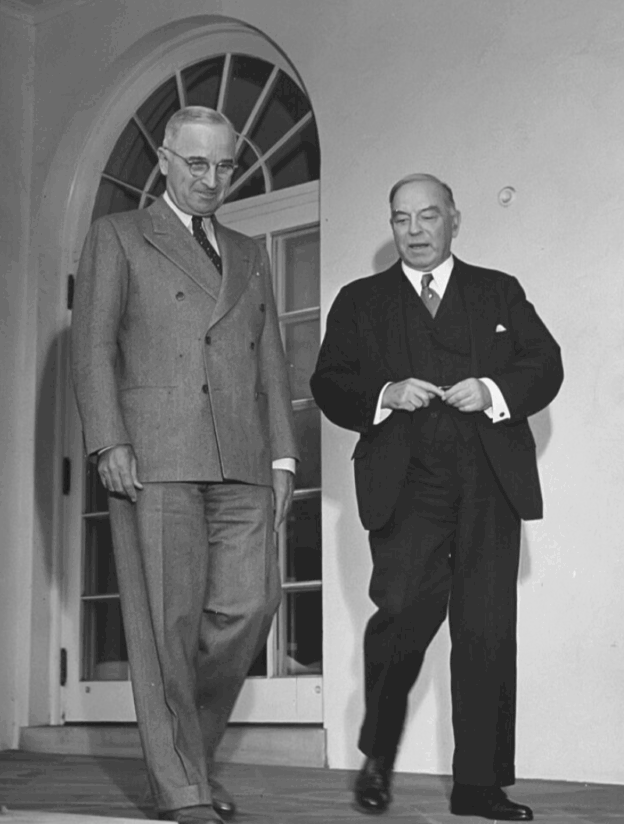
The first official state visit by a Canadian Prime Minister to the White House was in 1945. On November 10, 1945, Canadian Prime Minister William Lyon Mackenzie King met President Harry S. Truman to discuss many post-World War II issues—including atomic energy.
Following US President Donald J. Trump’s proclamation of world-wide tariffs, high-level meetings have recently been among the headlines of the daily newspapers. There was a time when preparing for a business meeting I dressed in a 3-piece suit. Lately however the occasion for those meetings is as infrequent as my observance of a formal dress code. Today however we have a meeting with our financial advisor. In deference to what is anticipated to be the uniquely commercial tone of the event, I have for the moment abandoned my panama shorts and Polo shirt. Instead I am wearing long cuffed pants, a long-sleeved button-down Oxford shirt and dark woollen cardigan. I have as well exchanged my usual Apple Watch (which when tricycling I use to open the garage door) for a Bulova Precisionist as an indication of my less athletic pursuits.
Naturally I fully expect that my appearance will have no more appeal or value than that of the many dignitaries or leaders communicating with Trump about the tariffs. Nonetheless I believe it is credit to the worth of the get-together that one should impart a degree of submission much the same way as one dresses for church or a wake. Already – as I await our scheduled departure for the meeting – I am clamouring to restore my customary costume.
Our meeting today is of course a sub-plot to the global investment strategy. While one wouldn’t normally consider the highly personal features of investment to form part of the overall outlook, I believe there are significant touch-points. Most importantly these – not unlike the pinnacle meetings – surround a discussion of what will be the continuing relationship with the United States of America. The boundaries of the meeting will extend beyond the regular economic spheres. As such the content will be both fairy-tale and real life. In short there is an emergency to the discourse.
My expectation is that investment strategy will seek to avoid Trump’s mercurial economic behaviour entirely. It would – by the least calculated business model – amount to indiscretion to pretend to manage a portfolio in such a volatile atmosphere. This current adversity – reminiscent of any other personal obstruction – has fuelled the contemplation of ways around the dilemma. The most exciting ambition to come to the surface is the redefinition of global trade patterns, having the effect not only of removing oneself from the fickleness and dominance of the USA but also of stimulating adjustment of one’s internal trade patterns.
The erstwhile conduct of psychological negotiation so familiar to real estate developers has been unceremoniously replaced with the broader educated concepts of cooperation and mutual benefit. To think otherwise in a global community is both antique and self-destructive. There is now virtually nothing in the world not consisting of parts from abroad. Our commercial products are almost universally a construct of diverse constituents manufactured throughout the world. No one nation has all the components: the intelligence, the resources, the labour, the water or the electric power. It is axiomatic that working together is the logic. Regressive and isolationist behaviour will similarly have its own self-evident conclusion.
I
Meeting
The first official state visit by a Canadian Prime Minister to the White House took place on November 10, 1945, when William Lyon Mackenzie King met with President Harry S. Truman to discuss the unsettled post-war world—including atomic energy.
More recently, amid headlines about President Donald J. Trump’s sweeping tariffs, high-level meetings have once again dominated the news cycle. I’m reminded of a time when my own business meetings demanded a three-piece suit. These days, the occasions for such formality are as rare as my adherence to a strict dress code. But today, we meet with our financial advisor, and in deference to the commercial tenor of the affair, I have temporarily abandoned my panama shorts and Polo shirt. Instead, I wear long, cuffed trousers, a button-down Oxford shirt, and a dark wool cardigan. I’ve swapped my usual Apple Watch—handy for opening the garage door while tricycling—for a Bulova Precisionist, signaling less athletic pursuits.
Of course, I expect my appearance to carry no more weight than that of dignitaries appealing to Trump about tariffs. Still, I consider it a small courtesy to the occasion, much like dressing for church or a wake. Even now, as I await our departure, I feel the tug to return to my customary uniform.
Today’s meeting, minor as it may seem, is a subplot in the larger drama of global investment strategy. Investment is deeply personal, yet inevitably bound to broader currents. Chief among them is the ever-complicated relationship with the United States. Our modest conference will stray beyond financial charts—it will tread into both fairy tale and hard reality. There’s an urgency here, though quiet.
I fully expect that our strategy will steer clear of Trump’s mercurial economic winds. To pretend otherwise would be folly. Volatility demands not confrontation, but circumnavigation. Indeed, the present turbulence invites us to imagine new trade patterns—ones that loosen dependence on America’s caprice and invigorate our internal markets.
Gone are the days when negotiations could be won by sheer bravado, as real estate barons once believed. The world has moved on to a higher plane—one of cooperation and mutual benefit. Anything else, in today’s interwoven global fabric, is self-destructive. No nation possesses all the elements: intelligence, resources, labor, water, and power. Collaboration is not idealism; it is logic. Isolationism and regression carry their own inevitable and ruinous conclusion.
II
Meeting
The first official state visit by a Canadian Prime Minister to the White House was in November 1945. William Lyon Mackenzie King crossed the border to meet Harry S. Truman, and between them, they tried to stitch together a world singed by war and shadowed by the bomb. Say what you will about them—they had grown-ups in the room.
Fast forward, and today’s “high-level” meetings resemble a circus where world leaders elbow one another to guess which mood President Donald J. Trump woke up in. One day tariffs rain down like confetti, the next they’re withdrawn with a shrug, and all the while the stock tickers spin like fruit machines. Diplomacy now is less Vienna Congress, more back-alley dice game.
Closer to home, I find myself preparing for a lesser summit: a meeting with our financial advisor. Once, such a conclave demanded my finest armor—a three-piece suit, polished shoes, a tie knotted like a noose of ambition. These days, both the frequency and necessity of such rituals have dwindled. But in a nod to the ancient gods of commerce, I have today surrendered my panama shorts and Polo shirt, and clothed myself in long, cuffed trousers, a button-down Oxford, and a dark wool cardigan. My wrist, too, has been drafted into the charade: off comes the Apple Watch (mostly used to open the garage door while tricycling) and on goes the Bulova Precisionist, a relic from a time when watches were tools, not tiny nagging screens.
Of course, I harbor no delusions. My modest costume change will sway no more fortune than the long lines of foreign dignitaries who file into Washington, hats in hand, to beg clemency from the chaos. But like dressing for a funeral, one complies with the ritual—not to change the outcome, but to show you still recognize the theatre. Even now, as I sit waiting to depart, I can hear my softer clothes whispering their sweet promise of escape.
Our meeting today, of course, is a footnote to the grand farce of global finance. Investment strategy is always sold as cold reason, but it dances to older tunes: fear, greed, and the ancient instinct to avoid getting eaten. Chief among the concerns is our lopsided affair with the United States—a country that now lurches like a drunken giant, knocking over furniture while insisting it meant no harm. The conversation today won’t just be about numbers; it will circle, inevitably, around the question: how long can you trust a partner that can’t trust itself?
The only sane move is to sidestep the mess entirely. Pretending you can build a stable portfolio in the blast radius of American tantrums is not bold; it’s suicidal. Like every obstacle since the dawn of man, this one demands the same solution: find another path, quietly, while the bull stomps around the china shop. And from this mess rises the only real ambition worth having: redraw the trade routes, ease away from America’s clumsy grip, and breathe life back into domestic markets that have been half-asleep for years.
The old real estate trick—bluster, bullying, and backroom threats—has had its time. It belongs with the dinosaurs, top hats, and powdered wigs. In today’s world, where even your toaster has passports from three continents, nationalist posturing is not only pathetic—it’s operational suicide. No nation holds the full deck. Not the brains, nor the resources, nor the labor, nor the water, nor the power. Cooperation isn’t some idealistic fantasy; it’s the only engine still sputtering along. And those who insist on isolation will get exactly what they deserve: irrelevance, poverty, and the slow, satisfying collapse of their own delusions.
III
Meeting
In November of 1945, Mackenzie King went to Washington. He met with Harry Truman in the White House, two men in suits sitting down to divide up a post-war world and make sense of the atom bomb’s arrival. They wore the clothes, they spoke the language, and whatever else they got wrong, they took the exercise seriously. That counted for something then.
Now, it’s all noise. Presidents announce tariffs on a whim. Markets lurch. Leaders fly in and out, trying to guess which version of America they’re dealing with that day. I read the headlines, but I’m long past pretending to be shocked.
Closer to home, there’s a quieter ritual on my schedule today: a meeting with our financial advisor. Not quite history-making, but important enough in the narrow borders of my own life. Years ago, I’d have approached such a thing with ceremony—a three-piece suit, shoes polished to a mirror, tie knotted just so. These days, the suit hangs mostly untouched, and the tie hasn’t felt my hands in longer than I care to admit.
But I still make a gesture. The shorts and polo go back in the drawer. I put on long pants with cuffs, a button-down Oxford, and a dark wool cardigan that smells faintly of old winters. The Apple Watch comes off—useful, yes, for opening the garage door when I tricycle around the neighborhood—and in its place, I strap on the Bulova Precisionist. It doesn’t buzz or nag; it just tells the time. That feels right today.
I don’t flatter myself that any of this will make a difference. No more than changing your shoes can alter a storm front. But I was raised to believe that certain things deserve at least the form of respect, even if the substance has long since drained away. Like dressing for church, or a wake. You do it because you still believe in the idea, if not always the practice.
The truth is, this meeting is just a small subplot in a much bigger, messier story. These days, investing isn’t about logic so much as avoiding the next tremor. America, once the anchor, now wobbles like an old table with one short leg. You can’t build on that. All you can do is keep your balance, shift your weight, and look for steadier ground.
And I’ve lived long enough to know better than to chase after the noise. The old style—the bluster, the chest-thumping, the threats traded behind closed doors—that’s all theatre. It worked for a while, in a world that was simpler and smaller. But now, when everything you touch has passed through half a dozen countries, pretending you can shut the doors and go it alone isn’t just foolish—it’s fatal.
No country has it all. Not the brains, not the stuff, not the power. The only thing that works now is cooperation, and even that’s fraying at the edges. The ones who forget this—who wrap themselves in flags and pound the table—will end up where they always do: stranded, diminished, and wondering what went wrong.
I’ve seen it before. More times than I care to count. And as I sit here, waiting for our appointment, I already feel the pull of home, of comfortable clothes, and the quiet refuge from all this posturing. The world will spin on, with or without my polished shoes.
IV
Meeting
The first official state visit by a Canadian Prime Minister to the White House was in November 1945. William Lyon Mackenzie King crossed the border to meet Harry S. Truman, and between them, they tried to stitch together a world singed by war and shadowed by the bomb. Say what you will about them—they had grown-ups in the room.
Fast forward, and today’s “high-level” meetings resemble a circus where world leaders elbow one another to guess which mood President Donald J. Trump woke up in. One day tariffs rain down like confetti, the next they’re withdrawn with a shrug, and all the while the stock tickers spin like fruit machines. Diplomacy now is less Vienna Congress, more back-alley dice game.
Closer to home, I find myself preparing for a lesser summit: a meeting with our financial advisor. Once, such a conclave demanded my finest armor—a three-piece suit, polished shoes, a tie knotted like a noose of ambition. These days, both the frequency and necessity of such rituals have dwindled. But in a nod to the ancient gods of commerce, I have today surrendered my panama shorts and Polo shirt, and clothed myself in long, cuffed trousers, a button-down Oxford, and a dark wool cardigan. My wrist, too, has been drafted into the charade: off comes the Apple Watch (good for opening garage doors mid-tricycle ride), and on goes the Bulova Precisionist, a relic from a time when watches were tools, not tiny nagging screens.
Of course, I harbor no delusions. My modest costume change will sway no more fortune than the long lines of foreign dignitaries who file into Washington, hats in hand, to beg clemency from the chaos. But like dressing for a funeral, one complies with the ritual—not to change the outcome, but to show you still recognize the theatre. Even now, as I sit waiting to depart, I can hear my softer clothes whispering their sweet promise of escape.
Our meeting today, of course, is a footnote to the grand farce of global finance. Investment strategy is always sold as cold reason, but it dances to older tunes: fear, greed, and the ancient instinct to avoid getting eaten. Chief among the concerns is our lopsided affair with the United States—a country that now lurches like a drunken giant, knocking over furniture while insisting it meant no harm. The conversation today won’t just be about numbers; it will circle, inevitably, around the question: how long can you trust a partner that can’t trust itself?
The only sane move is to sidestep the mess entirely. Pretending you can build a stable portfolio in the blast radius of American tantrums is not bold; it’s suicidal. Like every obstacle since the dawn of man, this one demands the same solution: find another path, quietly, while the bull stomps around the china shop. And from this mess rises the only real ambition worth having: redraw the trade routes, ease away from America’s clumsy grip, and breathe life back into domestic markets that have been half-asleep for years.
The old real estate trick—bluster, bullying, and backroom threats—has had its time. It belongs with the dinosaurs, top hats, and powdered wigs. In today’s world, where even your toaster has passports from three continents, nationalist posturing is not only pathetic—it’s operational suicide. No nation holds the full deck. Not the brains, nor the resources, nor the labor, nor the water, nor the power. Cooperation isn’t some idealistic fantasy; it’s the only engine still sputtering along. And those who insist on isolation will get exactly what they deserve: irrelevance, poverty, and the slow, satisfying collapse of their own delusions.
V
Meeting
In November 1945, Canada’s Mackenzie King paid his respects at the White House, sitting down with Harry Truman to sift through the ashes of war and ponder the terrifying promise of atomic energy. They wore their suits, they played their roles, and whatever else one might say, they took the business of nations seriously.
Now, seventy-odd years later, I watch leaders scurry to decipher which direction Donald Trump’s economic weather vane is spinning today. Tariffs slapped on in the morning, shrugged off by evening. Grand threats, followed by grander retreats. It’s less diplomacy than pantomime, with the world press straining to keep up with the plot twists.
And here I am, preparing for a meeting of my own—granted, a humbler affair: sitting down with our financial advisor to plot our modest course through this same stormy landscape. Once upon a time, I’d have polished my shoes, knotted a silk tie, and adjusted my vest before entering such a room. That breed of meeting demanded costume and posture—the silent language of seriousness.
But time trims away such rituals. Today, I make a small, token concession: the panama shorts and polo shirt go back in the drawer, and on go long, cuffed trousers, a button-down Oxford, and a dark wool cardigan that signals, I hope, a certain subdued gravity. I even trade my Apple Watch—handy for opening the garage when I’m tricycling—for my old Bulova Precisionist. A quiet nod to days when a watch measured time rather than shouting reminders at me.
It won’t matter, of course. No more than a delegation’s wardrobe will sway a president’s tantrums. But I’ve always believed some occasions deserve a flicker of formality—like dressing for church, or a wake, even if your mind is already halfway back home in your comfortable clothes.
Today’s meeting, I know, is a footnote to the grander, noisier stories in the headlines. But on its own scale, it echoes them. Investing these days isn’t just about choosing between stocks and bonds; it’s about guessing how much longer you can hitch your wagon to a country that keeps veering off the road. Our southern neighbor, once a sturdy partner, now stumbles around like an overgrown adolescent, drunk on its own bluster and too big to fall without flattening the rest of us.
So I don’t kid myself. The only sensible strategy is to step lightly, keep clear of the flailing arms, and quietly find new paths. Pretending you can plan around such chaos is like building sandcastles during a hurricane. Better to turn your gaze elsewhere—toward quieter markets, toward alliances that don’t shift with the latest mood swing.
I’ve lived long enough to see the old real estate swagger—bullies in boardrooms and backslapping dealmakers—lose its charm and reveal its emptiness. That style belongs to another age, best left to the same museum case as top hats and vaudeville routines. In today’s world, where even my coffee machine contains pieces from half a dozen countries, the idea of going it alone is worse than quaint—it’s suicidal. No one nation has it all. Not the smarts, not the stuff, not the muscle. Cooperation isn’t charity; it’s survival.
And those who forget that lesson—who wrap themselves in flags and shut their doors—will get what they’ve asked for: a slow, embarrassing slide into irrelevance. I’ve seen that story too. More than once.
VI
Meeting
In November of 1945, Mackenzie King went to Washington. He met with Harry Truman in the White House, two men in suits sitting down to divide up a post-war world and make sense of the atom bomb’s arrival. They wore the clothes, they spoke the language, and whatever else they got wrong, they took the exercise seriously. That counted for something then.
Now, it’s all noise. Presidents announce tariffs on a whim. Markets lurch. Leaders fly in and out, trying to guess which version of America they’re dealing with that day. I read the headlines, but I’m long past pretending to be shocked.
Closer to home, there’s a quieter ritual on my schedule today: a meeting with our financial advisor. Not quite history-making, but important enough in the narrow borders of my own life. Years ago, I’d have approached such a thing with ceremony—a three-piece suit, shoes polished to a mirror, tie knotted just so. These days, the suit hangs mostly untouched, and the tie hasn’t felt my hands in longer than I care to admit.
But I still make a gesture. The shorts and polo go back in the drawer. I put on long pants with cuffs, a button-down Oxford, and a dark wool cardigan that smells faintly of old winters. The Apple Watch comes off—useful, yes, for opening the garage door when I tricycle around the neighborhood—and in its place, I strap on the Bulova Precisionist. It doesn’t buzz or nag; it just tells the time. That feels right today.
I don’t flatter myself that any of this will make a difference. No more than changing your shoes can alter a storm front. But I was raised to believe that certain things deserve at least the form of respect, even if the substance has long since drained away. Like dressing for church, or a wake. You do it because you still believe in the idea, if not always the practice.
The truth is, this meeting is just a small subplot in a much bigger, messier story. These days, investing isn’t about logic so much as avoiding the next tremor. America, once the anchor, now wobbles like an old table with one short leg. You can’t build on that. All you can do is keep your balance, shift your weight, and look for steadier ground.
And I’ve lived long enough to know better than to chase after the noise. The old style—the bluster, the chest-thumping, the threats traded behind closed doors—that’s all theatre. It worked for a while, in a world that was simpler and smaller. But now, when everything you touch has passed through half a dozen countries, pretending you can shut the doors and go it alone isn’t just foolish—it’s fatal.
No country has it all. Not the brains, not the stuff, not the power. The only thing that works now is cooperation, and even that’s fraying at the edges. The ones who forget this—who wrap themselves in flags and pound the table—will end up where they always do: stranded, diminished, and wondering what went wrong.
I’ve seen it before. More times than I care to count. And as I sit here, waiting for our appointment, I already feel the pull of home, of comfortable clothes, and the quiet refuge from all this posturing. The world will spin on, with or without my polished shoes.