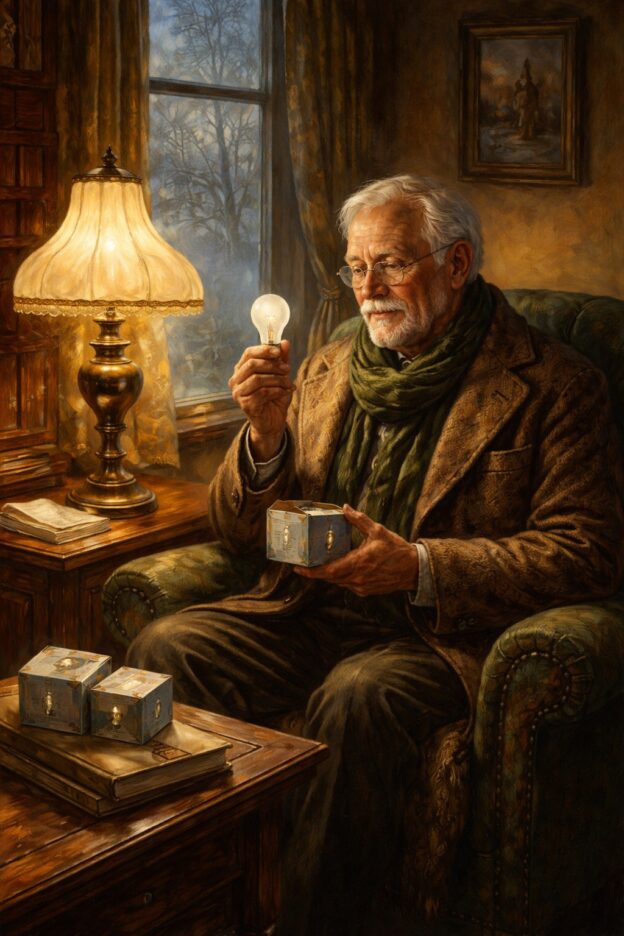
On Saturday morning, beneath a sky the colour of old pewter reluctantly admitting a bruise of blue at its margins, a senior gentleman resolved upon an act of quiet daring: he would purchase a 15-watt light bulb.
This was not, in his estimation, an extravagant ambition. For decades, a 15-watt bulb had been the very emblem of modesty — sufficient for bedside reflection, forgiving to the eyes, companionable rather than interrogative. It was the wattage of murmured thoughts, not surgical procedures.
His bedside lamp had expired during the night with a faint sigh, as though weary of illuminating footnotes and the margins of history. The floor lamp in the drawing room — where he conducted his reading with the gravity of a minor tribunal — flickered ominously in sympathy. Two bulbs, then. A simple errand.
The difficulty began at the threshold of the hardware store.
Once upon a time, bulbs had been obedient things. They were round. They were clear or frosted. They were 15, 40, 60, or 100 watts. They glowed. They died. One replaced them. Civilization continued.
Now they existed in a taxonomy that would have daunted a medieval scholastic. Warm white. Cool white. Soft white. Daylight. Energy saving. Vintage filament. Globe. A19. E26. Dimmable unless not dimmable. Equivalent to but not actually. Lumens, not watts. Kelvin, not common sense.
He approached a young assistant whose name badge declared him “Aiden,” though the spelling suggested a silent rebellion against orthography.
“I’m looking for a 15-watt bulb,” the gentleman began, in the tone of one stating a precedent.
Aiden brightened. “We’ve got lots of 25-watt LEDs.”
“Fifteen,” the gentleman repeated, enunciating with the patience of a retired litigator addressing a recalcitrant witness.
“Right, but 25-watt equivalent,” Aiden clarified, gesturing toward a wall that shimmered like a technological mosaic. “They only use, like, three watts.”
This introduced a metaphysical wrinkle. The gentleman had not come prepared to debate ontology — what a thing is versus what it claims to be equivalent to. In his world, a watt was a watt, not a polite fiction.
“Do you have any that are actually 15 watts?” he persisted.
Aiden paused, as if the question referred to gaslight or whale oil. “I don’t think they make those anymore.”
The word anymore landed with quiet finality. The incandescent age had apparently been folded into history without so much as a footnote.
After a period of negotiation — conducted with admirable civility on both sides — the gentleman conceded that the age of 15 watts, at least in its traditional embodiment, had passed into legend. He was guided toward two 25-watt (putatively LED) bulbs, frosted to eliminate glare — a mercy to retinas accustomed to a gentler century.
“They’ll be brighter,” Aiden warned.
“They mustn’t be,” the gentleman replied, with a firmness suggesting constitutional amendment.
The boxes were small and alarmingly lightweight. No bag was offered; perhaps bags too had joined the incandescents in exile. The gentleman slipped both packages into the deep pockets of his overcoat, where they nestled beside a folded handkerchief and a receipt for dry cleaning.
He walked home under that dim grey frontier of sky, blue pressing through as if testing the constitution of the day. The errand had assumed, in his mind, the proportions of a campaign. Old terminology had collided with new metrics. Experience had contended with cheerful efficiency. And yet — no blood had been shed.
At home, with ceremony befitting the moment, he removed one bulb from its packaging. It was not bulbous in the old way; it possessed a certain modern austerity. He screwed it into the bedside lamp.
Click.
Light.
Not a blaze. Not an interrogation. A civilized glow. The frosted coating performed its office admirably. The room softened. The bedspread resumed its familiar dignity. The shadows returned to their appointed corners.
He stood for a moment, evaluating the result as though reviewing a verdict.
It would do.
The laughable paradox of the entire unsettling commercial enterprise — the taxonomy, the generational translation, the existential debate over wattage — was that the total cost for both bulbs amounted to $6.47.
Six dollars and forty-seven cents.
An epic struggle concluded for less than the price of a modest luncheon.
And yet the undertaking had achieved two ends of no small importance: it fulfilled an imperative — there would be light for reading, light for thought — while avoiding extraordinary expense. Prudence had survived modernization. The old gentleman had not required a tutorial in lumens after all.
Outside, the winter sky continued its hesitant illumination, blue emanating from behind the dim grey frontier like an LED disguised as something older and warmer. Inside, the lamp glowed with agreeable restraint, and a senior sat down in his drawing room — victorious, economical, and faintly amused at having crossed, and survived, the boundary between eras.
Post Scriptum:
Hal – Please create a semi-comic narrative about the struggle of an elderly man (a “senior”) on a Saturday morning and a whim to purchase a 15-watt light bulb for his bedside lamp and for the floor lamp in the drawing room where he does his reading. The boundary between incandescent and LED, plus the vast number of bulb choices available, adds further obstruction to the difference between old people and the young (many of whom are probably unfamiliar with the so-called “traditional” light bulbs). And of course the assistant at the store was one of those young people. After considerable effort to communicate between the elderly man and the young assistant – and after the elderly man conceded there were no 15-watt bulbs of any description to be had (the clerk kept referring only to 25-watt bulbs) – the man bought 2-25 watt bulbs (putatively LED) which had a frosted coating (to eliminate glare). When the man got the two packages home in his coat pocket (the store attendant had no bag in which to carry the products), he immediately screwed one of the bulbs into his bedroom lamp and the result was successful all ’round – not too bright, and everything fit. The laughable paradox of this enormously unsettling commercial enterprise is that the total cost for both bulbs was $6.47. It does however illustrate that the indisputable relief of the modest undertaking was to fulfill an imperative while at the same time avoiding extraordinary expense. The narrative blended nicely with the wintry sky, the pathetic fallacy of emanating its blue shades from behind the dim grey frontier.