Given that Friday, March 20, 2026, 10:46 a.m. Northern Hemisphere · Eastern Time is the first day of spring, the vista today has a contrastingly frigid emergence as the dwindling snowbanks are cemented in the sub-zero temperatures and yesterday’s pools of water on the balcony are hardened. On the river’s edge, secluded from the brisk northeast wind, a flock of Canada geese retreats among the spires of cattails. When they fly, the geese are low-level, seemingly intent upon landing immediately again. The river glistens, illuminated by the blurred sunlight through the grey clouds. Sunday morning CBC FM ecstatically proclaims les Voix du Monde while the white and tawny colours of the fields lend the likeness of a sacramental runner upon the altar.
In Carleton Place when stationed in the grocery store parking lot, I was approached by an eager young woman. She applauded the look of my car then asked what I had paid for it. I told her I hadn’t any idea because it is my custom when trading cars to ask only the difference. Turns out that the young woman’s husband (who materialized shortly afterwards) is the son of a former GM employee in Oshawa (their former residence before being drawn to acreage in nearby Beckwith Township). The husband (who added that he has an engineering degree from Carleton University) said he is entitled to a family discount from General Motors Corporation. He also advised in answer to my enquiry that he – apart from the two children that he and his wife had together – has also a 25 year old son conceived out of wedlock when he as 22 years old. We all summarily agreed that was a large enough family. The woman informed us that she is a social worker, dealing primarily with mental illness among the homeless. Her father is a mechanic.
It was the young woman’s initial automotive interest which unhesitatingly galvanized my own. She shared that she currently has a GMC vehicle which she bought new 12 years ago but which is now about done. I figured this lack of profligacy explained her remorseless curiosity regarding my own vehicle. Naturally the candid conversation thriving among us was two-way. We shared some of the details of our own association with Almonte in addition to our names and the indirect price of the car. Serendipitously my partner located sales information on the Reid Bros Motor Sales website regarding my former vehicle recently traded for the one I now own. This about concluded our confab like birds-on-the-wire. We disentangled with the same unwitting facility as we had begun.
What then followed was an aimless drive to Stittsville, a car wash and the acquisition of packaged towelettes for cleaning the interior. This domestic refinement completes the recent days’ introduction of a handheld vacuum devoted to the automobile. For years I had struggled to think up an expedient means of cleaning car mats and door sills. It is perhaps a small compliment to the wisdom of advancing age that I have at last succeeded to do so. Now, with the aplomb of a carefree soul, I shall complete my estrangement from the gas pumps, no longer bound to search for paper towels nor to use windshield washer fluid to dampen and perfect my abstract notions of detailing.
A demanding journey such as this is not without its commensurate enlightenment and strengthening. Just as the grandest tree emanates from the smallest seed, likewise I have enabled the bounty of a relieving agenda for the independent management of motor vehicle cleanliness. Et tu, Brute? has nothing on me!
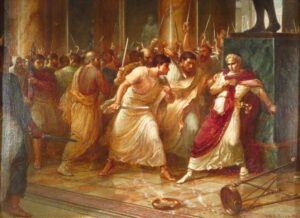
On March 15 (the Ides of March), 44 BC, the historic Caesar was attacked by a group of senators, including Brutus, who was Caesar’s friend and protégé. Caesar initially resisted his attackers, but when he saw Brutus, he reportedly responded as he died. Suetonius mentions the quote merely as a rumor, as does Plutarch who also reports that Caesar said nothing, but merely pulled his toga over his head when he saw Brutus among the conspirators.
Caesar saying Et tu, Brute? in Shakespeare’s play Julius Caesar (1599 was not the first time the phrase was used in a dramatic play. Edmond Malone claimed that it appeared in a work that has since been lost—Richard Edes’s Latin play Caesar Interfectus of 1582. The phrase had also occurred in another play by Shakespeare, The True Tragedie of Richard Duke of Yorke, and the death of good King Henrie the Sixth, with the Whole Contention betweene the two Houses Lancaster and Yorke of 1595, which is the earliest printed version of Henry VI, Part 3.