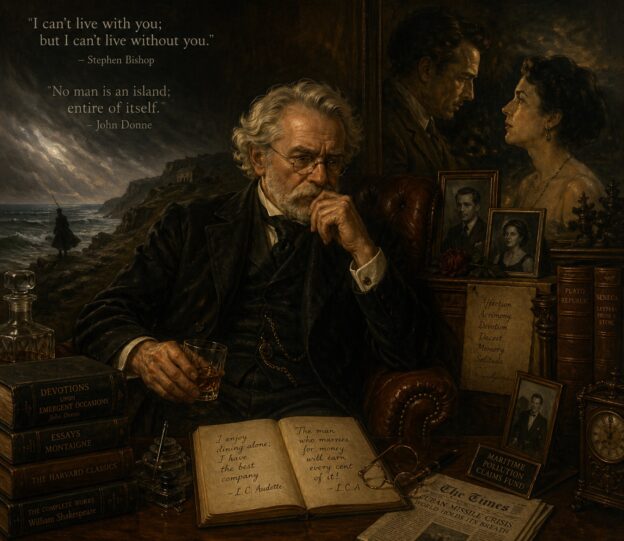
It is, I find, useful to remind oneself of the frequency of a popular social dilemma: I can’t live with you; but I can’t live without you! The apparent contradiction is common among partnerships of any description, whether unwed, married, bisexual, unisex, short-term or long-term associations. The broader universal truth may be more poetically rendered by the now famous observation that, “No man is an island…” by John Donne.
“No man is an island” originates from a 1624 prose work by English poet and cleric John Donne (1572–1631) titled Devotions upon Emergent Occasions. It highlights that no human is self-sufficient and that all people are connected, suggesting that isolation is unnatural and that we are all part of a larger community.
The quote implies that we are not meant to live in total isolation and that we depend on each other, often interpreted today as a statement on the necessity of community and empathy. Nonetheless acrimony exists between partners, both national and international. Indeed it is not rare to hear of those who celebrate their repeated squabbles as indicative of a healthy relationship.
Often we humans condescend to admire the more honest depiction of a relationship v-à-v the Polly Anna version for story books. This is not to say there is not a discernible commitment and romance between those who share their differences. The 1966 film “Who’s afraid of Virginia Woolf” featuring Rex Harrison and Elizabeth Taylor is a stunning example of the dangers of private deceit. In 2013, the film was selected by the Library of Congress for preservation in the United States National Film Registry as being “culturally, historically, or aesthetically significant” (Wikipedia).
Albee’s 1962 play was filled with dialogue that violated the standard moral guidelines for films at the time, including multiple instances of “goddamn” and “son of a bitch”, along with “screw you”, “up yours”, “monkey nipples” and “hump the hostess”. It opened on Broadway during the Cuban Missile Crisis, and audiences who had gone to the theatre to forget the threat of nuclear war were shocked by the provocative language and situations that had not been seen before outside of experimental theatre.
This is not to say that relationships should be maintained merely for the sake of endurance – although I am reminded of my erstwhile companion L. C. Audette QC OC who often noted, “The man who marries for money will earn every cent of it!” Certainly some relationships are deliberately and ingeniously preserved for ulterior motives. And as often those skilful associations are workable. Some are not. Eventually one can hit an obstruction which is plainly too difficult to vault. The urgency to withdraw from such withering relationship will naturally curtail the possibility over time to be proven wrong. Yet frequently there are detectable signals which must not be ignored.
To conclude, I must add another of my friend Audette’s remarks, “I enjoy dining alone; I have the best company!” Audette lived and died a truly sole practitioner. Although he cared for his invalid brother at arms’ length, throughout his entire life the only other member of his adult household was his steward Jeffrey (who later enjoined his spouse Linda). Audette was active in the Maritime Pollution Claim Fund and a legal analysis team, in addition to being fulfilled as an exceptionally avid reader (who, by the way, enjoyed his “whiskey and soda”).