Chapter 7
Across the Sea
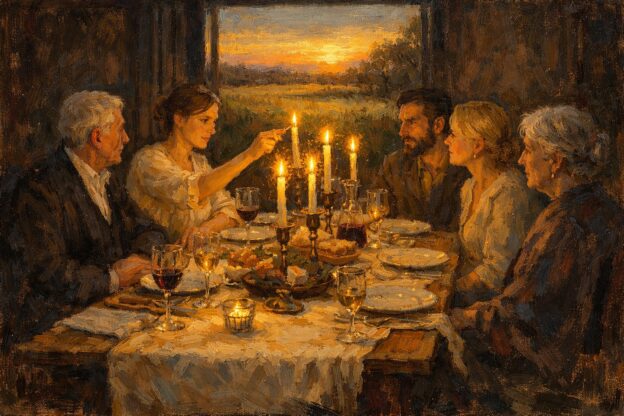
The evening announced itself quietly. There was no ceremony to it beyond the way the last light slid off the fields and the candles were struck, one by one, along the long oak table. Lavinia had set it with a deliberate elegance—linen softened by use, glassware thin enough to sing when touched, plates whose imperfections were earned rather than designed. Rahim noticed these things, as he always did, but said nothing. He understood that the room itself would do the speaking.
Alan arrived with the faint stiffness of a man accustomed to cities, still carrying Ottawa in his shoulders. He shook hands too formally at first, then laughed at himself and relaxed. The house helped with that. Old houses always did. They insisted on honesty.
Dinner unfolded without hurry. A small circle of local friends filled the remaining places: a winemaker with soil under his nails, a retired art teacher who spoke in asides, a neighbour whose only contribution was a talent for listening. Conversation moved like the candle flames—flickering, sometimes dipping, never extinguished. Alan listened more than he spoke, absorbing the cadences of Lavinia’s voice, the careful precision with which Rahim framed his thoughts. They spoke of art without pretension, of the difference between beauty that announces itself and beauty that waits. Alan recognized the distinction immediately. It was one his own family had understood for generations.
When the plates were cleared and the wine reduced to a shared indulgence, Lavinia mentioned—almost carelessly—a long-ago discovery, something found rather than acquired. She did not elaborate. She did not need to. Alan felt the subtle tightening of his attention, a familiar sensation, like the first tug on a fishing line.
He slept that night in the guest bedroom, beneath a slanted ceiling and a window that framed the moon like a deliberate composition. He dreamed badly, though not unpleasantly: sand and salt air, a glint of gold disappearing beneath stone, a painted surface breathing in darkness. When morning came, he left with gratitude and restraint, promising to return soon, already knowing that he would.
Toronto received him with its usual impatience. Meetings, galleries, obligations—he attended to them all, but his thoughts kept circling back to the County, to the careful way Lavinia had avoided detail, to Rahim’s silence when she spoke. Alan had grown up with stories that behaved in much the same way: family legends told only to the point of ignition, then left to smoulder. His grandfather had called it prudence. His father, memory. Alan himself had come to think of it as respect.
It was in Toronto, late one afternoon, that coincidence finally abandoned all subtlety. At the back of the newspaper, folded beneath theatre listings and real estate notices, a short item caught his eye. An ancient work of art. Newly discovered. A young couple from London, now settled in rural Canada. The language was deliberately vague, the kind used when lawyers are already circling. But it was enough.
Alan read the piece twice, then folded the paper with care. He did not feel surprise so much as recognition. The parallel between the article and what he had learned—what had been withheld—was too exact to dismiss. He thought of his own lineage then, of North African traders and Maldivian sailors, of stories that crossed seas before they crossed into books. He thought of a ring, golden and unassuming, and a painting hidden not merely from sight but from history. As a child he had dismissed the tale as ornamentation, a way of making ancestors seem larger than life. Now, older and less certain, he wondered if the story had been waiting for him.
He arranged a meeting in Prince Edward County with little explanation. Lavinia and Rahim agreed at once. They, too, had been reading.
They met in a borrowed space overlooking the water, the lake flat and metallic beneath a lowering sky. Alan wasted no time. He spoke plainly, almost bluntly, about what he knew, what he suspected, and what he believed could be done if they were willing to think together rather than defensively. He spoke of provenance not as ownership but as responsibility. He spoke of myth not as fantasy but as compressed history.
When he mentioned the ring, Lavinia’s composure shifted—only slightly, but enough. Rahim leaned back, folded his arms, and closed his eyes for a moment, as though consulting an internal map.
What followed was not confession so much as alignment. Each of them placed a fragment on the table: a date that did not reconcile, a symbol repeated where it should not have been, a reference excised from an otherwise meticulous archive. Alone, the pieces had been troubling. Together, they began to cohere.
There was no dramatic revelation, no single moment of triumph. Instead, there was a shared certainty, quiet and unmistakable. They were not inventing a story; they were recovering one. An unrecorded feature of an old myth, yes—but also a truth that had survived by being incomplete.
As the light faded and the water darkened, they understood that the circle was closing. Not with finality, but with intention. Whatever came next would require discretion, patience, and a willingness to disappoint those who wanted spectacle.
None of them minded that.