Definition of a parish
In non-religious terms, a parish can be described as an intergenerational community that engages with people from birth to death, and gathers regularly, often with music and song, to learn about values that promote civil society and personal well-being; to reflect on what it means to live in a good way; to grow and be renewed in spiritual ways; to provide durable social connection; and to share individual and collective gifts in the service of others.
Today was perfectly clear and sunny. Last evening, after having read the advertisement in the Millstone news about breakfast at St. George’s Anglican Church in the Village of Clayton, we decided it might be a pleasant outing. And, it was. Exceedingly so. The breakfast was delicious and delightfully rounded – eggs, sausages, pancakes with butter and maple syrup, a chocolate and walnut chip muffin and homemade beans.
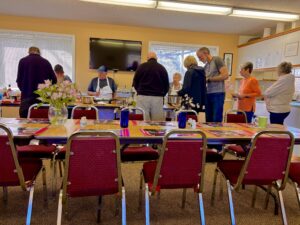
When seated at the breakfast table in the assembly hall of the cottage of St. George’s Anglican Church we chanced to meet Wayne Guthrie whom I hadn’t seen for years. He was outfitted in a secular apron which, in addition to illustrating his humour, displayed his involvement at the cooking stations. Wayne informed us that the public breakfast tradition at the church happens the first Saturday morning of every month. Wayne and I are former brethren of the Masonic craft to which John Fulton (who later appeared with his wife Elaine) is also a member.
Driving about the Village reminded me of an avalanche of people. These included Bill Bellamy (the “Mayor of Clayton “) and his wife Margaret, Allan McIntosh, John and Halcyon Bell and Dennis and Jean LeClaire. There were numerous others whose names I can no longer recall. With one of them I was engaged in a serious and unusual conflict arising from the local heritage committee of which he and I were members. In the repair of my heritage office building I had failed as required to provide a photo of the original front door to be replaced. It was not possible to get such a photo because the door which was there had already replaced the original years before.
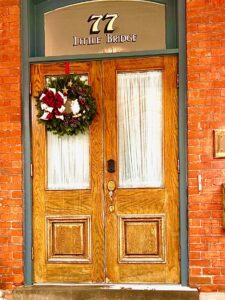
I could however estimate from the remaining indentations where and what the original double door had been. I employed a heritage and conservation specialist to design a compatible replacement door. Because the heritage refund cheque payable to the property owner was from the Town of Almonte I quickly secured the consent of the Treasurer (Desmond H. Houston) to the payment, thus bypassing this annoying and frivolous obstruction.
Driving along the Clayton Road, up ad down, winding past hilly pastures and over burgeoning streams, I recalled the first house to which I was referred by my erstwhile employer Michael J. Galligan QC. The house was a tiny log house on a small lot facing the road. It illustrated everything of a critical nature that there was to know about country living; viz., remote, secluded, well and septic system. To someone such as I – that is, someone with the least mechanical knowledge imaginable, someone who was a boarding school student/undergraduate resident/ law school fraternity member/Devonshire House Don/apartment cave dweller, the mere thought of having to shovel snow or cut the grass was both foreign and frankly off-putting. I gave it a pass – though 49 years later I acknowledge it might well have been a colourful and no doubt instructive introduction to rural living and local ancestry.
Returning to Almonte from the country church near Clayton Lake felt horribly urban and cosmopolitan by comparison. We had however fulfilled our parochial ambition – though admittedly with less reinvigoration than I had anticipated nearly fifty years after having settled the estates of many of the notable clan leaders from the area including Russell Bain Thompson of the maple syrup fame. But – as I a discovered yesterday when speaking to “ little Tommy Levi” (whom I met as a child around 1976 when living on Martin St N in the home of Rev. and Mrs. George Bickley while they inhabited the parish house of St. Paul’s Anglican Church on Clyde St in Almonte), not everyone has even heard of Raymond Algernon Jamieson QC – the family behind Carss Street (Raymond’s mother), Almonte’s first grand piano (followed a half century later by his son John’s purchase of a Steinway salon grand with Louis XIV cabinet direct from New York City), the eponymous street in Metcalfe Park and one of the subscribers (as Town clerk and solicitor) to the unique Town of Almonte Act of the Ontario provincial legislature (a private bill to entitle the town to override the exclusive parkland usage limitations of the testamentary charitable bequest of Winnifred Gemmill).