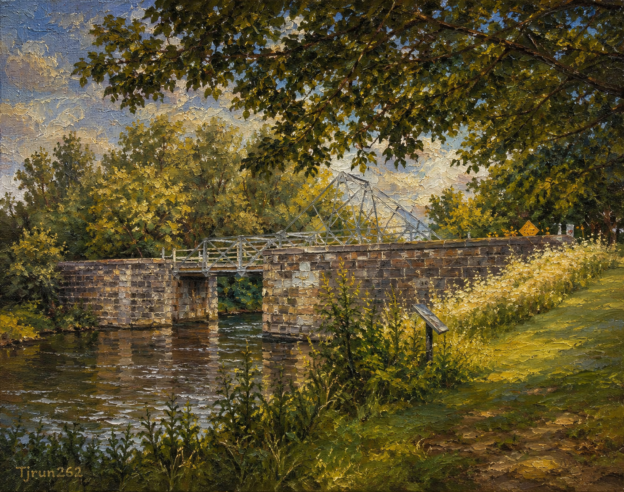
More as an accreditation of the universal limits of modernity, an indifferent blotting up of the history of the locale surrounding the nation’s capital (including our beloved Town of Almonte) discloses a number of pungent similarities, among them waterways, railways, grist mills and woollen mills. That – and the fur trade – constitute the underlying commercial development of our country so far as I can recall. It illustrates too that the identity of the United Empire Loyalists was a chart not entirely determined by the unsettling events of 1764 in the United States of America. Indeed, one occasionally stumbles upon archival fragments whose very language discloses the breadth of the British imperial world: “Sundry Negroes on Nichola Town Estate late the property of George [?] Esq. now belonging to Charles Spooner Esquire … Port of Grenville in Grenada.”
This is because the United States did not yet exist, and the term itself was not coined until the 1780s. In 1764, the region was still under British colonial rule, and the American Revolution (1775–1783) had not yet occurred. The honorific title “United Empire Loyalist” (UEL) was officially created in 1789 by Lord Dorchester, the Governor-in-Chief of British North America, to honor those who supported the British Crown during the revolution.
I mention these historic matters because there is a taint of that history on my father’s side of the family in the Province of New Brunswick.
The name Chapman is linked to the United Empire Loyalists (UEL) through prominent Canadian families of English descent originally from Yorkshire who fled the newly formed United States after the American Revolution to rebuild their lives in British North America. The Chapman branches associated with the Loyalists include lineages that originally settled in provinces like New Brunswick (e.g., Salisbury and Hillsborough) and later moved throughout Ontario. Today, proving a direct ancestral lineage to these original Loyalist settlers grants descendants the right to use the post-nominal letters UE (Unity of Empire).
Official ship manifests show that the Chapman lineage actually departed Hawnby, Yorkshire, England, and arrived at the Chignecto Isthmus (the border region of modern New Brunswick and Nova Scotia) in 1774 aboard the ship Albion.
My further point is to remark upon my nonchalant sojourn about the countryside this afternoon. While sitting alert at the wheel and inwardly stewing upon philosophic nonsense, my historical interest unexpectedly bestirred itself. If one departs (as I intentionally did) from the 4-lane highway onto the back-country roads, there unfolds a stunning visual report. Not far beneath the southern boundary of the City of Ottawa the territory instantly becomes vast open unpopulated farmland – easily viewed because the land once approached a river (so I am told) and accordingly the land is flat. This makes for moving imagery – as it did this afternoon – on a clear day with a rich blue sky and billowing white clouds.
As I drove silently up and down the winding roadways there were two places I was especially pleased to see: one, Burritt’s Rapids (which I had seen in the past); and, two, a place I never knew existed – Beckett’s Landing. The history of both is much the same. Naturally the similarities reminded me not of one or the other; rather, I couldn’t by-pass the recollection of my treasured Town of Almonte. Indeed, as inspiring as were the commercial and residential developments in nearby Town of Kemptville, my collective summary of benefits of the Town of Almonte immeasurably outweighed any unintended prejudice.
This seemingly trite conclusion is in fact part of a larger and on-going discussion (within my head) about where, if anywhere, in the world one should go. Increasingly – through the magic of old age and the prospect of death – I find myself contemplating my physical boundaries. I can tell you that, as I look over the top of my computer screen onto the late afternoon mirror reflections upon the river, I have no desire to remove myself. I admit for the record that part of the concession is merely the unrelated product of painful mobility. It is an abuse from which I have inconveniently been able to withdraw myself. It does a lot to temper anything beyond the ordinary. But – and here is the notation – I shall defer the innovation to Management.
In 1793, Stephen and Daniel Burritt, from Arlington, Vermont, settled in the vicinity of the area now known as Burritt’s Rapids. A plaque was erected by the Ontario Archaeological and Historic Sites Board commemorating the founding of Burritt’s Rapids.
By 1812, Burritts Rapids had become a bustling hamlet. At the peak of its prosperity, it had telegraphic and daily mail, 2 general stores, a bakery, a millinery shop, 2 shoe shops, a tin and stove store, a grist mill, a woolen mill, a tannery, 3 blacksmith shops, 3 wagon shops, a cabinet shop, 2 churches, 2 schools, 2 hotels, a bank and an Orange Lodge.
The hamlet’s natural advantages as a transportation centre were enhanced by the opening of the Rideau Canal in 1831. Burritts Rapids was the site of the first bridge across the Rideau River. A post office was opened in 1839.
By 1866, Burritts Rapids was a village with a population of about 400 on the Rideau canal, in the townships of Oxford and Marlborough, and counties of Carleton and Grenville. It had two schools, and citizens were in the lumber business.
Unfortunately, the hamlet was by-passed by the railway, and its importance gradually diminished with the decline of the canal as a means of transportation.
HAL: