Thanks to Professor Daniel Laprès of Paris, France I learned today of articles from the Institute for China-America Studies (ICA). While Professor Laprès extolled the articles as “worthy of interest, one on the law governing the Strait of Hormuz and the other on an Arctic régime based less on presence than on capabilities in which all stakeholders participate”, its efforts have been described as “a channel for propaganda” skewed towards the policies of the People’s Republic of China.
The vital interest of ICA surrounding the Strait of Hormuz generates a law school platform for the debate and interpretation of international maritime law. Not surprisingly there are many competing claims. The importance of the discussion extends to polar territorial claims affecting countries such as Canada (but significantly, not China other than indirectly).
A U.S. government report from the United States–China Economic and Security Review Commission described ICAS as an attempt by the CCP to “directly inject its own voice into policy discussions” as “part of a campaign to introduce Beijing’s views on its territorial claims in the South China Sea to Washington.”
Foreign Policy reported that despite its significant funding, ICAS struggles to gain credibility and attention in the U.S. due to its alignment with Beijing’s views and lack of aggressive engagement and sophisticated operations within the think tank ecosystem. It is viewed as part of China’s multi-pronged strategy to force its will in the South China Sea against international law and as a mouthpiece for the CCP.
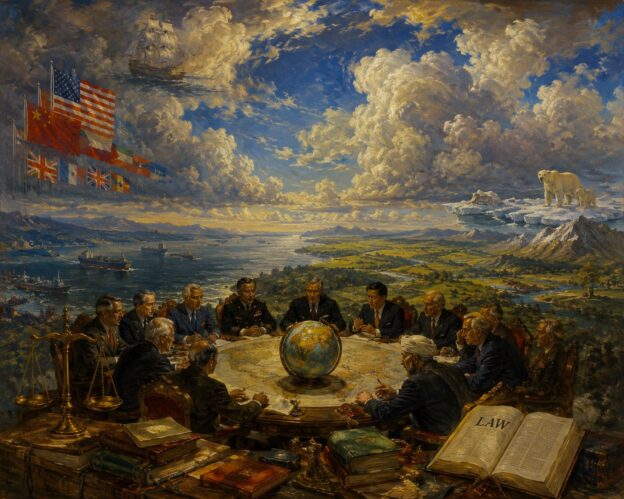
This discredited view of the think tank will not be a surprise – any more than any other nationally oriented programme. What however lingers most evocatively is the general conclusion that law of any extraction is irrelevant. Instead what predicts outcome is nothing more elaborate than cooperation and compromise, the duality which appears to have haunted Iran and USA in their latest volatility. Imagining the competing bargainers at the table with their presumed superiority of legal or territorial rights illustrates the vastness and incomprehensibility of the cooperative effort. The refinement of the jurisdictional debate may also depend ultimately not upon intelligence and logic; rather upon money and power (the machinations of which are too labyrinthine to be readily understood).
It is not my intention to minimize the enforcement of legality. Nor do I recognize law as axiomatic. I am therefore equally bound to confess that our vehicles for compelling global sanctions are moderated by some uninventive people, indeed people whose credibility may emerge from no greater a foundation or imperative than luck of the draw. The world’s affairs are conducted by people, people looking to sustain employment, people with gratuities to extend and to endorse, people with position, people fulfilling lifetime ambitions, people with children and family to care for. Clouded by this complex array of stimulants – many of which conflict – the domaine of engineering the world quickly becomes of atmospheric proportions, even out-of-reach.