Category Archives: General

What motivates you?

It’s an innocent enough question: “What motivates you?” Yet it is almost too innocuous to excite any depth of response, the sort of uninspired question a radio interviewer might ask one’s guest in order to keep the conversation moving. Indeed it was that very circumstance which this morning during my breakfast repast captured my attention while listening – as I always do – to CBC Radio. I can’t recall who the host was interviewing nor about what, but I distinctly recall being intrigued by the question.

The first thing that came to mind was the seemingly obvious identification that we are in fact motivated to do what we do; that is, that things don’t just happen. Mr. Everyman’s progress is sired by incentives or causes. I suppose that for some the unfolding of their lives is nothing more glorious than the toss of a die, but nonetheless that sometimes harsh randomness does not in my opinion extinguish the fervour we may still feel for the controlled conduct of our lives in spite of our luck.

Tuning into one’s private stimulation is perhaps the first step in bringing forth results. I think you’ll agree that acknowledging that there are things which incite one to activity is more likely destined to fruition than merely assuming that knee-jerk reaction to events or going with the flow. This recognition may come late in life for even the most successful of our number. The sometimes overwhelming confluence of social and cultural factors can lamentably direct us in ways which have very little to do with our deeper inclinations. Suddenly twenty-five years into the game we find ourselves sitting at a desk stunned by the inutility of what we’re doing, a rude awakening at times. Yet the realization is never too late as it prompts an acceptance of a sensitivity to the more fundamental features of our make-up which may end by precipitating almost sacrificial though beneficial behaviour.

That was the second point of comprehension; namely, that the distinctive marks of one’s character are what drive us. Identifying them is the equivalent of analyzing a seed to fathom what it will generate. Equally important is the knowledge of how to assist the germination of that seed.

Some people thrive upon repetition and precision; others prefer a less obsessive and more relaxed environment. Either way, what’s bred in the bone will out in the flesh. Knowing what’s happening within oneself allows one the privilege of being able to side-step or ignore useless endeavours, and to nurture and develop what is dearest to us each.

As I have observed before, “There are two ways to get down a river: either you know where to go or where not to go”. Call it a process of elimination. So often we waste time doing anything but what we want to do or what we are suited to do. I suspect nature loves what is ultimately easiest (in the sense of most adaptable) in the end. Life needn’t be an uphill effort to conquer someone else’s battles.

This introspection may, however, be both liberating and limiting. Too often for example we are mistakenly encouraged to imagine that our capacity is boundless (see “The Little Engine That Could” a diabolic and misguided children’s tale of self-discovery with about as much credibility as the American Dream) when in fact it would be more properly expounded that our abilities are governed and controlled by our constitution. Yet even in this more restrictive view of our capabilities I find solace in that it encourages dedication to what one does best, in itself both emancipating and enfranchising, not to mention that it enables one to turn down what you know in your heart isn’t right.

That has to be the third and most important point of analysis. Suddenly knowledge of what motivates you is the authority by which you act. How great is that! Now you have a reasoned excuse for doing what you prefer to do! Talk about cutting away the dead wood! It is no doubt in this spirit that one hears of those who profess to getting out of bed every morning and loving what they do. Put another way, if you do what you like, you’ll like what you do. Granted such a perfunctory adage is more cute than persuasive, but given sufficient reflection upon what exactly it is that one likes to do, there may indeed be a germ of truth in it.

Around the Block

Whether it is a product of wholesome habit or merely an upshot of the recent bent for economy, a simple and effortless jaunt around the block on my trusty Electra bicycle has become part of my prescription for good living. Both healthful activity and austerity share the same attributes of being improving, regular and stream-lined. At my superior age, however, I have discovered that the secret in this as in so many other things is not only not to overdo it but also not to make it disagreeable. For one thing, excess has always been the first nail in the coffin no matter what the undertaking. For another, at a certain point in one’s life it is no longer either convenient or desirable to be driven by Stoic directives such as “Just do it!” We are not after all in the army, much less in our teens! No, the gainful model of behaviour – if it is to be sustained over time – must be more along the lines of contentment (with just a soupçon of ease).

Whenever one infects an activity with an element of glee there is an inclination to presuppose that the task is illegitimate. This inaccuracy arises from the introduction of an extraneous edict, namely “No pain, no gain!” If you measure the consequence of your gratification in life by the degree of deprivation, then I suggest it is time to reconsider the formula. Suffering and dispossession are unwelcome and menacing subterfuges which have no place in polite society.

Reflecting upon this subject (which you’ll admit smacks slightly of the Calvinist Work Ethic) makes me question whether the patterns of my youth were for naught. Indubitably strain was as common as air in my earlier years. Almost everything was a struggle (granted, sometimes of my own doing). Certainly the years have provided dividends regarding what I consider to be wisdom, an advantage which however may be peculiar to maturity only. As a result I am not persuaded that youth can escape the tribulations of rising experience. This is an unfortunate conclusion, as it suggests that all young people must of necessity run the gauntlet. Without the benefit of having been a parent, I challenge any one of you to contradict me on this.

In any event the point is that when one at last sees the light it is time to take pleasure in it. One is encouraged in this partiality by the knowledge that this life is limited, stale-dated and inevitably over.

New car

Yesterday as I drove to Myers Cadillac, 1200 Baseline Road, Ottawa to conclude the final details of my new car purchase I attempted to recall in particular the General Motors products I had owned since my father bought me my first automobile in 1975 and in general how many new cars of any manufacturer I had bought in total.

Continue reading

Lining them up!

While I would prefer to think otherwise, it is likely the sign of a small mind to obsess over the picayune details of everyday living throughout an entire night. Such however was my unfortunate condition last Wednesday evening. In defence, my haunting fears were abetted by the peripheral forces of a violent storm bearing lashing winds and torrential rains, made all the more provocative by the scrapping of branches against the side of the house and the concussion of hydro wires. One more thing to add to my list – the arborist!

When, after having brooded for hours upon the tedious refrain of a multitude of tasks screaming for cognizance, I finally revived myself in a numbed and dilapidated state at six o’clock this morning, it was but a heartbeat before I began planning my assault upon the mountain of misery which I had so painstakingly manufactured overnight. Whether driven by impatience or an appetite for consummation, in my aching state of insomnia I had assembled a list of duties which had by now assumed an unquestionable urgency. Suddenly everything was on the table and everything needed to be fixed! I had convinced myself that for too long I had allowed these several problems to slip into apparent oblivion and their compelling nature needed to be revived.

As I had already established a certain priority among my list of things which required application, I jumped in with both feet by telephoning two gentlemen of the many trades with which I was currently engaged. My enthusiasm was betrayed by the fact that I was calling them only shortly after seven o’clock in the morning. I have long been convinced that any tradesman worth his salt is well on the road to prosperity before eight o’clock. I was not defeated in this assumption; and, to my entire satisfaction, I was within minutes able to wrestle two of my more component concerns to the ground, with reassuring words from both gentlemen that they would execute the required feats of engineering.

One by one I worked my way through my register of complaints. Not all grievances were centered on fiddling matters of personal importance. Thrown into the mix were other issues arising from my professional obligations, matters which had – as they so often do – percolated to the top only after a reasonable lapse of time but which had now materialized sufficiently to warrant address. In these potentially contentious circumstances one is never entirely certain of the reception one is about to receive in the cooperating office, which naturally excites the agony. Today however I was rewarded with a favourable response, a fact which nicely lubricated the grimy gears of my midnight demons. Things were noticeably starting to look up!

The real lesson in all this torment is that life is guaranteed to provide a relentless manifestation of challenges of one description or another. It is inescapable. It is equally assured that the slaying of the dragon, when at last it happens, will be an ephemeral delight only. Just around the corner another emergency is about to transpire. I don’t mean to sound defeatist in this, but rather straightforward. Whether it takes a restive night or any other scheme to surmount the current dilemmas in one’s life is a matter of personal preference in the end. It appears that my own tact is to quietly suffer periods of inactivity before becoming agitated enough to line them up and shoot them down.

Staking the Joint

The pluperfect subjunctive doesn’t begin to capture the state of unreality in which I found myself absorbed for an entire afternoon recently.

About two weeks ago the Town employees dug a deep hole in the street in the front of my office to repair a damaged water connection. Subsequently on a Friday afternoon as I returned to work from lunch a team of contracted workers arrived with a cement truck to pour the replacement slab. Eying the process from my office window I was stirred to approach the foreman of the crew and enquire what if anything they proposed to do to prevent delinquents from defacing the new concrete. The foreman clearly hadn’t any particular plan in mind, and my question was noticeably an unwelcome interruption, following which he immediately returned to shouting instructions and waving his arms at the younger workers. I let it go, but not without reservation. The area in front of my office is a high traffic area for young people, more especially during the school year, but also at other times. The proximity of the TYPS (“Take Young People Seriously”) office contributes to the regular passage of youth. I knew that wet concrete is a magnet to nefarious amusement.

As it turns out it wasn’t long after the cement crew had departed that my worries began to enlist substance. Attracted like flies to the proverbial, two young boys on bicycles suddenly materialized at the corner of the now barricaded glistening cement slab. I caught the sight of them out of the corner of my eye through the garden shrubbery as I worked at the computer in my office. My hurried glance at first told me that their preoccupation was mere curiosity. I wasn’t however ready for what then transpired. In a matter of seconds, the employment of the boys turned from casual inquisitiveness to determined obliteration. One of them descended from his bicycle and moved aside the barricade. Then in a flash he raised his right leg and planted his foot firmly and deeply into the wet concrete. I couldn’t believe my eyes! I ran from my office to the street but the boys had disappeared with the speed of vanishing flies. I continued my search for them by checking the area behind my office but without success.
Meanwhile I returned to the scene to fathom what I could do to repair the damage. The footmark depression was at least six inches into the corner of the slab. Not surprisingly my office is not outfitted for anything approaching out-of-doors service. I knew I had a spoon in a drawer somewhere but speedily dismissed that utensil as a useful possibility. What I needed was something larger and firmer. A mere piece of cardboard would not serve as an implement. At last I settled upon a plastic dust pan. In a decidedly unprofessional manner I restored the cement to a semblance of what it had been originally. I tried to refine the appearance by drawing a corn broom across the top of the damaged area to imitate the lines which the workers had previously applied.

Upon completion my mind returned to the original act of vandalism, prompting me once again to go in search of the culprit. This time I was in luck. In the distance near the TYPS office I saw about six boys sitting in a line, their bicycles resting nearby. I approached with the stealth of an animal on the hunt. My searching looks at the boys were immediately rewarded. One of them was sporting a sneaker which had clearly been recently mired in some grey matter. As I wasn’t positive that he was my man, I decided to introduce the subject offhandedly. I began by asking whether all the boys were on bicycles today, to which they replied they were. That at least cleared that element of the evidence in support of my case. I decided that the bicycle combined with the soiled shoe was sufficient to permit an inductive leap. Looking intensely into the eyes of the targeted young man I blandly commented that I disapproved of his having planted his foot in the new cement slab on the street and that I noticed his shoe was testimony to the act. He began by telling me that he had fallen from his bicycle (at least he acknowledged the performance), but my look of disbelief in addition to my blunt statement that I had seen him do it prevented him from advancing his theory of defence any further. He then adopted a new diplomacy, explaining that he wasn’t a bad boy, that he never did anything wrong and so on. I diverted him from this entertainment by telling him that actions such as his give young people generally a bad name. His colleagues by the way were singularly silent throughout this interrogation. I decided to punctuate the vandalism by asking if he knew where the police were at this time (someone on the street had tipped me off that there was a policeman in Baker Bob’s). The boy said yes, he did know where they were. I asked him whether we should have a chat with the officer. The boy naturally discouraged that course of action and I acquiesced.

Having done all that I felt was necessary to deal with this common prankster, I merely capped it off by telling the boy that it was a dumb thing to have done. I walked away from the crowd (privately wondering whether I would be hoot-called in my retreat but thankfully I hadn’t to suffer that indignity). It may have helped that at least one of the boys among the group was known to me as I had previously met him and others at an open-house sponsored by TYPS. That same boy had discovered that I knew his grandparents as well.

As I continued to brood about the matter it occurred to me that as practical retribution I should invite the boy who did the damage to sit by the slab over the next two hours until it set to ensure no further damage was done. However I quickly discarded that pitch as I could see I was setting myself up for a false imprisonment action by the boy’s disgruntled parents. It was easy to make out the translation of irresponsibility into a constitutional crisis. Instead I settled for my own scheme of observation. I returned to my office and opened the side door which leads directly to the area of the new concrete slab. I reasoned that the open door would alert any further trespassers that there were eyes on the project.

Meanwhile, in keeping with a long-standing convention, a dear friend of mine came to the office for a late afternoon visit, a coffee and a gossip. She sat in her usual chair which was now precisely in the open doorway, something she suggested was a pleasant change from the former less airy environment. Naturally I narrated the details of what had previously transpired. My story was accompanied by the expected huffs and puffs, expressing disbelief, annoyance and so on. The focus of our combined antagonism was young people.

Well, what then unfolded just shows how wrong one can be! While we two were sitting there in my office, chitchatting back and forth, with the door wide open upon the scene of the crime, a gentleman of about forty years of age came along the street. To our surprise unaware of our immediate presence he knelt on the street at an interior corner of the new slab. Neither my companion nor I could decipher what he was doing. My visitor speculated sotto voce that he was collecting garbage. For some reason neither of us felt entitled to question the chap about what he was doing as he appeared very intent but not furtive.

When the man evaporated I went to the street to see if there was any proof of what he had been doing. To my utter astonishment I discovered that he had engraved his initials and those of someone else into the corner of the cement! This was the limit! I immediately began imaging every possible form of agony which I would inflict upon him if we were ever to meet in the street.

This further transgression of course only heightened our collective scrutiny of the concrete slab. Twice we had witnessed the speed of these surreptitious and unanticipated acts.

By this time, the concrete had begun to set. It was also approaching five o’clock and I confess I am a creature of habit when it comes to leaving the office promptly at the end of day on a sunny Friday afternoon. We were however treated to one last assault. This time there was a young man in the company of two young girls who we saw kneeling on the sidewalk at another corner of the slab. When I approached him and asked him what he was doing, he frankly stated that he was putting his initials into the concrete. I then asked him why, to which he replied “To go down in history!” I returned the volley by observing that he would only go down in history for destroying public property. This had the desired effect and he withdrew. In any event his labours would have been without profit as the concrete was now sufficiently set to withstand any menace.

I acknowledge that I may be becoming a curmudgeon but truthfully I have no desire to spend the rest of my career coming to the office every morning having to witness a boot depression or some stranger’s initials in the pavement. Both efforts at art and notoriety have thankfully been defaced.

Island Living

When you hear the expression “Island Living”, no doubt what comes to mind is some glossy American magazine about how the smart set live in Florida on the intra coastal waterways, in large mansions with endless bamboo and overstuffed furniture. In our small Town, however, the enclave known as the “Island” is considerably different, though equally exclusive in its own way.

Continue reading

The Not So Great Depression

Even if you do not regularly torture yourself by listening to Bloomberg or the BBC (that purveyor of “news of fresh disaster”) it is I think accepted that the worldwide economy is not exactly buoyant at the moment. I won’t add to the torment by imagining that I can say anything less than trivial about the economic theories which are driving this lapse. What however interests me more is the effect of these events upon people in the street, quite apart from how Wall Street and the global stock exchanges juggle the numbers. In the final analysis what sustains our national coffers and pumps our financial institutions is probably nothing more glamorous than personal income tax and the housing industry (there’s a reason they keep reminding you that the purchase of your home is likely the largest single investment you’ll ever to make). It doesn’t require much imagination to see or predict the infection of the financial markets when people start to lose both their jobs and their houses, a pattern which in the United States at least is considered far from over. It is remarkable that these two pillars of society (jobs and houses) are apparently so easily jostled and toppled. The American experience discloses that the housing industry had become a complete sham, the product of deliberate artifice. Not surprisingly the ramifications were widespread, pointedly tainting even the grandest of institutions at the top which sought to take advantage of the
In times of general austerity, it is common to see a reduction in so-called “discretionary” spending which can include artwork, jewellery, automobiles, furniture, clothing, vacationing, dining out, even estate planning; in short, everything other than the essentials, namely food, shelter and energy. The broad scope of discretionary prohibitions ensures that almost every facet of commercial and professional society is touched. As is so often repeated, “No one is spared!”

One can see the diminishing effect of a stagnant economy on the street. People are less inclined to mill about the commercial centres because they have no purpose in going there. Nonetheless some firms persist in their attempts to capitalize on the current conditions. For example I noted with interest a recent television advertisement by Canadian Tire in which they skillfully contrasted and promoted a tent and folding chair by a campfire to a five star hotel. While there is obviously a demographic to which this appeals, I doubt it will be sufficient to save the economy from otherwise collapsing. I can imagine that there is a threshold beyond which no amount of reduction in price makes anything attractive. The shop keepers must simply wait it out.

An economic downturn first instills caution, then fear and finally paralysis. We all know of the rolling effect of stagnation; it starts first with one sector, which in turn corrupts another and so on. The effort to reverse the trend may also precipitate insular thinking though I believe it is now widely acknowledged that the days of closed borders (“Buy American!”, “British Jobs for the British People!”) are no longer realistic or even beneficial.

Some people imagine that the US economy is losing ground to China. Remember however that agriculture is about 20% of China’s output and that its production consumes about 40% of its labour force to do it. Even if it is anticipated that by 2050 the average household income in China will increase 800% over what it was in the year 2000, it will then still be only one-third of what it is in the United States. In other words, though China has come a long way, it still has a long way to go.

It bothers me to know that the only palpable remedy for the Great Depression was a world war. Though I seriously doubt this will happen, given the animosity which currently exists in Europe (particularly between Germany and Greece, and perhaps soon involving Italy, Spain and Portugal), the possibility of skirmishes between these once cohesive entities is not unthinkable.

The frailty of our economic bulwarks is heightened by the fact that more so than ever our young people are unable to secure employment. If this continues, it is a condition which will rot our social system from the inside out.

My ninety-three year old father regularly observes that “Money doesn’t disappear; it just changes hands”. There is a certain comfort and attraction to this adage in that it has the appearance at least of suggesting that the capital of this world is a constant and that though its employment may alter it will not entirely evaporate. This further suggests that there may indeed be other ways to manipulate and profit by our current trove of capital, that while some of the present machinery is either outdated or redundant, there are nonetheless other ways by which our inventory of resources may be advantageously put to use. In a sense this is perfectly logical, given our understanding and acceptance of where we went wrong in the past. It stands to reason that we must learn from our mistakes even if severe compromises are required. It also provides a glimmer of hope.

Tabula Rasa

According to our good friends at Wikipedia (the internet “Free Encyclopedia”), Tabula Rasa is the epistemological theory that individuals are born without built-in mental conduct and that their knowledge comes from experience and perception. The term in Latin equates to the English “blank slate” (or more accurately, “erased slate”). In Western philosophy traces of the idea appear as early as the writings of Aristotle, though it went largely unnoticed for 1,000 years. Tabula Rasa is also featured in Sigmund Freud’s psychoanalysis. Freud depicted personality traits as being formed by family dynamics (see Oedipus complex, etc.). Freud’s theories imply not only that humans lack free will, but also that genetic influences on human personality are minimal. In psychoanalysis, one is largely determined by one’s upbringing.

Continue reading

Gems in the Rough

JoAnn Ferguson

The glint in her eye (if you’re quick enough to catch it – assuming she’s not evasively glancing sideways or downwards) instantly betrays her mischief. The curled corners of her mouth barely disguise the obvious gratification she derives from the devilment. JoAnn Ferguson is one very opinionated lady and it requires but a hint of assent or objection by her correspondent to translate the initial reaction into either glee or resentment. Don’t count on hearing anything direct, just innuendo – usually deprecatory.  Her tongue has the dexterity of a lizard. Some people call it satire. I consider it less cerebral, more visceral. JoAnn is after all primarily the keeper of a cave. She’s an animal with the instinct to guard the door against intruders. Her blunt native talents haven’t been contaminated with the fractious liberalism of higher education. Nor for that matter has she had any formal training whatsoever as far as I know which no doubt has sadly contributed to keeping her in her place (though not without the penalty of intransigence generally).  As a result I have never thought of her as intellectual, in fact just the opposite.  She won’t however betray her lack of comprehension any more readily than any other of her innermost sentiments, always shrouded. But I – alive to her sensitivities and detecting her feelings of inadequacy – have learned to accommodate her challenges by offering a simplified explanation where required. Years of researching the esoteric details of law have positioned me to practice plain-speaking analysis if I am to be understood.

Continue reading

Visit with Grandmother Telling on Hilton Head Island

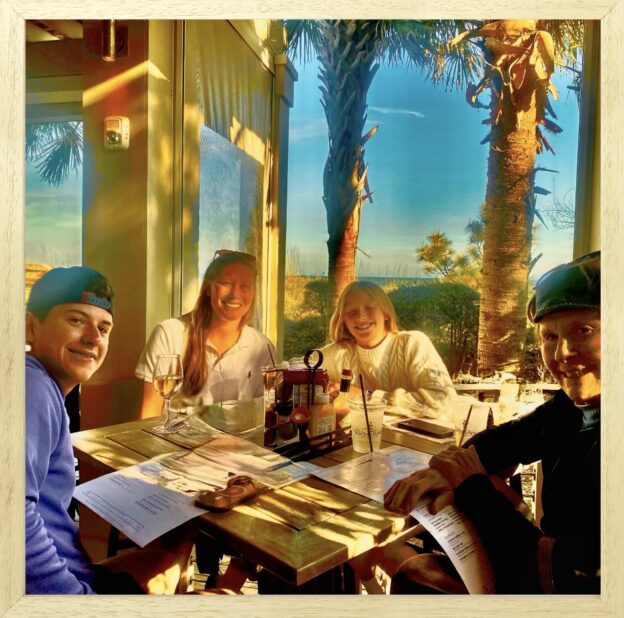
It was early evening, and the sun was beginning to dip below the horizon, casting warm hues of orange and pink across the sky. The sea breeze, carrying the scent of salt and sand, swirled around the Sea Pines Beach Club as Aris, Caroline, and Alexandra, all from up north, settled around a large table, their faces glowing from the soft light of the setting sun. The sound of the ocean’s gentle waves echoed in the background, adding a calming rhythm to their dinner.

Carol Telling, their beloved grandmother, was seated at the head of the table, catching the last rays of the sun. She had always been a woman who found peace in the quiet beauty of the South Carolina coast. “I’m so glad you’re all here,” she said, her voice as warm as the evening air. “This place is like a second home to me.”

Aris, the 16-year-old, was full of energy, recounting the bicycle ride they’d taken earlier that day. “We saw so many palmetto ferns along the pathways,” he said, his voice tinged with excitement. “The whole area is like a jungle, but without the bugs!” He grinned, his youthful enthusiasm infectious.

Caroline, the 29-year-old, chuckled softly. “It was a perfect day for a ride,” she said. “The pathways here really are something else. So different from the city streets in Illinois.”

Alexandra, at 12, had a quiet but thoughtful demeanor, and she added, “I loved the feeling of the air as we rode. It felt like the world was just… open.” She smiled, her gaze drifting toward the ocean. The golden light seemed to pull her thoughts toward something peaceful, something eternal.

As they dug into their dinner, a blend of fresh seafood and southern specialties, Carole shared stories of her younger years living in the area, painting pictures of old friends and memories of simpler times. The children listened intently, fascinated by her tales of days gone by. They laughed as she told stories of her adventures in Sea Pines before it had grown into the popular destination it was now, and of the quiet mornings spent walking along the beach.

The dinner carried on with easy conversation, the sea breeze cool against their skin. The food was as delightful as the company, and soon the children were talking about plans for tomorrow’s adventure. Aris wanted to try kayaking, while Caroline and Alexandra were eager to explore the nearby nature trails. Carole, always a lover of the outdoors, promised to take them wherever they wanted to go.

As night fell and the stars began to twinkle above the Atlantic, the family sat back, content and full. The bond between grandmother and grandchildren was palpable, their hearts tied together by shared memories and a love for this special place by the sea. The evening ended with quiet chatter and laughter, the ocean continuing its endless lullaby as the world around them slipped into night.

It was a day they would all remember—a day of simple joys and quiet adventures. And for Carol, it was a gift to have her grandchildren beside her once more, the young ones bringing new energy to a place that had always felt like home.