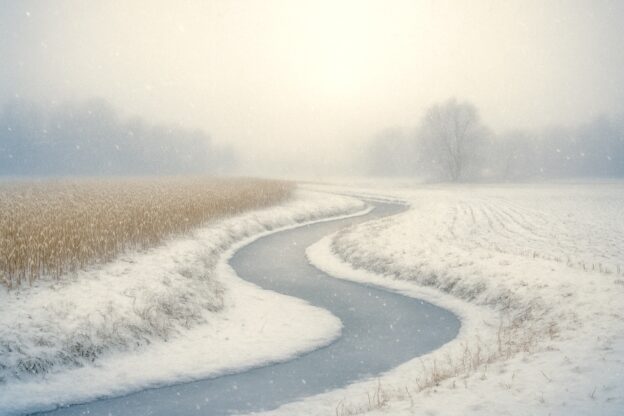
Oh, the weather outside is frightful,
But the fire is so delightful,
And since we’ve no place to go,
Let it snow, let it snow, let it snow!
Let It Snow
Lyrics by Sammy Cahn, music by Jule Styne
Based upon what I’ve heard this morning in a local telephone conversation and what I’ve subsequently read in an email from across the province, everyone is staying cozy inside today – including I suspect Fiona’s and Paul’s cat Raffi (seen here exemplifying the posture on a less wintry day).
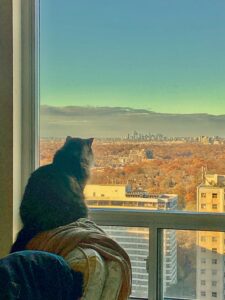
Whether on this snowy day we shall be capable of devoting ourselves with similar unqualified focus as Raffi is questionable. Her Ladyship Fiona has already alluded to the inherent British inclination she suffers to occupy herself – no doubt as well a lingering disposition from her days as an entrepreneur. For many people retirement is the signal of confinement; for others, a release. My own devolution is fortuitously compensated by instinctive submission to the moment. Curiously I have by contrast always suffered the inability – other than in a vague or trifling manner – to dwell upon either the past or the future. I will though acknowledge my conviction to amplify the present – either by movement (historically bicycling, tricycling and swimming) or expression (historically music, writing and photography). But is this historic agenda sufficient to withstand or tolerate an idle regard of the present?
Louis de la Chesnaye Audette QC OC, when asked if he had one thing to recommend, replied unhesitatingly, “Read, read and read!” This morning – by way of acknowledgement of the injunction – I extended my petty personal imperatives by reading more of Plutarch’s Moralia. Amusingly the subject was Talkativeness. It embraced not only prolixity but also drunkenness and other “diseases of the soul” such as love of money, love of glory or love of pleasure. Plutarch disparaged the fellow who is “always at you, plucking hold of your clothes and chin, or giving you a dig in the ribs with his elbow”. It made for heavy reading, at times perilously close to the bone. Nonetheless the derivative was fruitful. Plutarch’s insights are both revealing and stimulating – “for we overcome the passions (the itch for talking and prating) by judgement and practice”.
For no one is wont to shun, and eradicate from his soul, what he does not dislike. And we dislike the passions only when we discern by reason the harm and shame that results to us by indulging them. As we see every day in the case of talkative people: if they wish to be loved, they are hated; if they desire to please, they bore; when they think they are admired, they are really laughed at; they spend, and get no gain from so doing; they injure their friends, benefit their enemies, and ruin themselves. So that the first cure and remedy of this disorder will be to reckon up the shame and trouble that results from it.
Excerpt From
Plutarch “Plutarch’s Morals”
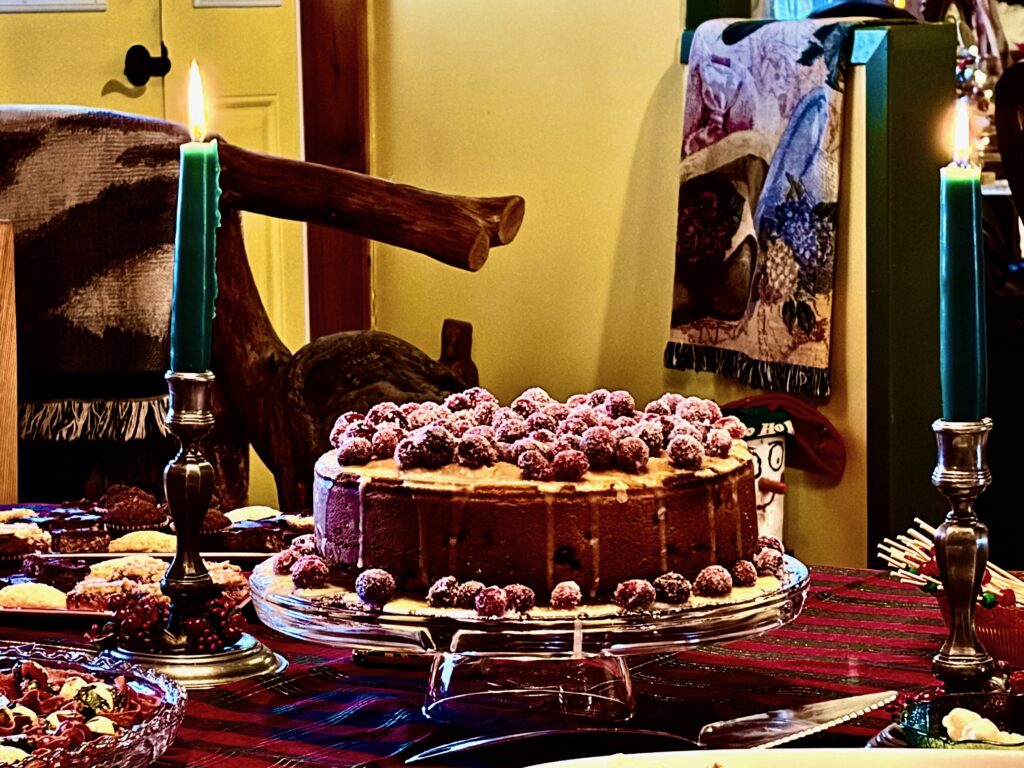
Having thus expiated any guilt attached to the pursuit of my narrow private ambitions, I have accordingly returned to a whimsical regard of the blurry white fields. A career of commercial activity affords its measure of reward. Yet I view the entitlement to retirement as another model of behaviour, not as a platform for descent to the grave. To credit that entitlement is to require its own alternate compliance. Years ago, when I was a freshman at Glendon Hall full of P&V, I heard it said by a senior colleague, “Doing nothing is the hardest thing to do!” And while I haven’t the understanding or desire to undertake that novel enterprise, I appreciate the occasional limitation of what I once identified as the benefits of rigour and application. Permit me to share the expansion of that assertion by attaching a photograph of a dessert lately prepared for another wintry gathering by a dear neighbour. This reflection of zeal perfectly captures the mystique of the season and is a veneration of the Canadian winter.