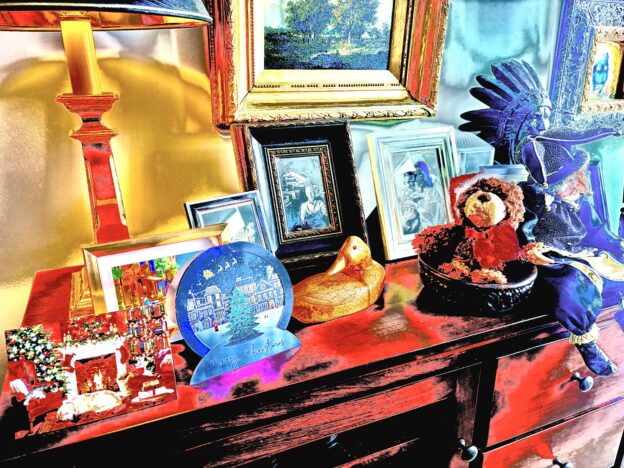
Children are the centre of Christmas. I say this reluctantly as a septuagenarian because to this day I suffer what is the unbecoming nostalgia and tradition of the holiday season. Lately – that is, within the past decade since retirement – I have managed to trim the vulgar scope of Christmas from mid-November to December 25th. Before that Thanksgiving interferes; after that it’s all about the New Year. This year (in our family Christmas card) I mistakenly presumed to welcome the Winter Solstice prior to its precise astronomic alignment with December 21st (though I did mollify the indignity by advancing that the term “advent” derives from the Latin ad– ‘to’ + venire ‘come’ which I felt afforded breadth). You can tell that in my seventh decade I have trouble limiting the festive impress of the holiday season. Readily I recall that my sister Linda and I routinely rehearsed our Christmas pageant in July. The animation of the cause is formidable – gemstone colours, blazing desserts, roaring fireplaces, sparkling pinetree and – perhaps the most important – boundless dreams and fantasies.
My sister Linda has always been more reserved (and more prudent) than I. It was our custom on Christmas morning – after I had descended the stairs from my bedroom to the drawing room to investigate the transition of the Christmas tree overnight (that is, to ensure that Santa had come and deposited his trove thereunder) – that I would tiptoe into her bedroom and with evident lack of restraint gleefully whisper, “Lindy, it’s Christmas!” That was the signal to don the requisite apparel of gown and slippers then gravitate to the scene of the action where we spent the next several hours selectively reviewing anything that wasn’t gift-wrapped and whatever was in our festal stockings hanging by the fire. This economic boundary was succeeded by the arrival of our parents, then breakfast (historically a monument of my mother’s culinary exhibitions) and finally a return to mass of treasures beneath the tree.
Looking back upon those irreligious days I recognize I have no longer the wish for anything material. As much as I take intellectual credit for the outcome, by accident or fortuity (whichever sounds least objectionable) I have merely exhausted my interest in stuff. Accessories, toys, machines – even works of art – no longer persuade me as they once did. Admittedly I like to remain au courant with the iPhone, and perhaps having a late model car is a strategic requisite (equivalent I might say to assuaging a worrisome health issue); but otherwise I am satisfied with the remnants of my profligacy (such as it is after record auctions of everything from real estate to pearl handled dessert spoons and Coburn and Masson originals). The plain truth is that, given the impending peril of death, nothing much matters (an obsession made more crucial weekly by news of friends no longer whinnying among us). Though that candid account may surpass the realm of wisdom or optimism, frankly I cannot say that anything especially entertains me now apart from what I possess (the preservation of which I translate to a successful modification of my erstwhile material urgencies). My Bulova pocket watch and chain being the most proximate illustration of accommodation and conservation.
Yet the seasonal celebration hinges by no accident to the ancient agricultural transitions commensurate with the change when the sun reaches its minimum declination. The historic symbiosis of falling temperatures and rising austerity commingle to furnish the unwitting merriment of the season, a prelude to the prolonged darkness and frigidity. It is a detraction that echoes our changing vernacular this year as we remove ourselves from the United States of America amid its unsettling mandates governed not by law but by unalloyed discretion, a submission to subalterns I am not comfortable digesting. I shall instead preserve my acquaintance with domestic bliss by reinvigorating the lost amplitude of the winter’s central theme for wishes come true.The tolerance of Christmas surrounded by white sand is not a debate for the pusillanimous.
Refined Version
May all your wishes come true.
Children sit at the heart of Christmas. I admit this a bit ruefully as a septuagenarian who still succumbs to the curious mix of nostalgia and ritual that December provokes. Only in the past decade—since retirement—have I managed to crop the season’s excess from its vulgar sprawl beginning in mid-November down to a tolerable span ending promptly on December 25th. Before that, Thanksgiving musses the schedule; afterward, the whole enterprise properly gives way to the New Year.
This year, in our family Christmas card, I had the temerity to welcome the Winter Solstice before its official astronomic moment on December 21st. I softened the trespass by noting that “advent” comes from ad (“to”) and venire (“come”), which granted a touch of lexical latitude. Still, the truth is plain: well into my seventh decade, I remain susceptible to the holiday’s gravitational pull.
My sister Linda and I were once so thoroughly enthralled that we routinely rehearsed our Christmas pageant in July. The season’s spark—the gemstone colours, the gaudy desserts, the roaring fireplace, the glittering tree, and the bottomless reservoir of dreams and fantasies—was impossible to resist.
Linda has always been the more reserved and measured of the two of us. It was our childhood custom that, after I crept downstairs on Christmas morning to verify that Santa had indeed worked his nocturnal magic, I would tiptoe into her room and whisper, with all the restraint of an espresso-fueled elf, “Lindy, it’s Christmas!” That was her cue to pull on gown and slippers and join me at the tree, where we spent the next hours examining whatever remained unwrapped and dutifully investigating the contents of our stockings. Only after our parents arrived and my mother’s traditional breakfast had been dispatched did we return to the greater trove beneath the tree.
Looking back on those cheerfully irreligious celebrations, I realize that I no longer want anything material. I’ve tried to take philosophical credit for this detachment, but if I am honest, it is more a product of fatigue than enlightenment. Things no longer entice me—gadgets, trinkets, toys, even artworks. I maintain a mild interest in the latest iPhone, and a modern car seems a sensible concession to life’s uncertainties, but beyond that I’m content with what remains after years of auctions, purges, and downsizing of everything from real estate to pearl-handled dessert spoons and Coburn and Masson originals.
One grows aware, as mortality makes its weekly introductions through the loss of friends, that possessions lose their flavour. What reprieve still matters lies in preservation, not acquisition. My Bulova pocket watch and chain are my current emblem of that shift—an object not new, but meaningful enough to keep.
And yet the season’s endurance isn’t accidental. Its cheer is wired into the ancient agricultural calendar, into the moment the sun reaches its lowest declination and the world braces for the long dark. The interplay of falling temperatures and rising austerity gave our ancestors cause for merriment, a brief festival before winter tightened its grip. There is a certain solace in remembering this older rhythm.
This year, that rhythm stands in contrast to our retreat from the United States, whose present climate—ruled not by law but by the whims of petty authority—has made us uneasy. Domestic contentment, by comparison, seems a blessing worth defending. And so I mean to revive the season’s central promise: that wishes might yet come true, even at winter’s nadir.
As for celebrating Christmas on white sand—well, that debate is best left to the timid, and I’ve never counted myself among them.