Le terme désaxé qualifie une personne qui a perdu son équilibre psychique, sa stabilité ou ses repères. Au sens propre, il se dit d’un mécanisme ou d’une pièce qui est sorti de son axe.
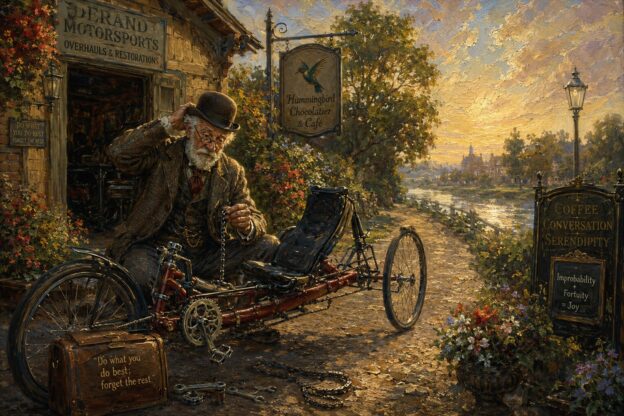
\Without notice the chain came off my tricycle today. Proof that serendipity is as much a product of improbability as fortuity. I was testing the trike. It was the first chance following its return from Derand Motorsports (where it was overhauled) that I had had the opportunity to ride it. I tried the brakes, felt the tires and switched the gears. Everything was fine until I shifted through all 7 gears. It derailed on the lowest gear which I seldom use in any event – and, yes, I should have let well enough alone in the first place. I crawl!
The obstacle – though trifling when admired from a purely clinical advantage – would however have to be addressed by someone other than me. Not only am I tarsomely unmechancial; my vertebrae would begin to crumble within minutes. I simply haven’t the spine to remain standing. Besides it was long ago that I learned the more functional reason not to mess with accounting, financial planning and everything else; viz., Do what you do best, forget the rest! Naturally I am perturbed by this unanticipated sequence but as a mollification I continued to remind myself that it was a relatively minor inconvenience.
I conveniently discharged myself of the crippled trike when I was but a short distance from its cage. Before concluding this regrettable chapter, I would have to ruminate upon these critical eventualities. For the moment however I had to attend a coffee klatch at nearby Hummingbird Chocoltier & Cafe. During that very agreeable reunion – followed coincidentally by a chance visit with a mutual acquaintance – I received from my partner news of the perfection of the battered tricycle. My spirits were instantly uplifted. Indeed so enthused was I that, instead of immediately driving home to check the trike, I succumbed to that native passion – a car wash. But I only drove to the nearest Petro-Canada outlet (which just happens to be where I always go) before eagerly turning homeward.
Once landed in the garage, I mounted the renovated trike. All was in order! But I could not withstand a mere jaunt in the subterranean garage. I opened the garage door then – engaging Pronto’s electric boost – vaulted into the open. Up the ramp! Onto the quiet neighbourhood roadways, passing along the river into the late afternoon sunshine. Positively euphoric! I continued seemingly effortlessly. I was employing my own and electric power as I wished, no regrets, no diminished detail.