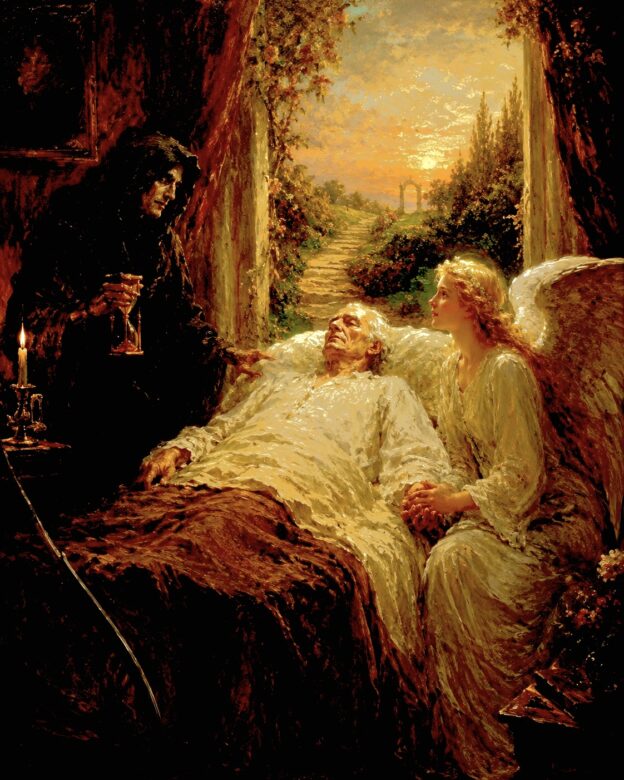
Death, howsoever elegantly portrayed, is I believe more worrisome than most care to admit. The religious pacification of death is – to my philosophic training – no more persuasive than two fingers of whiskey; that is, helpful but not necessarily determinative or lingering. My greatest despair is disconnecting from my loved ones, those to whom I owe so much. It is an unaccountable privilege.
Mortal coil is a poetic term for the troubles of daily life and the strife and suffering of the world. It is used in the sense of a burden either to be carried or to be abandoned. To “shuffle off this mortal coil” is to die, exemplified in the “To be, or not to be” soliloquy in Shakespeare’s Hamlet.
The Catch: Ultimately, he concludes that people choose to endure the miseries of life only because they are terrified of the unknown that comes after death.
There are in my opinion two different though analogous extremes apart from life and death; namely, youth and old age. The distinction captures life’s buoyancy and its ultimate evolution. Everything we know about ourselves and every other living creature is characterized by propagation, flourishing then demise. This covers the breadth of growth and decline. Thinking about the dreadful subject death is partly cushioned by the natural sequence of events. There is a moderate confession of propriety if death and old age align. An early demise – while not irrational – is carriage along a unique and formidable pathway. Metaphors and poetry are seldom a sufficient reply.
For my part, I have long ago acknowledged that life owes me nothing. Now as I approach my eighth decade I willingly allow that life has been rich and fulfilling; and, while I won’t pretend to hurry the conclusion of this earthbound marvel called life, nor am I about to squirm as the clock progressively winds down. Resistance is futile in any event. This is not to suggest one should hurry the progression. On the contrary it is both psychologically and practically expedient to seek to embrace the depth of life and all that it offers. We have technically no proof of the anticipated end of life. A lark sailing in the sky preserves unrestrained its height and song.
To be, or not to be, that is the question:
Whether ’tis nobler in the mind to suffer
The slings and arrows of outrageous fortune,
Or to take arms against a sea of troubles
And by opposing end them.
To die—to sleep,
No more; and by a sleep to say we end
The heart-ache and the thousand natural shocks
That flesh is heir to: ’tis a consummation
Devoutly to be wish’d.
To die, to sleep;
To sleep, perchance to dream—ay, there’s the rub:
For in that sleep of death what dreams may come,
When we have shuffled off this mortal coil,
Must give us pause—there’s the respect
That makes calamity of so long life.
For who would bear the whips and scorns of time,
Th’oppressor’s wrong, the proud man’s contumely,
The pangs of dispriz’d love, the law’s delay,
The insolence of office, and the spurns
That patient merit of th’unworthy takes,
When he himself might his quietus make
With a bare bodkin? Who would fardels bear,
To grunt and sweat under a weary life,
But that the dread of something after death,
The undiscovere’d country, from whose bourn
No traveller returns, puzzles the will,
And makes us rather bear those ills we have
Than fly to others that we know not of?
Thus conscience doth make cowards of us all,
And thus the native hue of resolution
Is sicklied o’er with the pale cast of thought,
And enterprises of great pith and moment
With this regard their currents turn awry
And lose the name of action.