The regularly cited aside that history repeats itself is exemplified in different ways many of which are often highly uncomplimentary. Yet even when the record is seemingly improving and forward looking there is an underlying current of repetition which by that character alone contaminates the overall regard. In a word, as significant as was the original dereliction and the resulting fulfillment, nothing has changed. The clock is just rewound and everything starts over again. The abstraction is an especially shocking admission from the astronomic perspective of time; that is, when looking back some 300 years. Granted, humanity and its animal nature are never completely disassociated. Yet the adhesion points to a far stronger alliance, one that historically is recalcitrant and implacable. We seemingly haven’t learned to distinguish ourselves from a fighting mob intent upon domination and control. It represents a curious entanglement with leadership of the pride as though uniformity and potency were the answers.
Increasingly – with the expansion of the global population and the frequency of our collision one with another – the erstwhile objective of sovereignty has become preposterous. Yet we’re a long way from affording one another the privilege of singularity.
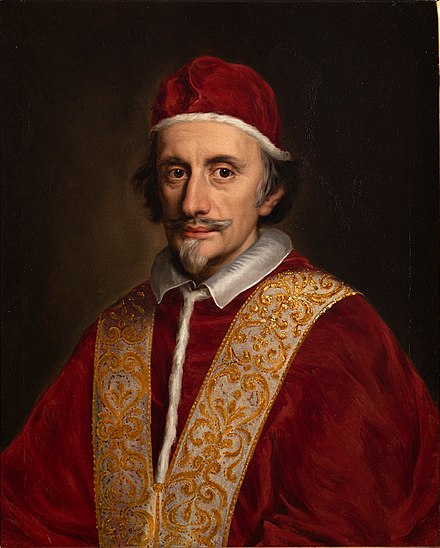
Pope Innocent XI (Latin: Innocentius XI; Italian: Innocenzo XI; 16 May 1611 – 12 August 1689), born Benedetto Odescalchi, was head of the Catholic Church and ruler of the Papal States from 21 September 1676 to his death on August 12, 1689.
Political and religious tensions with Louis XIV of France were a constant preoccupation for Innocent XI. Within the Papal States, he lowered taxes, produced a surplus in the papal budget and repudiated nepotism within the Church. Innocent XI was frugal in his governance of the Papal States, his methods evident in matters ranging from his manner of dress to a wide range of standards of personal behavior consistent with his conception of Christian values. Once he was elected to the papacy, he applied himself to moral and administrative reform of the Roman Curia. He abolished sinecures and pushed for greater simplicity in preaching as well as greater reverence in worship, requesting this of both the clergy and faithful. In consideration of his diplomatic and financial support for efforts to free Hungary from Turkish domination, he is still widely referred to in the country as the “Saviour of Hungary”.
After a difficult cause for canonization, starting in 1791, which caused considerable controversy over the years and which was stopped on several occasions, he was beatified in 1956 by Pope Pius XII
As one entitled to the dubious acclamation of having had a line of credit with every chartered bank of Canada I am the last person to calumniate the lending of money. Even if the deprivation were once healthful, forgive me for asking the question precedent; namely, Says who? If, as appears to be the case, the parsimony is spirited solely by some spiritual fabrication of inauthentic basis, I have little truck with such twisted logic. And notice if you will the former ecclesiastic mantra has long ago dissolved – though not without shrouding others for eternity with unmerited excoriation.
Jewish relations
Innocent XI showed a degree of sensitivity in his dealings with the Jews within the Italian states. He compelled the city of Venice to release the Jewish prisoners taken by Francesco Morosini in 1685. He also discouraged compulsory baptisms which accordingly became less frequent under his pontificate, but he could not abolish the old practice altogether.
More controversially on 30 October 1682 he issued an edict by which all the money-lending activities carried out by the Roman Jews were to cease. Such a move would incidentally have financially benefitted his own brothers who played a dominant role in European money-lending. However, ultimately convinced that such a measure would cause much misery in destroying livelihoods, the enforcement of the edict was twice delayed.
The spiritual flapping of hands and ritual burning of incense proclaims yet another trespass upon reality.
God commanded Moses to make an Altar of Incense for worship in the Tabernacle: You shall make an altar to burn incense upon; of acacia wood shall you make it . . . And Aaron shall burn fragrant incense on it; every morning when he dresses the lamps he shall burn it, and when Aaron sets up the lamps in the evening, he shall burn it, a perpetual incense before the Lord throughout your generations. (Exodus 30:1-10)
Abortion
Innocent XI issued the papal bull Sanctissimus Dominus in 1679 to condemn 65 propositions that favored a liberal approach to doctrine which included two that related to abortion. He first condemned proposition 34 and countered that it was unlawful to procure abortion. He also condemned proposition 35, which stated: “It seems probable that the fetus (as long as it is in the uterus) lacks a rational soul and begins first to have one when it is born; and consequently it must be said that no abortion is a homicide.”
It hardly seems right by any account to enforce upon others one’s personal convictions howsoever generated. Our leadership is perhaps sadly derived from the identical barrel. If there were anything universal said about world leadership it is sadly derogatory. The slap generally highlights self-interest and mercenary behaviour. Nor does it appear to matter whether the accused is a priest or a legislator; and, historically both attract the defensive approbation of their peers (whether by action or inaction).
It is absurd to imagine that any one person controls the reins of government. While it is foreseeable that some candidates are ill-suited to governance, I see no reason we should submit to those who make inadequate choices. It is to my mind equally predictable that no decision will be acceptable to everyone. Assuming an argument arises we must be guided not so much by what we should do as by what we should not do. The most extreme example is that we must never accept war as a solution. Even if we acknowledge the inevitability of disagreement we must at least agree that the overriding imperative is the well-being of others not just ourselves. I say that not out of any passion for beneficence but purely as an acceptance of what goes around comes around. Until we remove ourselves from entitlement by virtue of gender, race, culture, sexuality or religion, we’ve got to recognize that we have no such entitlement; and that instead we must devote ourselves to a broader narrative.
And if you don’t think that will work, then I ask you, “So how’s it going?”