Following is an article I published December 16, 2011 in my hometown’s local newspaper The Millstone at a time when I was still practicing law.

Following is an article I published December 16, 2011 in my hometown’s local newspaper The Millstone at a time when I was still practicing law.

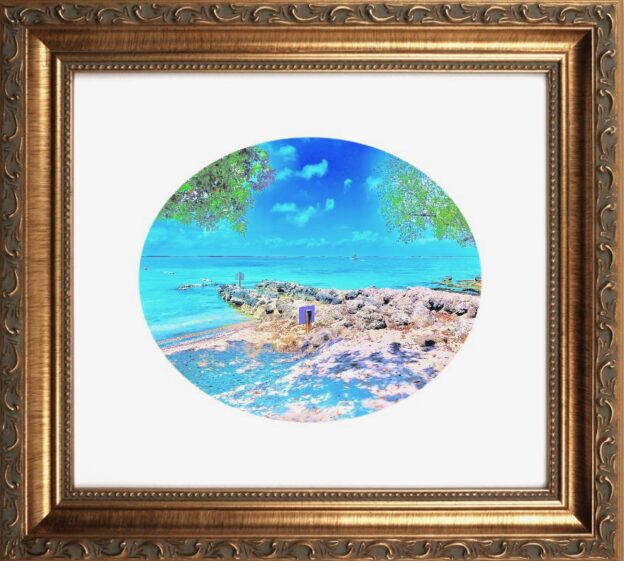
Curiously I find awakening on Key Largo each morning to an agenda of unsurpassed leisure to be moderately unraveling. The predictable insouciance of each day is nonpareil. And after my customary sustaining breakfast of fresh fruit and sprouted bread I routinely punctuate the equanimity with a purifying 4Km tricycle ride about the neighbourhood of Buttonwood Bay. For that athletic endurance I reward myself by prolonging upon a chaise longue at one of the three pools. Instantly that I am so situated I inevitably succumb to the radiant heat of the blazing sun amid the azure dome encircled by the silvery palm trees and swaying green fronds. This in turn subsequently motivates me to seek the blissful cool of the pool waters where my torpidity exalts. Thereafter I am completely absorbed in the subtropical atmosphere of balmy sea air.

The measure of today’s radiant heat, though notably invidious, was nonetheless obscured by the ambient temperature. When approaching 85ºF the task of discerning the proximate cause of solar contamination is less assured to be precise. Yet through the cloud of electrification there persists an inarguable sensation which predicts a more elemental springboard. Nature’s warning signals are not to be ignored or uncertified. Those visceral instincts we’ve been allotted exist for a reason; and they are remarkably trustworthy.

I cannot conceive — and I doubt even writers more serious than me (sic) could conceive — of putting pen to paper except in hope of readers. You might as well expect a plumber to plumb without anyone to plumb for.
The Sunday Times, Tuesday, April 4, 2023
by Matthew Parris (who) joined The Times in 1988. He worked previously at the Foreign Office, as Margaret Thatcher’s correspondence clerk, and as Conservative MP for West Derbyshire. He was the paper’s parliamentary sketch writer for 13 years and he now writes a diary column on Wednesdays and an opinion column on Saturdays. In 2015 he won the British Press Award for columnist of the year. Matthew is also a regular columnist for The Spectator and presents the biographical program Great Lives on BBC Radio 4. He has written a number of books, including Chance Witness: An Outsider’s Life in Politics, his autobiography, which won the Orwell prize in 2002.

Dower: from Medieval Latin dotarium, from Latin dotare “to endow, portion,” from dos (genitive dotis), from PIE *do-ti, from root *do- “to give”, *dō-, Proto-Indo-European root meaning “to give.”
It is the hypothetical source of/evidence for its existence is provided by: Sanskrit dadati “gives,” danam “offering, present;” Old Persian dadatuv “let him give;” Greek didomi, didonai, “to give, offer,” dōron “gift;” Latin dare “to give, grant, offer,” donum “gift;” Armenian tam “to give;” Old Church Slavonic dati “give,” dani “tribute;” Lithuanian duoti “to give,” duonis“gift;” Old Irish dan “gift, endowment, talent,” Welsh dawn “gift.”

As I removed and deleted the TeamReach App from my iPhone earlier this morning I contemplated the particulars of the gregarious personality and related communal distinctions. It astonished me to learn that in the wild, trees are usually gregarious plants; and, that wasps and bees are considered gregarious insects because the parent guards its larvae from threatening parasites (hence wasps are perhaps more accurately described as contiguous than gregarious).

There are three swimming pools at Buttonwood Bay. Each of them is within walking distance of one another and nearby each of the residents (though obviously of varying proximity). The pool closest to us for example is less than 100 yards away. The others; namely, the Central pool by the front gate and the Island pool are nearby and easily accessible by me on my tricycle.
Only this morning when saying goodbye to a couple leaving Buttonwood Bay for the season I was reminded of a quip I heard years ago in a Monty Python movie called the Something or Other in which the Laird of the Manor was seen at his desk, shouting “Who are those people I really hate?” Behind him (and unknown to him) approached Her Ladyship (in whose company was a handsome young priest recently admitted to the household). In the next scene, His Lordship (still seated at his desk) is overheard once again shouting, “How do you spell disembowelled?” When Her Ladyship approached (once again), she asked what he was doing, to which His Lordship replied, “I’m writing a letter to The Times!”

Abeyance (from the Old French abeance meaning “gaping”) is a state of expectancy in respect of property, titles or office, when the right to them is not vested in any one person, but awaits the appearance or determination of the true owner. In law, the term abeyance can be applied only to such future estates as have not yet vested or possibly may not vest. For example, an estate is granted to A for life, with remainder to the heir of B. Following A’s death, if B is still alive, the remainder is in abeyance, for B has no heirs until B’s death.

The phrase pathetic fallacy is a literary term for the attribution of human emotion and conduct to things found in nature that are not human. It is a kind of personification that occurs in poetic descriptions, when, for example, clouds seem sullen, when leaves dance, or when rocks seem indifferent. The British cultural critic John Ruskin coined the term in the third volume of his work Modern Painters (1856).