”Is life worth so much?” or “Is it worth living?”, Michel Eyquem de Montaigne (28 February 1533 – 13 September 1592) widely regarded as the originator of the modern essay. He prominently featured and meditated on this exact question in his magnum opus, Essays (Book III, Chapter 13: On Experience”). In fact however this poignant existential inquiry comes from the Roman poet Maximianus (Elegies, I, 155).
In his writings, Montaigne explores how humans often suspend their enjoyment of the present moment and ruin the actual experience of living just to “ensure they stay alive”. He uses the question to challenge rigid habits, the fear of death, and the societal pressures that force us to compromise our peace of mind merely to extend our days.
The quote critiques a world where we spend our limited, precious life points working so hard to stay alive that we forget how to live. These societal pressures include the belief that your human worth equals your productivity; the social conditioning that links happiness to wealth and possessions; and, the systemic pressure to compete constantly with peers.
Ultimately, Montaigne suggests that life is best experienced when we embrace its natural form rather than complicating it with unnecessary strain or the constant anxiety of its end. Montaigne used it to question whether the frailties, pains, and indignities of old age and sickness are truly worth the continuation of life. It is a timeless philosophical question about the value of existence when faced with suffering, fatigue, or uncertainty.
Having a favourable outlook, while unquestionably politically correct, is not always simply a matter of disposition. Pain – whatever its origin – is seldom hugely tolerable. No doubt part of the scheme to defeat suffering and uncertainty is the celebration of age and time in its characteristic manners of birthdays, anniversaries and formerly victory on the battle field. Whatever the triumph, they are a reminder of the sometimes indistinguishable allure of the day. Succeeding to an elevation of mind or body is not though assured. Paradoxically often the greatest obstruction to this generous regard of existence is merely the contamination of what might otherwise suffice as prosperity and fortuity. Limiting our experience to day by day occurrences – even hour by hour – is ultimately Montaigne’s secret.
A modern retreat may be, “Sit back and enjoy!” Submitting to this enviable obligation is – as I am certain, dear Reader, you may already know – not easily managed. Even feathery birds permit themselves occasionally to conjoin with dispute and alteration. Nature’s uniformity is inarguable. Yet, apart from those momentary lapses of enjoyment, it borders on axiomatic to conclude that division of any nature is passé. No amount of lingering dispute or quarrel will obliterate what has already transpired. Hence, the alternative innuendo within the postulates and assumptions of the ancients.
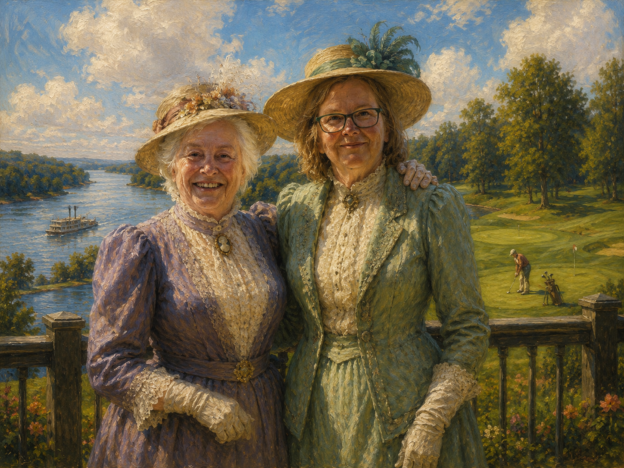
This morning at the golf club we foregathered with my erstwhile legal assistant to recognize her further advancement into the 8th decade. By any standard the achievement is not to be denied. Serendipitously the event marks the 50th year of my domicile in the Town of Almonte; also, what would have been the 100th birthday of my mother. I suspect there are other opportunities for imagination and coincidence, hitherto hidden measures of unity, confluence and influence. The manifestations are unfathomable – eventualities which I rightly assume to be unanticipated and magical.
Strengthening this profitable view of existence is the unparalleled conduct of those involved. One mustn’t overlook the obvious. A casual regard of the parties involved in today’s modest congregation at the golf club discloses the very worthiness of humanity. Meanwhile, afterwards following mundane outings to the grocery store, to the coffee shop and routine circulations upon my tricycle and my motor vehicle (my daily prescription for accomplishment), we are blessed with an unsurpassable summer afternoon, rowers on the river, rich blue sky and thick white fluffy clouds on the horizon, the fields of mounting greenery.