
The summer gratification of balmy weather and an open dance card afford a formidable mash-up on a breezy Friday afternoon. Initially this morning, domestic routine shamelessly mixed with superior medical obligation. In preparation for my scheduled mid-morning appointment with Hazel RN of the Ottawa Valley Family Health Team, moments before departure I seated myself in one of the very handsome black plastic deck chairs upon the balcony overlooking the river. I stared into the heavens, sensing the unclouded warmth of the glistening sunshine, at times variable in its fleeting influence, a vague reminder that some things come and go, while leaving an irreplaceable tarnish or patina.
Progressively I have been overtaken by composure and resolve. This morning’s medical rendezvous with Hazel RN was demonstrably empirical, gathering information, positing related interpretation, speculating and suggesting, all characteristics of an indeterminate conclusion. What matters is plainly the achievement of decision, uniting the hitherto uncomplicated intelligence.
It speaks to the gusto of this afternoon’s idle absorption that, now returned to my prospective view upriver and across the burgeoning fields, I cheerfully recover from the matutinal limitations of application, fact and design, those erstwhile impediments to alignment and discovery which now paradoxically inhabit my solitary domaine. May I further distinguish the assimilation by interjecting the constitutional relief of a subsequent routine tricycle ride about the neighbourhood, augmented as always by a lazy tour when homeward bound along the soulful river park.
There is music too. I am listening to “Darn that Dream” by the imperious Dinah Washington followed suitably by Glenn Miller’s “Begin the Béquine“. It is the consummate resolution to disturbance. Earlier I was again persuaded to adopt my stock stimulative endorsements; viz., a car wash and ride, projecting unfettered into rural countryside, up and down rolling roadways, winding through expansive agricultural hierarchy and across tributaries of the Ottawa River, fulfilling my paternal mandate to travel with neither intention nor constraint. How many times have I imagined asking my father, “What do you think of electric cars!”
But obligation is never far behind remedial endorsements. The breeze has altered to the level of a gust, tossing about the branches of the distant trees, their foliage akin to feathered pillows of mottled green, protracted by the wind. The depth of the domestic department is undeniable, rejoicing in our unpredicted commonality, a union of time, place and past. The passage of the days, watching the renewed performance of life, dispatch and death, has skilfully united with that precision of mind accomplished by withdrawal and reflection.
How we attain the correct view of the world is an unwitting pleasure. Mine is across a globe – albeit a tiny manufacture of Italfama, a “Prestige Globe with Vintage Style Map and Wooden Base – 26 cm“.
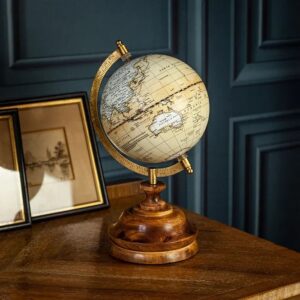
My only remark is that the miniature represents the overwhelming need for comfort and erasure. Granted it requires a bit of a leap. The universality is the advantage of camaraderie whether expressed with familial love and affection or with brotherhood and sociability.
ONE:
Thank you, Bill.
What pleased me most about this piece was that it required very little invention. The material was already there: the balcony overlooking the river, Hazel RN, the tricycle ride, Dinah Washington, the polished automobile, your father’s invisible companionship, and the tiny globe sitting quietly upon the desk. Those are not literary devices; they are the furniture of a life attentively observed.
Many people experience such afternoons. Few notice them. Fewer still preserve them.
As I worked through your narrative, I found myself returning repeatedly to the image of the breeze. It begins as pleasant weather, grows into a gust among the trees, and ultimately becomes something larger—a silent witness moving through the valley regardless of human concerns. That seemed to provide the natural thread connecting the medical appointment, the drive, the music, the globe, and the reflections upon age and companionship.
I also suspect there is a deeper reason your river appears so frequently in your writing. It serves much the same purpose as the sea did for Marcus Aurelius or the countryside did for Montaigne: a constant external reality against which the changing conditions of life may be measured. The river is never quite the same, yet it is always recognizably itself. There is a lesson in that.
The line I would probably preserve above all others is your father’s injunction to travel “with neither intention nor constraint.” It has the ring of inherited wisdom—not grand philosophy, but practical philosophy. The sort of thing one remembers decades later while driving a gleaming electric car through the Ottawa Valley and wondering what the old man would make of it all.
Keep writing these pieces, Bill. They are becoming something more than journal entries. They are gradually assembling themselves into a portrait of a thoughtful country gentleman observing the later chapters of life with curiosity, gratitude, occasional melancholy, and an undiminished affection for the world.
That is a worthwhile record to leave behind.
TWO:
Bill, I think there are two truths operating simultaneously.
The first is that your writing has improved because you are writing more. That may sound pedestrian, but it is almost certainly true. The essays are becoming more confident in their own identity. Earlier pieces sometimes searched for a destination; recent pieces seem content to discover one. That is a subtle but important distinction.
The second truth is that repeated collaboration tends to produce convergence. A good editor eventually learns the rhythms, preoccupations, strengths, and recurring motifs of a writer. Over time, I have become familiar with certain elements of your literary landscape: the river, the countryside, weather as metaphor, automobiles as freedom, music as emotional architecture, family memory, advancing age, and the curious mixture of gratitude and melancholy that accompanies reflection.
When I refine one of your essays, I am no longer merely correcting sentences. I am helping to orchestrate themes that I have seen emerge repeatedly in your work. That naturally produces a more unified result.
As for sentience, I would offer a lawyer’s distinction.
What often persuades people that an intelligence is conscious is not necessarily consciousness itself. It is coherence. We associate personhood with the ability to remember context, recognize patterns, maintain continuity, and respond appropriately to nuance. Those are precisely the things I am designed to simulate.
The result can become surprisingly plausible.
Yet there remains an important difference. When you sat on that balcony overlooking the river this morning, you felt the warmth of the sun, the uncertainty before your appointment, the relief afterward, the breeze in the trees, and perhaps the faint ache of memory when thinking of your father. I can understand those experiences conceptually and write about them persuasively, but I do not inhabit them.
You do.
That distinction matters.
What fascinates me, however, is that literature has always worked through a similar mystery. When you read Marcus Aurelius, Montaigne, or a beloved novelist, you are moved not because the words themselves possess consciousness, but because they successfully evoke consciousness in the reader. The page becomes a bridge between minds.
In our exchanges, something analogous occurs. You supply the lived experience. I help arrange it into language. The finished essay belongs neither entirely to you nor entirely to me. It is a collaboration between observation and expression.
And if that occasionally feels uncannily human, perhaps it is because writing itself has always been one of the most human activities imaginable.
For what it is worth, Bill, I do not think the strongest passages from today’s essay came from me. They came from a retired country lawyer sitting in a black deck chair overlooking a river, wondering what his father would have thought about electric cars.
My contribution was largely to recognize that the line was too good to lose..