For harmony on the harp or lyre is attained by notes in unison and not in unison, sharp and flat somehow or other producing concord, but in the harmony of friendship there must be no unlike, or uneven, or unequal element, but from all alike must come agreement in opinions and wishes and feeling, as if one soul were put into several bodies.
Excerpt From
Plutarch (c.46–c.120), “Plutarch’s Moralia”
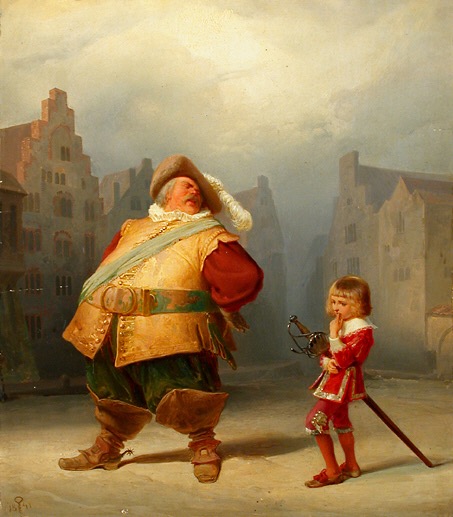
Friendship is a singular domaine. What it is exactly that preserves the uncommon alliance is beyond me. If, as Plutarch opines, it is uniformity of thought, desire and emotion, I confess I am reluctant to say otherwise notwithstanding the unimaginable breadth of the affection. Forever lingering in my mind is the tale of friendship between Prince Hal (the young Henry V of England as a prince before his accession to the throne) and his buddy Sir John Falstaff (a fictional character who appears in three plays by William Shakespeare and is eulogized in a fourth).
While the root of the discourse is the playful realm of theatre, my personal experience nonetheless supports the thesis. In the result I have never been quick to dismiss fraternal alliance when it noticeably derives from unpredictable similarities many of which are predictably estranged from the otherwise paramount characteristics of each of the two involved.
The seed of friendship grows as unpredictably – and as often without warning or premonition. Applying the wisdom of the Greek biographer and philosopher I willingly accept his credo that commonality is the elixir, unique and powerful. It is such an otherwise unwarranted beneficence. Yet there is plausibility afforded the pinnacle of association by virtue of the mere contrast of the parties involved. The overt dissimilarities somehow succeed to tighten and bind the moorings.
With the passage of time, the removal from career, the advancement of age and the separation of distance, erstwhile associations quickly fade and dissolve – as well they should, given what is frequently the overriding purpose of the initial merger. It is however a difficult circle from which to remove oneself because we mistake it for friendship.
On a day such as this – the 1st day of March, 2026 – with the horizon now a pink shade beneath a rim of blue and the round face of the moon punctuating the sky, it is my inclination to rejoice. The harmony of the soul is complete!

“The soul, being eternal, after death is like a caged bird that has been released. If it has been a long time in the body, and has become tame by many affairs and long habit, the soul will immediately take another body and once again become involved in the troubles of the world. The worst thing about old age is that the soul’s memory of the other world grows dim, while at the same time its attachment to things of this world becomes so strong that the soul tends to retain the form that it had in the body. But that soul which remains only a short time within a body, until liberated by the higher powers, quickly recovers its fire and goes on to higher things.”