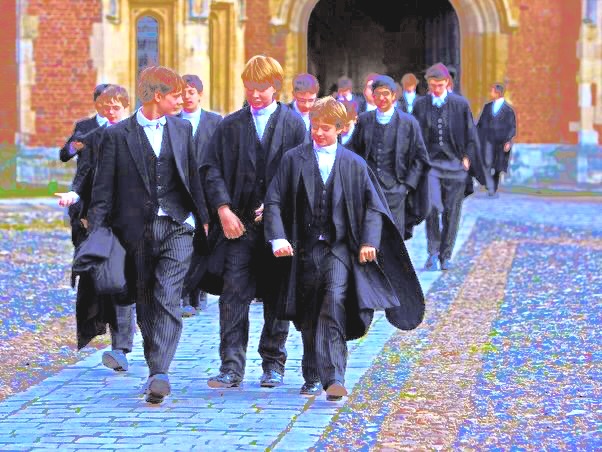
I can’t recall who introduced me to the adage, “Manners maketh the man” but I have never abandoned the proposition as sterile. Indeed I prefer instead to regard it as a catch-all that preserves an otherwise difficult situation from submersion. In that respect the maxim is far more than purely social; it is transactional.
What however I do remember very clearly is the suavity of the people whom I met who distinguished themselves by alliance to the apothegm. As you might well imagine, the legendary images date back to my youthful days when the mind is a developing spirit susceptible to influence and persuasion. Surprisingly the predominantly favourable treatment was exemplified not by parents (such as Dr. Frank Glassow) or Masters (such as James Carmen Mainprize); rather it was my housemate down the hall, Alexander Dougall, who was in fact in a junior Form to my own and likely younger as well. I suppose upon reflection it makes sense that the most immediate affect would come from those closest in time and space.
While Alexander and I never had a great deal to do with one another, his exemplary manner was always singular, indisputable and captivating. I play the piano by ear; by which I mean to imply that the sound of his voice may also have had something to do with it. Alexander is from Jamaica and he has that soothing West Indies resonance to his voice, strengthened by the legitimacy of an underlying British accent. And he has a ready laugh which no doubt further supplemented his already intoxicating tonality. But without a doubt the overriding element of his communication was its recognizable politeness. His was never a superfluous conversation; but it was invariably punctuated by digestitble civility.
Just to prevent Alexander from getting a fat head (should he by chance become acquainted with this vastly delayed approbation), I would unhesitatingly compliment the entire entourage from Jamaica with similar remarks. The breeding was common throughout those whom I had the pleasure to meet when invited to visit Jamaica at any early age. Naturally one is instinctively inclined to attribute the superiority to polish and refinement or conditioned urbanity. But it is far more than protocol and etiquette.
Now characterizing myself as a country lawyer (upon whom I have no doubt many city lawyers look askance with their noses well in the air) I have long ago learned that the discriminating civility of others is a reflection more of native intellect than pedigree or cultivation. This of course is not to suggest that the blue and white collared workers are not commingled both in and out of the country; but it highlights that presumptions of behaviour are unfounded. When once one has met a chap governed by manners, the experience is undeniable and memorable.
Misbehaviour is sometimes touted as an indication of strength, as though being objectionable is somehow a mark of dominance. Sadly the contaminated conduct, while seemingly tolerated by those who willingly step aside to allow the excrement to flow down the street, is a short-lived abuse and invariably one which is in the end self-incriminating. There is by contrast so much more by which to profit by observing the epigram.
Manners Maketh Man – William Horman, Headmaster of Eton School (circa 1440 and 1535)