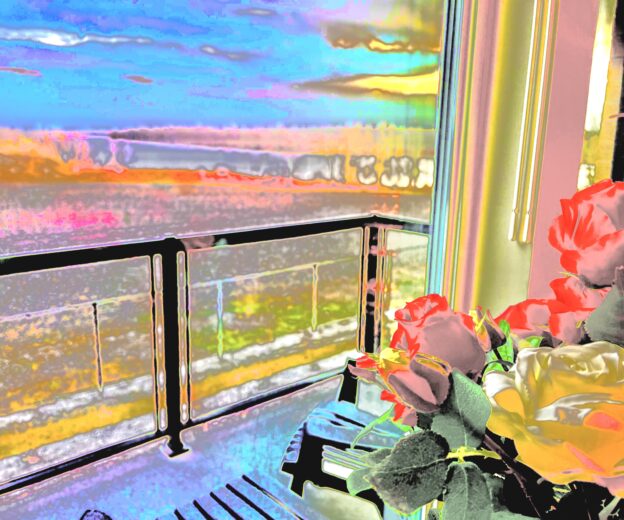
Today was a cool day in early December. Grey sunlight blurted from a murky orb low in the sky hidden in a wintry fog. By late afternoon the breath of indoor heat was welcome. I passed a woman in the lobby carrying a bag from which protruded a silvery bough heralding Christmas decoration. A delicate almost imperceptible snow had fallen and for the moment remains undisturbed, the first of the Artist’s gentle applications of which no doubt more shall follow. Recovering roost at my desk while overlooking a now mystified white field and frowzy grey river, accompanied by a bowl of sliced green apple to the left and a tiny mug of chilled espresso to the right, I was fitted to address that inexorable question, “Now, where was I?”
My habits fortunately interrupt my indolence and recognizable lack of industry. This too is a small compliment for my habits range from little more than tricycling back and forth in the subterranean garage then going for my ritual ride in my beloved automobile to the city and back. But, in fairness, throughout the catalogue of Nothingness and Whatever that accompanies those “endeavours” (permit me at least the elevation of the word) I reflect, I cogitate, I even go so far as I did today to condone my recent priggish behaviour with one to whom I thankfully owe nothing beyond a nod of acknowledgment. Certainly outside the parameters of affection there are limits to the politic necessity at times to crawl.
Normally I seek cooperation at any price. Nonetheless I regard this otherwise less than profitable arrangement as a triumph because, for the moment at least, I haven’t any contrary remedial or apologetic authenticity to bestow upon the mantle of that particular interlude in my life. Giving oneself the privilege of condonation is for me an unusual act; but in this instance I intend to call upon the “Get Out of Jail Free” card called Old Age, from which I further derive the excuse of being both entitled and curmudgeonly. Certainly it is an arrogance. But it resonates, if you follow me. To do otherwise is for the moment anyway coloured with illegitimacy.
And speaking of the conjugation of young and old, often I have reflected too upon the wisdom of my late friend Louis de la Chesnaye Audette QC OC who, when once I asked if he had a word of advice for a young man, replied, “I have three: read, read and read!” He was a voracious reader. Whenever I had occasion to visit him at his stately home in Sandy Hill there was always a stack of books aside his drawing room lounge chair (on the other side of which I might add equally illustratively was a side table upon which invariably his steward had delivered a highball).
Conjugation (mathematics): the solution of a problem by transforming it into an equivalent problem of a different form, solving this, and then reversing the transformation.
Audette shared his choice of books with me; and while I confess to have found each of them enlarging, never have I been persuaded to abandon Thomas Babington Macaulay.
The History of England, which expressed his contention of the superiority of the Western European culture and of the inevitability of its sociopolitical progress, is a seminal example of Whig history commended for its prose style.
Perhaps to my discredit and noticeable limitation I regularly re-attend my review of The History of England, from the Accession of James II. It consists after all of 5 volumes, each 1,000 pages. I do so with the same vigour I once attached to the examination of the decisions of Lord Denning Master of the Rolls or my own composition of inter vivos trust agreements. Which is to say with conscience notice of restriction and opposition. There is an unmistakable strength to be derived from exactitude and leaps from the traditional conclusions. In spite of the openness of the common law or the rigour of the Code Civil (or any statutory or constitutional creation) each is readily corrupted by logic. Reasonableness is not unlike any other posture in life; that is, always open to debate.