We punctuated our start of packing things up in preparation for our upcoming departure from Hilton Head Island on the weekend by hosting our neighbour “Carolina of South Carolina” late morning. She was interested to take a gander at our cottage with a view to renting it in the future. She was familiar with our inexpressible approval of our estate agency. Carolina treated us to a plate of succulent homemade brownies, a generosity which illustrates her general mien of beneficence previously signalled by the gift of a judicious collection of greens in a glass jar formerly used to transport pickled beets. We spent a congenial hour-long tongue wag together, chatting about the real estate naturally, but aimlessly venturing into that unpredicted catalogue of shoreline banter characteristic of people such as we who so clearly enjoy profitless socializing. She did however remove herself to attend to the superior interests of her visiting 16 year old grandson who has recently qualified himself for a driver’s licence; and also her 12 year old granddaughter (a dedicated hockey player reputedly of singular purpose) who recently distinguished herself by an appearance on-ice with the Chicago Blackhawks.
As though by serendipity we afterwards received a telephone call from our friend Jay in Nova Scotia. I refer to the call as a happy chance because, in the context of our upcoming travel plans, it is very much on our horizon to travel to Nova Scotia to see the improvements being undertaken by Jay (with the support of his wife Alana) to the three properties they have lately acquired on a lake, another nearby in metropolitan Halifax, and a third on the ocean. As we stressed to Jay during our fruitful conference, our ambition is to visit Peggy’s Cove (a mere 20-minute drive from the lake property), Lunenberg County and Chester (close to the large ocean property). By further coincidence we related to Jay that only moments earlier the property manager of our apartment building in Canada confirmed that the 240v outlet had been installed in the pillar adjacent our parking space to accommodate the charging of the new fully-electric automobile we intend to order upon our return.
The happy confluence of these crucial matters cannot be understated. As I told Jay during our chat, I am thrilled that he and Alana have adjusted so pleasingly to their new environment in Nova Scotia. I recall by contrast that when I left Upper Canada in 1970 after completion of undergraduate studies at Glendon Hall to attend law school in Halifax, my initial reaction to Nova Scotia, though brookable, had not been as embracing. As as result, I reapplied to Osgoode Hall for admission and was again accepted; but fortunately for me I was persuaded by the Dean of Dalhousie Law School in Halifax to remain on board instead of transferring to Osgoode Hall. Since that time, even though I returned to rural Ontario to practice law, I have never forgotten the integrity and flavour of life on the South Shore of Nova Scotia along the North Atlantic Ocean. Matters maritime have forever been embedded within my soul (and admittedly in my imagination). Though I acknowledge at my late stage of life that I shall never compete with my beloved home in Almonte, neither can I deny that I am filled with vitality to contemplate an excursion in the new electric vehicle to that dreamlike memory. Already I am listing my intentions, each mystified by the ocean breeze.
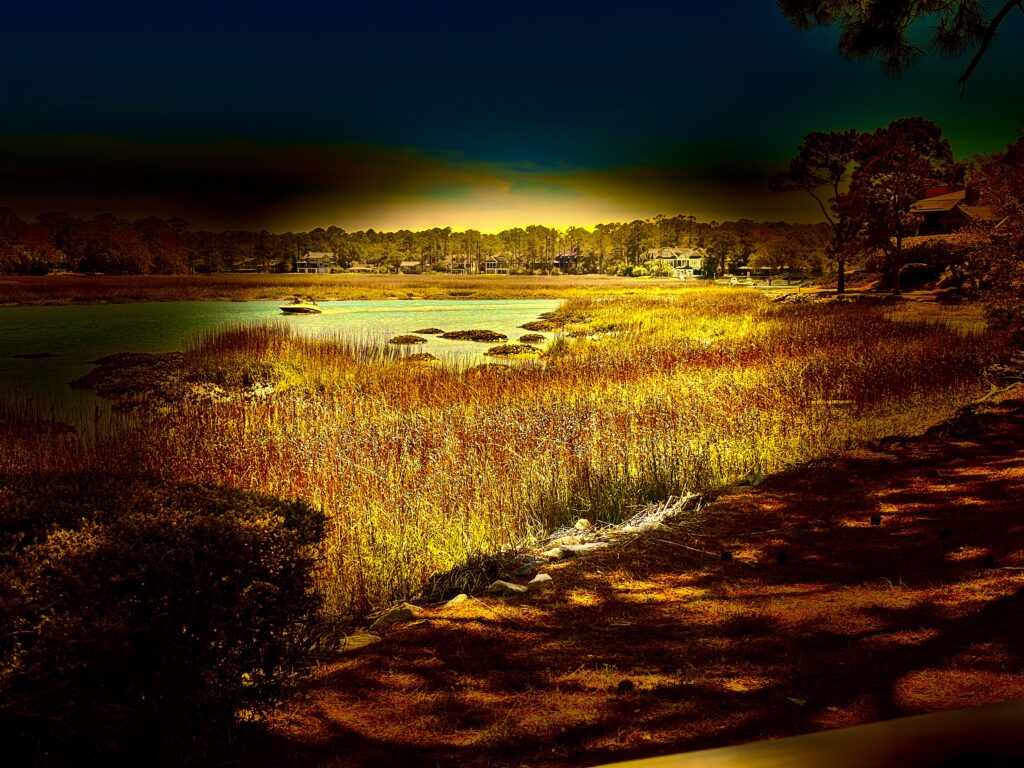
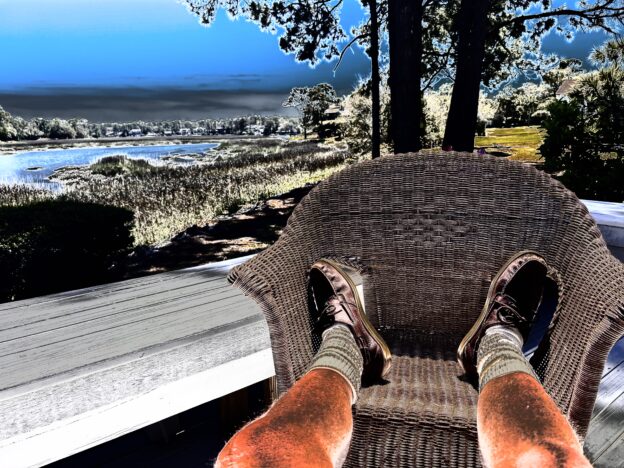
It was in this contented and contemplative frame of mind that, in lieu of repeating my now evaporated visits to Zips car wash this afternoon, instead I positioned myself in the beaming sunshine on the deck at the back of the cottage overlooking the oyster beds arisen at low tide on Braddock Cove. As though by supernatural forces, the elements had combined to perfect the achievement of this latest (and possibly last) sojourn on Hilton Head Island. There was not another feature of the venture overlooked or missing. We have correspondingly conformed the remaining provisions in the larder to withstand the last several remaining days here. As though reading from a script, we paused to ask ourselves whether we were ready to leave; and, together we agreed that we are.
It is an indefinable and maudlin occasion; relishing all that we have enjoyed here, the crashing ocean, the vast beach, the verdant Sea Pines corridors, the people, the memories. And at the same time we have the unanticipated vicarious invigoration of our dear friends in Nova Scotia with whom we share the glee of growth and change. Already I am awakening to the possibilities, maritime ventures, including the visceral pleasures of the table (we’re all seafood lovers).
In 1755, after the expulsion of the Acadians, the British needed to repopulate vacated lands. It offered generous land grants to colonists from New England, which was experiencing a severe shortage in land. Today these immigrants are referred to as the New England Planters. Lunenburg was raided in 1756 by a mixed group of Mi’kmaq and Maliseet raiders, devastating the town. The attacks continued on the British with the Lunenburg Campaign of 1758. Hostilities with Mi’kmaq ended around 1760.
During the American Revolution, privateers from the rebelling colonies raided Lunenburg, including the 1782 raid, devastating the town once again. The town was fortified at the beginning of the War of 1812. The British officials authourised the privateer Lunenburg, operated by Lunenburg residents, to raid American shipping.
Over the following years, port activities transitioned from coastal trade and local mixed fisheries,[23]to offshore fisheries. During the Prohibition in the United States between 1920 and 1933, Lunenburg was a base for rum-running to the US.
The Lunenburg Cure was the term for a style of dried and salted cod that the city exported to markets in the Caribbean. Today a large hammered copper cod weather vane is mounted on the spire of St. Andrew’s Presbyterian Church.
The Smith & Rhuland shipyard built many boats, including Bluenose (1921), Flora Alberta (1941), Sherman Zwicker (1942), Bluenose II (1963), Bounty (1961), and the replica HMS Surprise (1970). In 1967 the yard was taken over by Scotia Trawler Equipment Limited. After the end of World War II, shipbuilders switched from producing schooners to trawlers, aided by migrant labour from Newfoundland.