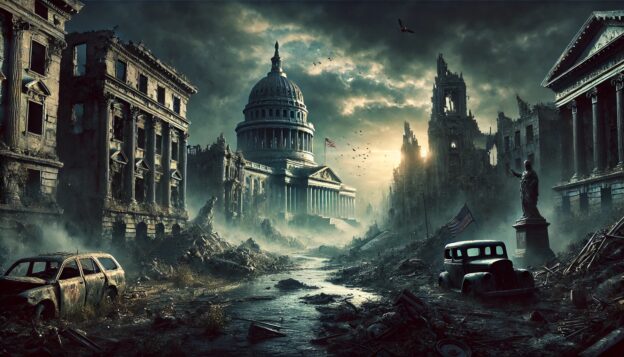
It began as all great declines do—not with a sudden rupture, but with a slow poisoning of the soul.
The leader, Magnus Caine, was a man who did not so much seize power as he was lifted into it by a people who saw in him their own reflections. They did not choose him despite his faults, but because of them. His weaknesses, his hatreds, his vulgarities—they were the very things that had festered in the hearts of his followers for generations. His ascent was not a rejection of their moral code, but the unveiling of it.
Caine was not a man of brilliance, nor of principle. His greatness lay in his ability to sniff the basest instincts of the people and wrap them in the banner of righteousness. He lied with the confidence of a prophet and stole with the entitlement of a king. His indiscretions—his defilement of the young, his plundering of wealth, his unrelenting deceit—were not hidden, but paraded. “All men do these things,” he declared. “I am simply honest about it.” And they cheered.
His followers, the devoted millions, saw his every crime as a virtue. When he was caught evading the taxes that others dutifully paid, they called him clever. When he defrauded the weak, they called him shrewd. When he took what he wanted, they called him strong. His cruelty was their vengeance; his lies, their liberation from truth.
With each passing year, the decay deepened. Science was mocked. History was rewritten. Reality itself became a shifting thing, molded by Caine’s words. “The truth,” he said, “is what we make it.” His followers nodded, eager to be unshackled from the burden of thinking.
Laws bent to his will. Judges, once impartial, learned to bow. The press, once a check upon power, became its megaphone. Dissent was treason, and treason was punishable not by trial, but by annihilation.
Outside the republic, the world recoiled. Where once travelers and thinkers had flocked to its borders, now they turned away in disgust or fear. Once a beacon of strength, the nation was now a prison of its own making, surrounded not by walls of stone, but by the walls of its own shrinking mind.
And yet, Caine’s people saw none of it. Even as their cities crumbled, even as their coffers emptied, even as their children grew weak and hungry, they still cheered. The suffering was not the fault of their leader, they said, but of the enemy—whoever that enemy was today.
But no empire, no illusion, lasts forever. Eventually, even the most fervent believers saw that their world had shrunk to a shadow of its former self. The rivers dried, the roads cracked, the towers leaned. The nation, once a colossus, had rotted from within.
Caine, bloated and aging, raged against the dying light of his dominion. He called for war, but his soldiers were ghosts. He called for loyalty, but his people were too hungry to listen. He called for faith, but even faith needs something to stand upon.
And so, as all great declines do, it ended—not with a revolution, not with a sudden fall, but with a nation staring into the abyss and realizing, too late, that the abyss stared back.
The Betrayal of the Republic
By the time the nation crumbled, only the most foolish or the most desperate still believed in Magnus Caine. For years, he had woven an empire of deception, a kingdom built not on stone but on the shifting sands of resentment and delusion. But the truth, like water, had a way of seeping through even the thickest walls of lies.
It was never about them. Not the people, not the nation, not the so-called sacred traditions he claimed to defend. It had only ever been about him.
Caine had never sought power to lead. He had sought it to protect himself. He had committed too many crimes, cheated too many people, broken too many laws. The moment he lost control, he knew, the walls of justice—long held back by his influence—would come crashing down upon him.
His strategy had been simple: corrupt the legal system before it could reach him. He appointed judges who owed him their robes, dismantled agencies that could investigate him, replaced laws with ones that shielded the powerful. Every indictment that threatened to rise against him was met with outrage, every conviction dismissed as the plot of unseen enemies. “They’re not coming for me,” he told his followers. “They’re coming for you, and I’m just in the way.”
For years, they believed him. They rallied behind him as he cast doubt on courts, discredited juries, and dismantled the very institutions that had once protected them. They did not see that while they were busy defending him, he was plundering the last remnants of their nation’s dignity.
But decay does not stop at the city gates. One by one, cracks appeared. The financial backers who had once championed him grew uneasy as the country’s economy withered. Foreign allies withdrew, refusing to engage with a government that had made itself a pariah. The once-loyal generals, seeing the state teeter on the edge of collapse, began questioning whether their devotion was worth the ruin.
And then, at the final hour—when the nation was weakest, when the people who had given him everything needed him most—Caine did what he had always planned to do.
He fled.
His escape was not an act of desperation, but of calculation. The private jet had been waiting for years, its flight plan meticulously arranged. The offshore accounts, once a paranoid precaution, were now his salvation. As his followers rioted in the streets, crying out for their leader to save them, he watched from a gilded villa in a country with no extradition treaties.
The people, betrayed and abandoned, were left with the ruins of what they had once believed. The courts, gutted and corrupted, were useless to restore order. The government, hollowed out by his greed, could not sustain itself. And so, the nation collapsed—not with an invasion, not with a grand rebellion, but with a slow and pitiful disintegration.
And Caine? He lived out his days in grotesque luxury, surrounded by wealth he had stolen from the very people who had worshiped him. He did not think of them. He had never thought of them. They had only ever been his shield, his pawns, his disposable army of the deceived.
The republic did not fall because of an enemy at the gates. It fell because it handed itself over to a man who had never loved it, never served it, and never cared for anything but his own escape.
And in the end, no one came for him. The world had moved on, disgusted but indifferent. He had fled accountability, but he had also fled relevance.
There was no statue to his name. No city bore his legacy. No history book spoke of him with reverence.
His greatest fear had come true.
He was forgotten.