
TikTok, whose mainland Chinese counterpart is Douyin, is a short-form video hosting service owned by Chinese internet company ByteDance. It hosts user-submitted videos, which can range in duration from three seconds to 60 minutes. It can be accessed with a smartphone app.
Since its launch, TikTok has become one of the world’s most popular social media platforms, using recommendation algorithms to connect content creators with new audiences. In April 2020, TikTok surpassed two billion mobile downloads worldwide. Cloudflare ranked TikTok the most popular website of 2021, surpassing Google. The popularity of TikTok has allowed viral trends in food and music to take off and increase the platform’s cultural impact worldwide.
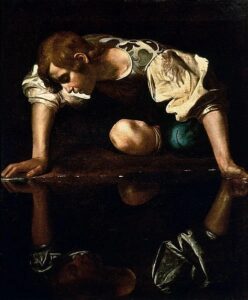
If by chance you are unfamiliar with TIkTok it isn’t long before you discern that the predominant preoccupation of its users on the site is themselves. There is a lot of self-pitying search for approbation. Clearly there are many among the young in particular (there is hardly anyone over 30 years of age on the site) who are in need of recommendation.
Long before Narcissus hit the studio stage, I suspect the matter of self-awareness was as rampant as it is today. Film artists such as Federico Fellini alluded to the subject in Satyricon.
The surviving sections of the original (much longer) text detail the bizarre exploits of the narrator, Encolpius, and his (possible) slave and catamite Giton, a handsome sixteen-year-old boy. It is the second most fully preserved Roman novel, after the fully extant The Golden Ass by Apuleius, which has significant differences in style and plot. Satyricon is also regarded as useful evidence for the reconstruction of how lower classes lived during the early Roman Empire.
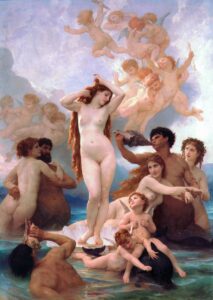
Unlike for Greek artists, the Roman version of Narcissus and Echo was a very popular subject in Roman art and is seen in almost 50 wall paintings at Pompeii alone. Renaissance art also took a shine to Narcissus; the story involving light and reflection proved irresistible to Caravaggio, who captured the myth in his celebrated 16th-century CE oil painting. Finally, his name lives on today in psychoanalysis where narcissism refers to the personality disorder of excessive self-admiration and preoccupation with one’s appearance.
In fairness there are many exhibiting themselves on TikTok who deserve the praise they pine to achieve. For whatever reason many of the young men have attached themselves to gymnasia in order to pump iron to an extraordinary degree. There also appears to be related healthful titbits regarding avoidance of alcohol, eating the proper foods and occasionally improving psychological ingredients. There can be no question that the developers of these web sites are familiar with the impact they have on others. Some of it unquestionably borders on lasciviousness; but, again in fairness, that is most certainly a part of youth.
There is evidence throughout TikTok that things are changing in the way people look at themselves and at one another. I won’t attempt to trot out the many names of these latest fashions; but I will say that from my remote perspective, young people appear to be adopting new mannerisms and standards. Likely nothing of substance will change. We’ll have crescendos but mostly things will remain the same. There’s little chance we’ll convince anyone in need of admiration that they are fine without it. Those are questions of personal resolve only. Suggesting that someone else’s beauty is a threat to oneself is in my opinion preposterous. Just ask Narcissus.
Narcissus
a beautiful youth who rejected the nymph Echo and fell in love with his own reflection in a pool. He pined away and was changed into the flower that bears his name.
Echo
a nymph deprived of speech by Hera in order to stop her chatter, and left able only to repeat what others had said.
Hera (female of Hero)
a powerful goddess, the wife and sister of Zeus and the daughter of Cronus and Rhea. She was worshiped as the queen of heaven and as a marriage goddess. Roman equivalent Juno.
Juno
Roman mythology the most important goddess of the Roman state, wife of Jupiter. She was originally an ancient Italian goddess. Greek equivalent Hera.