
Oddly seeing it in print yesterday “a Variety of Opinions” (it was an unwittingly comic but tragically misinterpreted English translation of an exotic culinary creation, seriously) instantly gripped me. It is such a disturbingly provocative though utterly ambiguous introduction. As a result of its overwhelming (but otherwise brainless) persuasion this gnomic utterance therefore forms the basis of my monologue today. And I may as well confess at the outset that it is my new found avowal of bloodyminedness. Hence no apology. If you wish to see me crawl, today is not the moment! You’ll have to book a return engagement for the concession of that particular indignity (though I suspect I shall not have to keep you waiting).
Should you care to know the further authority by which I claim entitlement to the declaration “a Variety of Opinions” it is no greater nor no less than the equally natural effluxion of time. I am however quick to punctuate what may at first seem a universal prerogative by reminding you, my dear Reader, that time does not indeed provide for those who wait. Time as you will no doubt appreciate is an indiscriminate associate notwithstanding King James and his colleagues of celebrated biblical repute.

James 5:7-11 – Good Things Come to Those Who Wait.
King James Version (KJV), English translation of the Bible, published in 1611 under the auspices of King James I of England. The translation had a marked influence on English literary style and was generally accepted as the standard English Bible from the mid-17th to the early 20th century.

James VI and I (James Charles Stuart; 19 June 1566 – 27 March 1625) was King of Scotland as James VI from 24 July 1567 and King of England and Ireland as James I from the union of the Scottish and English crowns on 24 March 1603 until his death in 1625. Although he long tried to get both countries to adopt a closer political union, the kingdoms of Scotland and England remained sovereign states, with their own parliaments, judiciaries, and laws, ruled by James in personal union.
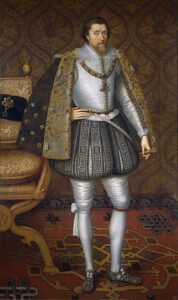
James was the son of Mary, Queen of Scots, and a great-great-grandson of Henry VII, King of England and Lord of Ireland, and thus a potential successor to all three thrones. He acceded to the Scottish throne at the age of thirteen months, after his mother was forced to abdicate in his favour.
I capture the above noted historic summary merely to illustrate the perfectly random (and at times hopelessly uncaring) feature of time. Meanwhile you and I, dear Reader, are here to talk about it. We have exceeded the boundaries of ultimate peril. And, while this is no small compliment, and not to dwell unnecessarily upon the segregation (for it is as natural as the wind which on occasion passes through us), I have yet the additional and perhaps singular accreditation of having today surpassed ¾ of a century.
Eclipsing so much of time by any account is for the most part an inscrutable advantage. While one might predict of me insatiable industry, belonging as I do to that uncommon fraternity of senior septuagenarians, and recognizing the impending limitation of the scope (whatever it may be), I am not however inclined to undergo any enterprise other than that which suits me. And as enigmatic as I may be, I shall happily adopt a variety of opinions. Integrally none of these opinions is to be denied my approbation and application. Therein lies the gift. It is the indisputable right – one which, by the way, I would willingly argue for the government – is axiomatic; that is, the right to a variety of opinions.
Featured photo: Appropriated from Substack. Provenance unknown.