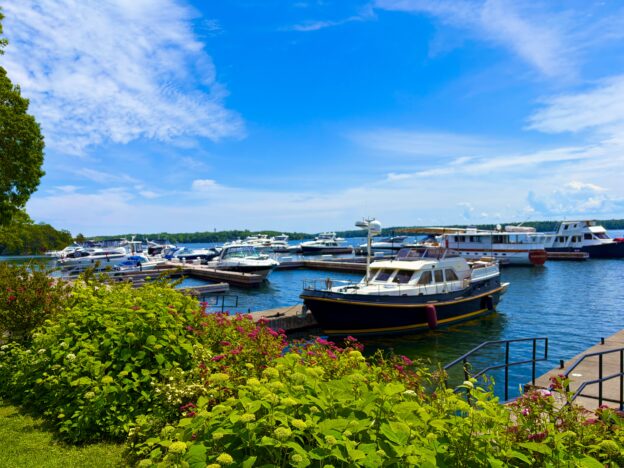
Today – after an early morning scheduled appointment at the hospital – we sauntered southbound to the Thousand Islands Parkway to the Ivy Lea Club for luncheon along the St. Lawrence River.
The Thousand Islands Parkway (often written as 1000 Islands Parkway) is a scenic parkway in the Canadian province of Ontario. It extends easterly from an interchange with Highway 401in Gananoque for approximately 40 kilometres (25 mi) to rejoin Highway 401 near the community of Butternut Bay, west of Brockville. The parkway follows the north shore of the St. Lawrence River, and was formerly designated Highway 2S (S for Scenic) until 1970. It passes through the communities of Gray’s Beach, Halsteads Bay, Ivy Lea, Darlingside, Rockport, Narrows, La Rue Mills and Mallorytown Landing, as well as providing access to the three inland properties of the Thousand Islands National Park. Highway 137, which meets the parkway near its midpoint, provides access to the Interstate 81 in New York via the Thousand Islands Bridge.
COVID adversely affected the Ivy League Club. The pandemic and inclement weather contributed to diminished business. It is slowly recovering. While the dockside outdoor patio was not open today, the upstairs dining room was. We sat in the enclosed balcony area overlooking the water. To my surprise I was able (as I have done in the past) to order a lobster roll though the commendable dessert called the Yukon replaced the traditional sticky toffee pudding in which I customarily indulged. I began with an appetizer of steak tartare.
As much as we enjoyed the outing, it was all we could do to escape our luncheon huddle and return home. We no longer require much diversion to exhaust our interest, capacity and sustainability. Age! The drive from here to there is not outlandish – and naturally I continue to entertain myself endlessly with the all-electric vehicle and its One Pedal Driving feature.
One-pedal driving (OPD) is an EV feature where pressing the accelerator moves the car, and easing off it slows the vehicle down. Releasing the pedal completely brings the car to a smooth, complete stop without you ever having to press the traditional brake pedal.
How It Works
Regenerative Braking: When you lift your foot off the accelerator, the electric motor reverses its function. It acts as a generator, creating resistance that slows the car down while capturing that kinetic energy to recharge the vehicle’s battery.
Seamless Stopping: As the car decelerates, the hydraulic brake lights activate automatically so drivers behind you know you are slowing down. The Brake Pedal: The actual brake pedal is still in the car and functions normally. You should still use it for emergency stops or if you need to brake faster than the regenerative system allows.
By late this afternoon we were both happy to reclaim home territory, brush our teeth, change into lounging clothes and preoccupy ourselves with routine domestic absorptions. Bouncing from the northern end of our territory at Neat Café in the Village of Burnstown in the County of Renfrew yesterday to its southern boundary today at Ivy Lea Club is apparently all that is required to fulfill our current social mandate.
Within moments of regaining our digs, I received a telephone call from my erstwhile physician. We are now poised for a visit to his country estate on the weekend for an afternoon swim. It is a luxury which has become another of our summertime traditions. As much as I like tricycling, swimming is by far the more manageable and rewarding exercise.