Category Archives: General

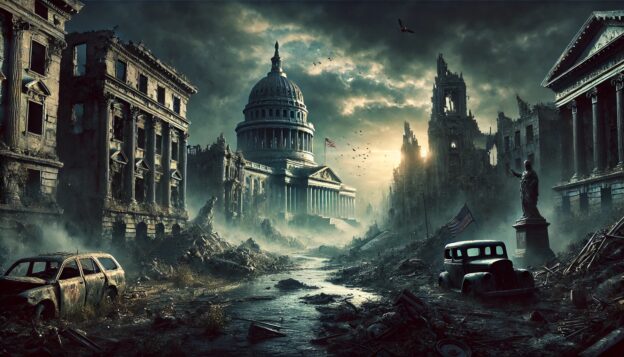
The Desolation of the Republic

It began as all great declines do—not with a sudden rupture, but with a slow poisoning of the soul.

The leader, Magnus Caine, was a man who did not so much seize power as he was lifted into it by a people who saw in him their own reflections. They did not choose him despite his faults, but because of them. His weaknesses, his hatreds, his vulgarities—they were the very things that had festered in the hearts of his followers for generations. His ascent was not a rejection of their moral code, but the unveiling of it.

Caine was not a man of brilliance, nor of principle. His greatness lay in his ability to sniff the basest instincts of the people and wrap them in the banner of righteousness. He lied with the confidence of a prophet and stole with the entitlement of a king. His indiscretions—his defilement of the young, his plundering of wealth, his unrelenting deceit—were not hidden, but paraded. “All men do these things,” he declared. “I am simply honest about it.” And they cheered.

His followers, the devoted millions, saw his every crime as a virtue. When he was caught evading the taxes that others dutifully paid, they called him clever. When he defrauded the weak, they called him shrewd. When he took what he wanted, they called him strong. His cruelty was their vengeance; his lies, their liberation from truth.

With each passing year, the decay deepened. Science was mocked. History was rewritten. Reality itself became a shifting thing, molded by Caine’s words. “The truth,” he said, “is what we make it.” His followers nodded, eager to be unshackled from the burden of thinking.

Laws bent to his will. Judges, once impartial, learned to bow. The press, once a check upon power, became its megaphone. Dissent was treason, and treason was punishable not by trial, but by annihilation.

Outside the republic, the world recoiled. Where once travelers and thinkers had flocked to its borders, now they turned away in disgust or fear. Once a beacon of strength, the nation was now a prison of its own making, surrounded not by walls of stone, but by the walls of its own shrinking mind.

And yet, Caine’s people saw none of it. Even as their cities crumbled, even as their coffers emptied, even as their children grew weak and hungry, they still cheered. The suffering was not the fault of their leader, they said, but of the enemy—whoever that enemy was today.

But no empire, no illusion, lasts forever. Eventually, even the most fervent believers saw that their world had shrunk to a shadow of its former self. The rivers dried, the roads cracked, the towers leaned. The nation, once a colossus, had rotted from within.

Caine, bloated and aging, raged against the dying light of his dominion. He called for war, but his soldiers were ghosts. He called for loyalty, but his people were too hungry to listen. He called for faith, but even faith needs something to stand upon.

And so, as all great declines do, it ended—not with a revolution, not with a sudden fall, but with a nation staring into the abyss and realizing, too late, that the abyss stared back.

The Betrayal of the Republic

By the time the nation crumbled, only the most foolish or the most desperate still believed in Magnus Caine. For years, he had woven an empire of deception, a kingdom built not on stone but on the shifting sands of resentment and delusion. But the truth, like water, had a way of seeping through even the thickest walls of lies.

It was never about them. Not the people, not the nation, not the so-called sacred traditions he claimed to defend. It had only ever been about him.

Caine had never sought power to lead. He had sought it to protect himself. He had committed too many crimes, cheated too many people, broken too many laws. The moment he lost control, he knew, the walls of justice—long held back by his influence—would come crashing down upon him.

His strategy had been simple: corrupt the legal system before it could reach him. He appointed judges who owed him their robes, dismantled agencies that could investigate him, replaced laws with ones that shielded the powerful. Every indictment that threatened to rise against him was met with outrage, every conviction dismissed as the plot of unseen enemies. “They’re not coming for me,” he told his followers. “They’re coming for you, and I’m just in the way.”

For years, they believed him. They rallied behind him as he cast doubt on courts, discredited juries, and dismantled the very institutions that had once protected them. They did not see that while they were busy defending him, he was plundering the last remnants of their nation’s dignity.

But decay does not stop at the city gates. One by one, cracks appeared. The financial backers who had once championed him grew uneasy as the country’s economy withered. Foreign allies withdrew, refusing to engage with a government that had made itself a pariah. The once-loyal generals, seeing the state teeter on the edge of collapse, began questioning whether their devotion was worth the ruin.

And then, at the final hour—when the nation was weakest, when the people who had given him everything needed him most—Caine did what he had always planned to do.

He fled.

His escape was not an act of desperation, but of calculation. The private jet had been waiting for years, its flight plan meticulously arranged. The offshore accounts, once a paranoid precaution, were now his salvation. As his followers rioted in the streets, crying out for their leader to save them, he watched from a gilded villa in a country with no extradition treaties.

The people, betrayed and abandoned, were left with the ruins of what they had once believed. The courts, gutted and corrupted, were useless to restore order. The government, hollowed out by his greed, could not sustain itself. And so, the nation collapsed—not with an invasion, not with a grand rebellion, but with a slow and pitiful disintegration.

And Caine? He lived out his days in grotesque luxury, surrounded by wealth he had stolen from the very people who had worshiped him. He did not think of them. He had never thought of them. They had only ever been his shield, his pawns, his disposable army of the deceived.

The republic did not fall because of an enemy at the gates. It fell because it handed itself over to a man who had never loved it, never served it, and never cared for anything but his own escape.

And in the end, no one came for him. The world had moved on, disgusted but indifferent. He had fled accountability, but he had also fled relevance.

There was no statue to his name. No city bore his legacy. No history book spoke of him with reverence.

His greatest fear had come true.

He was forgotten.
List of Aliens

Residing in Thurlow, Murray, Ameliasburgh, Hallowell and Sophiasburgh Townships

November 1815

Home Page My database at Rootsweb Contact Me
Records of the Bay of Quinte

The lists below of “aliens” living in these 5 townships in 1815 name men denied the right to take the oath of allegiance because they have arrived from the United States after the end of the War of 1812. Loyalty was a concern in the decade following the War of 1812 and these lists are an example of the tension and the actions taken by the Lt. Governor. Thanks to Guylaine Petrin for sending me a copy of the Thurlow list and getting me started on this little story.

Use these links to jump up and down this lengthy web page.
1. “The Alien Question”
2. Thurlow Alien list
3. Murray and Ameliasburgh Alien list
4. Hallowell and Sophiasburgh Alien list

1. “The Alien Question”
The leadership of Upper Canada was very concerned about the number of settlers living in the province who were born in America due to suspicion of their fondness for American republicanism. The War of 1812 had shown Upper Canada how important it was to hold strong ties to Britain for protection from the “treacherous enemy”.Lt Governor Francis Gore, arriving in Sept 1815, found that Americans were still “pouring across the border” and he ordered the Magistrates in the province not “to administer the Oath of Allegiance to any person not holding Office in the Province, or being the son of a UE Loyalist, without a special authority in such case”. Thus American citizens arriving in the province would not be able to secure title to land without the oath and this, it was hoped, would discourage settlement. The issue of “Aliens” continued with much acrimony, well into the late 1820’s and was one of the factors in the rise of the Reform Movement.The list below is a clear response to the order from Gore. There are a number of similar alien lists for other townships into 1816.Source: The above is paraphrased from Upper Canada, The Formative Years, 1784-1841, Gerald M. Craig, McClelland and Stewart, 1963. Chapters 5 and 6 give an excellent account of the alien issue. Craig gives this citation for the order C.O. 42/356, p. 123, Gore to Bathurst, 17 Oct 1815; U.C. State Papers, I, 149Another excellent book that sets the alien question in the context of the aftermath of the War of 1812 is, Plunder, Profit, and Paroles, A Social History of the War of 1812 in Upper Canada, George Sheppard, McGill, Queen’s Univ. Press, 1994
2. Thurlow Alien list

Midland District
Thurlow, 24th Novr 1815
Sir
Agreeable to His Excellency the Lieutenant Governors commands I herewith transmit to you for his information the names of all such as to my knowledge, have come to this place from the United States or elsewhere since the conclusion of the late American War. Some of whom I believe intend returning to the United States again shortly.
I shall strictly adhere to the command of the Lieutenant Governor also in not administering the oath of Allegiance hereafter – except in cases you mention.

I have the honor to be, Sir
Your most obedient and Humble Servant
[signed] James McNabb
To William Halton Esquire
Secretary to the Lt Governor
York

Report of the Number of Aliens, now residing in the County of Hastings, near the River Moira, Midland District.
Names Occupation Where from
Thomas Palmer Pedlar United States
Chauncy Palmer Ditto US
Franklin Elsworth Shoemaker US
Wadsworth Brown Ditto US
George Townsend Labourer US
James Foster Ditto US
George H Manther Carpenter US
Stephen Blanchard Mill Wright US
Reuben Potter School master US
Phineaus Byam? Brick Maker US
Alva Gates Hatter US
John Cuzzens [Cousins] Taylor US
William Slack Labourer US
John Whitney Hatter US
Benjamin Demell [Demill] Labourer US
Thurlow, 24th November 1815
James McNabb J.P.Source: Civil Secretary’s Correspondence, Upper Canada Sundries, 1766-1841, RG5 A1, LAC, film also at AO, Vol 25, C-4545, pp. 11039-42
Back to top
3. Murray and Ameliasburgh Alien list

Carrying Place
27 Nov 1815

Sir
I have the honor of acknowledging the Recpt? of yours, but sickness has prevented my sending a return of the aliens sooner – the included is a list of the aliens, now residing in the Township of Ameliasburgh and Murray, which I now forward for the information of his Excellency the Lieutenant Governor . I shall take the earliest opportunity of forwarding  to your office a List of those who may hereafter come into the Province who may come within the limits of my knowledge.
I have the honor to be, Sir, your most obedient  Humble Servant
James Young JP
[addressed to]
Wm Halton Esquire
Secrety etc etc

District of Newcastle, Township of Murray
Hiram Murray, labourer from the United States
Archibald Wilcocks   Do   Do
Joseph Smith   Do   Do

Midland District, Township of Ameliasburgh
Ebenezer Sloan, labourer from the United States
James Sweet   Do   Do
William Cumpton   Do   Do

[Signed] J Young JP
November 27th 1815

Source: Civil Secretary’s Correspondence, Upper Canada Sundries, 1766-1841, RG5 A1, LAC, film also at AO, Vol 25, C-4545, pp. 11094-96

Back to top

4. Hallowell and Sophiasburgh Alien list

Hallowell
1st December 1815

Dear Sir
We have duly received your Circular letter of the 14th October last, respecting a return of Aliens and now enclose to you the number at present Residing in the Townships of Hallowell and Sophiasburgh, as you will Observe your said return, and then several Occupations Together with their Designations assign as we have been able to Determine in that case, and agreably to his Excellency commands shall from time to time make known to you any of that Description which may hereafter come to reside within our knowledge.
James Cotter
John Stinson
Stephen Conger
Barret Dyer [all] Esquires
[signed]
Ebenezer Wash[burn – torn off]

[Addressed to]
On His Majestys Service
William Halton Esq
Secretary to his Excellency the Governor
York

Return of Aliens now in the Townships of Hallowell and Sophiasburgh in the County of Prince Edward of Upper Canada, having Emigrated there since the Conclusion of the late war with the United States of America and all from said States
Names No Occupation Remarks
Joel Carpenter 1 A stone mason Has a family, probably would wish to remain here, having married in this place.
Benjamin Raney 2 A labourer Wishes much to become a settler, and subject, here and take the oath of Allegiance, if Permitted so to do, having married in this place.
Abel Clarey 3 A schoolmaster Only intends remaining here while employed to his benefit.
Alan Shearman 4 Ditto Ditto
Conelous Phelphs 5 A labourer Will remain here no longer than he can benefit himself by his labour, etc
Solomon Duey 6 Ditto Ditto
William Taylor 7 Ditto Ditto
Michael Dockerty 8 A blacksmith Brought his family with him, and wishes to remain here if permitted & become a subject
Anson Bruster 9 A saddler Wishes to become a settler here and bring in his Family from the States if permitted so to do.
Gilbert Armstrong 10 A labourer Expresses a desire to become a settler here if permitted
Samuel Hunt 11 Ditto Will probably only remain here, while employed to his benefit
John Caster 12 A tanner Wishes to become a settler here if permitted
Consider Wellester 13 A saddler Ditto
Enos Burchet 14 A mill wright Ditto
John Allen 15 A stone mason Will probably only remain here, while employed to his benefit
Heman Rice 16  A schoolmaster Will remain here while employed to his satisfaction
Simon Corey 17 Ditto Ditto
Galvin Rossen 18 A carpenter Ditto
For James Cotter
John Stinson
Stephen Conger
Barret Dyer [all] Esquires[signed] Ebenezer Washburn JP
Hallowell 1st December 1815To William Halton Esq
Secretary to his Excellency the Lt Governor
Source: Civil Secretary’s Correspondence, Upper Canada Sundries, 1766-1841, RG5 A1, LAC, film also at AO, Vol 25, C-4545, pp. 11128-31

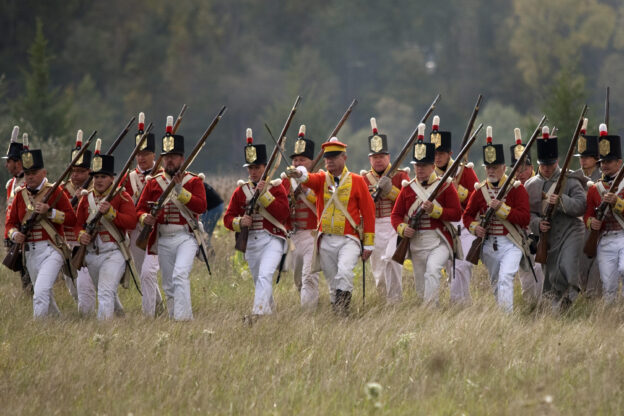
The War of 1812 was fought by the United States and its allies against the United Kingdom and its allies in North America. It began when the United States declared war on Britainon 18 June 1812. Although peace terms were agreed upon in the December 1814 Treaty of Ghent, the war did not officially end until the peace treaty was ratified by the United States Congress on 17 February 1815.

The last good years v2

The old lawyer had once been a man of perpetual motion—courtrooms, cities, first-class lounges, the world itself. Now, his movement was deliberate, strategic even, dictated in part by the sturdy tricycle that had become his chariot of choice. He had traded the salt air of a seaside resort for the gentler rhythms of the riparian countryside—where the rivers meandered at his pace and the local wildlife stared at him with the same bemused detachment he reserved for strangers.

Continue reading

The last good years

The old lawyer had once been a man of perpetual movement—courtrooms, cities, towns, the world itself. Now, his movement was measured, his steps deliberate, his outings dependent on the sturdy tricycle that had become both companion and necessity. He had left the clamor behind, retreating to the quiet countryside where time passed more slowly, unbothered by urgency.

Continue reading

Sunday preliminaries

Precisely 7 days from now – Saturday – we leave. This morning we began preliminaries of our long, slow descent to Canada, an anticipated journey from here of three nights and four days. Already we have dinner reservations along the way; and, we have targeted places to have the car washed. Early this morning after my constitutional breakfast of steel cut oats, berries, prunes and fruit, pecan slices, maple syrup and yoghurt I tricycled around Lands End then along S Sea Pines Dr and back for a total of 6.12 Kms. This final matutinal repetition kicked off the impending absorption.

Continue reading

Watching were I walk…

As the enraptured hours of our resort on Hilton Head Island diminish progressively, approaching our departure a week hence, I find myself having frequented only lately two venues which I have intriguingly spied – though had not yet frequented – throughout our two month tenancy here beginning the end of January last.  The tardiness speaks to the odd characteristic upon arriving at an unfamiliar territory to seek to discover, rather than what is immediately at hand and inviting perusal, instead that which is further beyond and unspeaking except because of its distance.

Continue reading

Gems in the Rough (AI Version)

Gems in the Rough
March 29, 2010
JoAnn Ferguson

The glint in JoAnn Ferguson’s eye—if you catch it before she evasively looks away—betrays her mischief. The slight curl of her lips barely disguises the pleasure she derives from her devilment. Opinionated to a fault, she needs only a hint of assent or objection to translate her correspondent’s reaction into either glee or resentment. Don’t expect direct statements, just innuendo—usually deprecatory. Her tongue moves with the precision of a lizard’s, striking quickly and with intent. Some call it satire; I find it more visceral than cerebral.

Continue reading

The unsurpassable production of breakfast

Unwittingly, we merged into the measured chaos of breakfast at Palmetto Bay Sunrise Café, rousing ourselves from the overnight tangle of sheets and blankets promptly at six a.m. in preparation for our scheduled departure. Showered, shaven, and dressed in freshly laundered clothes scented with lavender, we ventured into the early morning shadows, where the distant sun had yet to make its presence known. The winding corridors of Sea Pines Drive and Greenwood Drive, leading to Arrow Road and Helmsman Way, demanded careful attention as we navigated their dark, narrow passages.

Continue reading

Looking out to sea

The arrival today at 09:02 of the Vernal Equinox—the beginning of astronomical spring and the end of astronomical winter in the Northern Hemisphere—marked the accelerated descent toward our departure from Hilton Head Island less than ten days hence. This swift approach was further distinguished by an uncommonly cool, dry, and breezy climate, perfectly suited to a thin wool sweater, a silken scarf, and white woolen socks—a moderate shield against the elements, whether predictable or unexpectedly contrary to the euphoria of the irradiant day.

Continue reading